
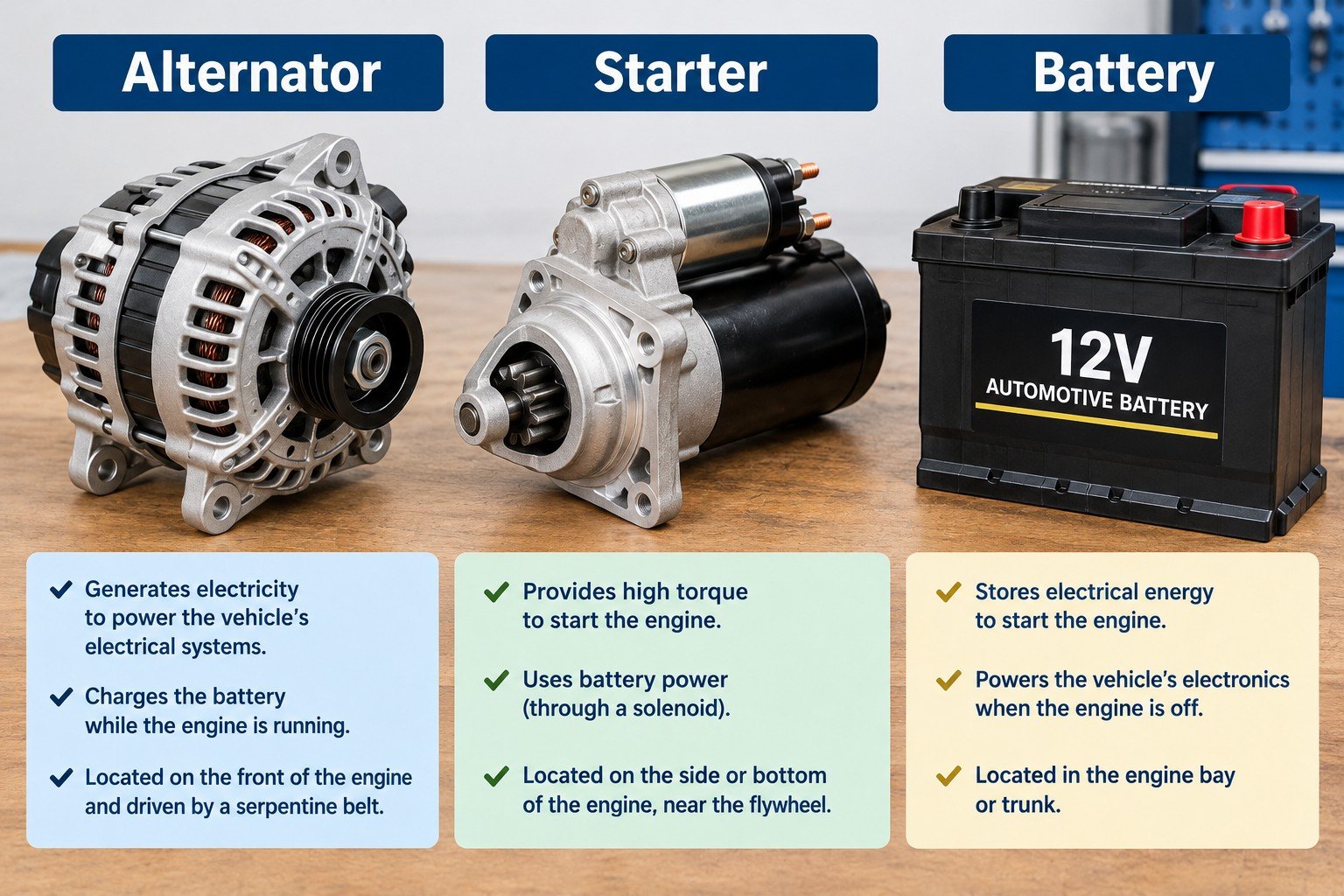
What each part actually does
Understanding the job of each part makes the symptoms make sense.
| Part | Its Job |
|---|---|
| Battery | Stores electrical power; starts the car and runs electronics when the engine is off |
| Starter | Uses battery power to crank the engine so it can start |
| Alternator | Recharges the battery and powers the electrical system while the engine runs |
The tell-tale symptom of each
Battery: will not crank after sitting, fine after a jump
The classic battery symptom is a car that will not start after sitting, especially overnight or in cold weather, with slow or no cranking and dim or dead dashboard lights. Jump-start it and it fires right up and keeps running. If a jump brings it back to life and it runs fine afterward, the battery is the likely culprit, though a bad alternator can also drain a battery, so a repeatedly dead battery points beyond the battery alone.
Starter: a click or nothing, with a good battery
The classic starter symptom is turning the key and hearing a single click, a rapid clicking, or nothing at all, while the battery is clearly good, lights bright, electronics working. The engine does not crank, or cranks inconsistently. A telling detail: if the lights and electronics are strong but the engine will not turn over, the starter is a prime suspect, because there is clearly power available and it is not turning the engine.
Alternator: starts fine, then dims or dies
The classic alternator symptom is a car that starts and runs, then shows charging trouble: dimming or flickering lights, a battery warning light, electrical accessories weakening, and eventually stalling as the battery runs down with nothing to recharge it. If the car starts fine but cannot stay running, or the battery keeps dying, the alternator is the likely cause.
The quick symptom decision guide
Use this as a starting point to narrow down the likely part. It is a guide, not a final diagnosis, since symptoms overlap.
| What You Notice | Most Likely |
|---|---|
| No crank after sitting, fine after a jump | Battery |
| Single click or nothing, but lights are bright | Starter |
| Starts fine, then lights dim and it dies | Alternator |
| Battery keeps dying repeatedly | Alternator (or old battery) |
| Cranks slowly, dim lights | Battery (or connections) |
| Grinding or whirring when starting | Starter |
| Dashboard battery light on while driving | Alternator |
| Nothing at all, no lights, no click | Battery or connections |
Why these three get confused
These parts are mistaken for one another because they share one job, getting and keeping the car running, and a symptom rarely announces which part caused it. A no-start could be any of the three. A dead battery could be a bad battery or a bad alternator that failed to charge it. Because the end result looks the same to the driver, guessing is easy and often wrong.
The cost of guessing is real. Replacing a good battery when the alternator failed leaves you stranded again within days. Replacing an alternator when the starter was the problem means the car still will not crank. This is why narrowing it down by pattern, and then confirming with a test, saves both money and repeat trips.
How they can damage each other
Part of what makes this tricky is that these components can cause each other's failures, so sometimes more than one needs attention.
- A bad alternator can kill a good battery. If the alternator overcharges or undercharges, it can damage the battery. Replace only the battery and it may fail again quickly.
- A weak battery can strain the alternator and starter. A failing battery forces the alternator to work harder and can make the starter labor, contributing to wear over time.
- Corroded connections mimic all three. Loose or corroded battery terminals, cables, or grounds can produce symptoms that look like any of these parts failing, while all three are fine.
Because of these interactions, a good diagnosis checks the connections and tests the battery and charging system together, rather than condemning a single part on a hunch.
How to confirm which one it is
Narrowing by pattern gets you close. Confirming is straightforward and often free.
Get a battery and charging system test
Many auto parts stores test the battery and alternator for free in minutes. This distinguishes a bad battery from a bad alternator directly.
Check the terminals, cables, and grounds
Clean, tight connections rule out the cheapest and most overlooked cause before you suspect a major part.
Note the exact behavior
Does it click, crank slowly, or do nothing? Does it start then die? These details point the diagnosis and help whoever tests it.
For a suspected starter, have it tested
The starter is harder to test at home than the battery and alternator, so a shop test is often the practical route if the pattern points to the starter.
This article describes common patterns for general information. It is not a diagnosis of your specific vehicle. A proper test, or a qualified mechanic, is the reliable way to confirm which part has actually failed before you buy anything.
Get Your Quote Today
Once you know whether it is the alternator, starter, or battery, call Vaz Auto Solutions at (240) 301-0095 with your VIN. We will match the correct alternator or starter to your specific vehicle, including the right specifications, help you choose between remanufactured and new, quote a delivered price with free US shipping, and email the warranty terms before you pay. Not sure which part it is? We can help you think it through before you order.