
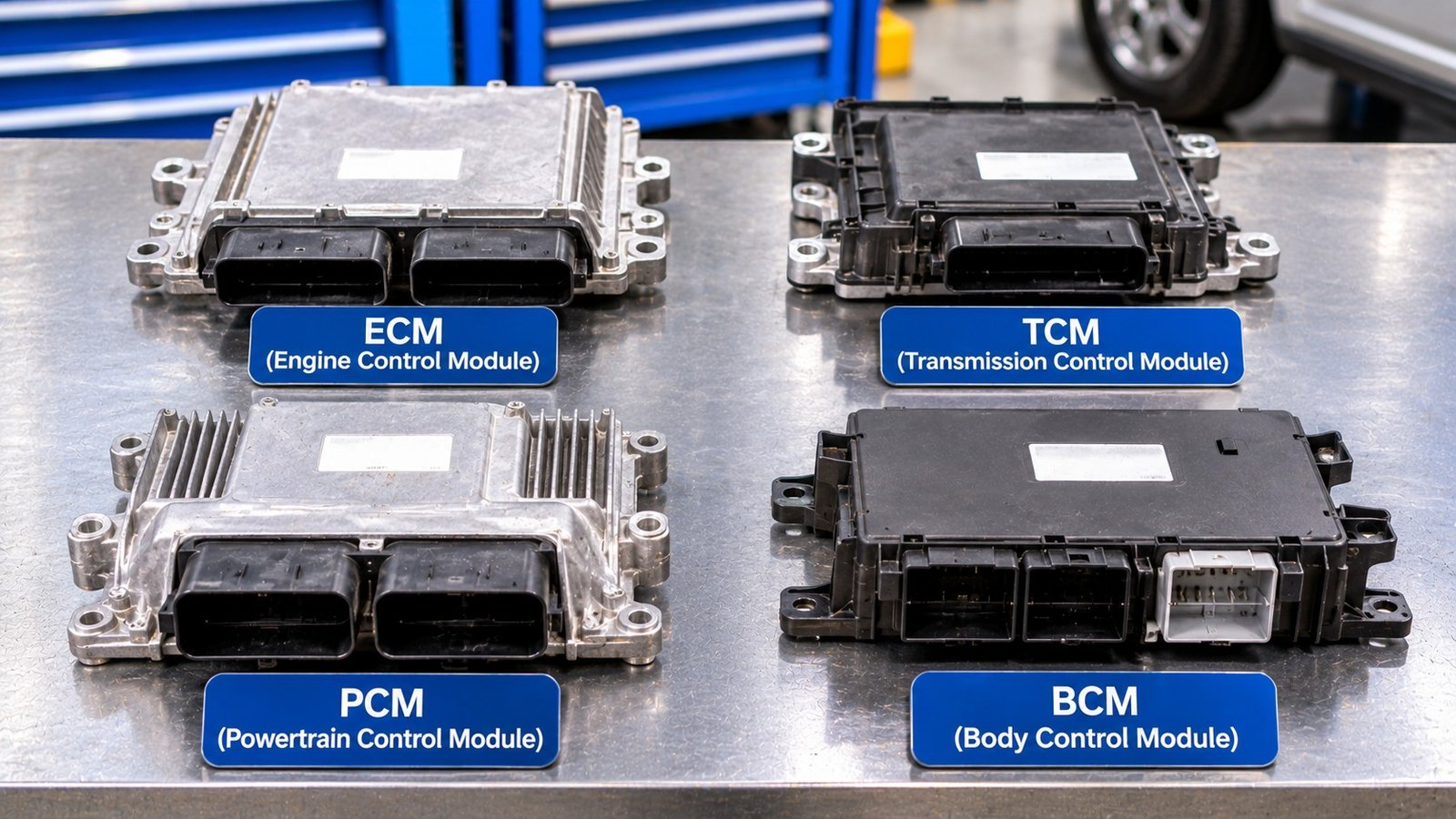
The four modules at a glance
| Module | Full Name | Controls |
|---|---|---|
| ECM | Engine control module | The engine: fuel, ignition, emissions |
| PCM | Powertrain control module | Engine and transmission combined |
| TCM | Transmission control module | The transmission (when separate) |
| BCM | Body control module | Body electronics: lights, locks, windows |
You may also see the term ECU, engine control unit, which means the same thing as ECM. Now the detail on each.
ECM: the engine control module
The ECM is the computer that runs your engine. It manages fuel delivery, ignition timing, the air-fuel mixture, emissions controls, and dozens of related functions, reading from sensors around the engine and adjusting continuously. When people talk about "the computer" in a car, they usually mean the ECM. It is also called an ECU, engine control unit. The two terms are interchangeable, though ECM is more common in the US.
On a vehicle that has a separate ECM and TCM, the ECM handles the engine only, and a separate module handles the transmission. On a vehicle with a PCM, the engine control function lives inside that combined unit instead.
PCM: the powertrain control module
A PCM is a single module that controls both the engine and the transmission. Many manufacturers combine the two functions into one unit rather than using separate ECM and TCM modules, because the engine and transmission work closely together and sharing one computer simplifies that coordination.
This is the source of a lot of confusion. On a vehicle with a PCM, there is no separate ECM to buy, the powertrain module is the engine computer. If you search for an ECM for a vehicle that actually uses a PCM, you can end up ordering the wrong thing. This is exactly why matching by VIN, rather than by the name you happen to use, prevents costly mistakes.
TCM: the transmission control module
The TCM controls the transmission: shift timing, shift pressure, torque converter lockup, and the adaptive learning that tunes shifts to your driving over time. On vehicles with a separate TCM, it works alongside the ECM, the two communicating constantly.
Not every vehicle has a standalone TCM. On PCM-equipped vehicles, the transmission control function is built into the PCM. On some vehicles the TCM is mounted inside the transmission itself. Where the transmission control lives affects both diagnosis and what you order when something fails.
BCM: the body control module
The BCM controls body electronics rather than the powertrain: interior and exterior lighting, power locks and windows, the horn, wipers, and often parts of the security system. It is a separate module from the engine and transmission computers and handles a different domain of the vehicle entirely.
A BCM problem produces very different symptoms from an engine computer problem, typically electrical quirks with lights, locks, or windows rather than engine running issues. Confusing a BCM symptom with an ECM symptom can send a diagnosis in the wrong direction, which is another reason the distinctions are worth knowing.
Why the terms get confused
Several things make these terms blur together in everyday use.
-
People use "ECM" as a catch-all
Many drivers and even some shops say ECM loosely to mean whatever computer is involved, even when the vehicle uses a PCM.
-
ECM and ECU mean the same thing
Two names for one part naturally creates confusion, especially since usage varies by region and manufacturer.
-
Whether functions are combined varies by vehicle
One vehicle has separate ECM and TCM units, another combines them into a PCM. The same function lives in a differently named box depending on the vehicle.
-
Manufacturers use their own names
Some brands have proprietary names for these modules, adding more terms to an already crowded field.
How to know which one your vehicle uses
Because the same failure can involve a differently named module depending on the vehicle, do not rely on the term you have been using. Instead:
Match by VIN.
Your VIN identifies the exact modules your vehicle uses. This is the single most reliable way to order the right part.
Have the failure diagnosed properly.
A correct diagnosis identifies which module has actually failed, rather than assuming based on symptoms.
Confirm engine and transmission control location.
Ask whether your vehicle uses a combined PCM or separate ECM and TCM units, so you order the correct configuration.
Remember the programming step.
Whichever module you need, most have to be programmed to your vehicle and often synced to the anti-theft system, so plan for that regardless of the name.
Get the module type right and the rest of the process, matching, programming, and installation, goes smoothly. Get it wrong and you have paid for a part that does not fit your vehicle's architecture, on top of the diagnosis you still need.
Not sure whether your vehicle uses an ECM, a PCM, a separate TCM, or which module failed?
Call Vaz Auto Solutions at (240) 301-0095 with your VIN. We will identify the exact module your vehicle uses, confirm which one you need, tell you whether it requires programming and immobilizer syncing, quote a delivered price with free US shipping, and email the warranty terms before you pay. Matching by VIN means you order the right module the first time.
