

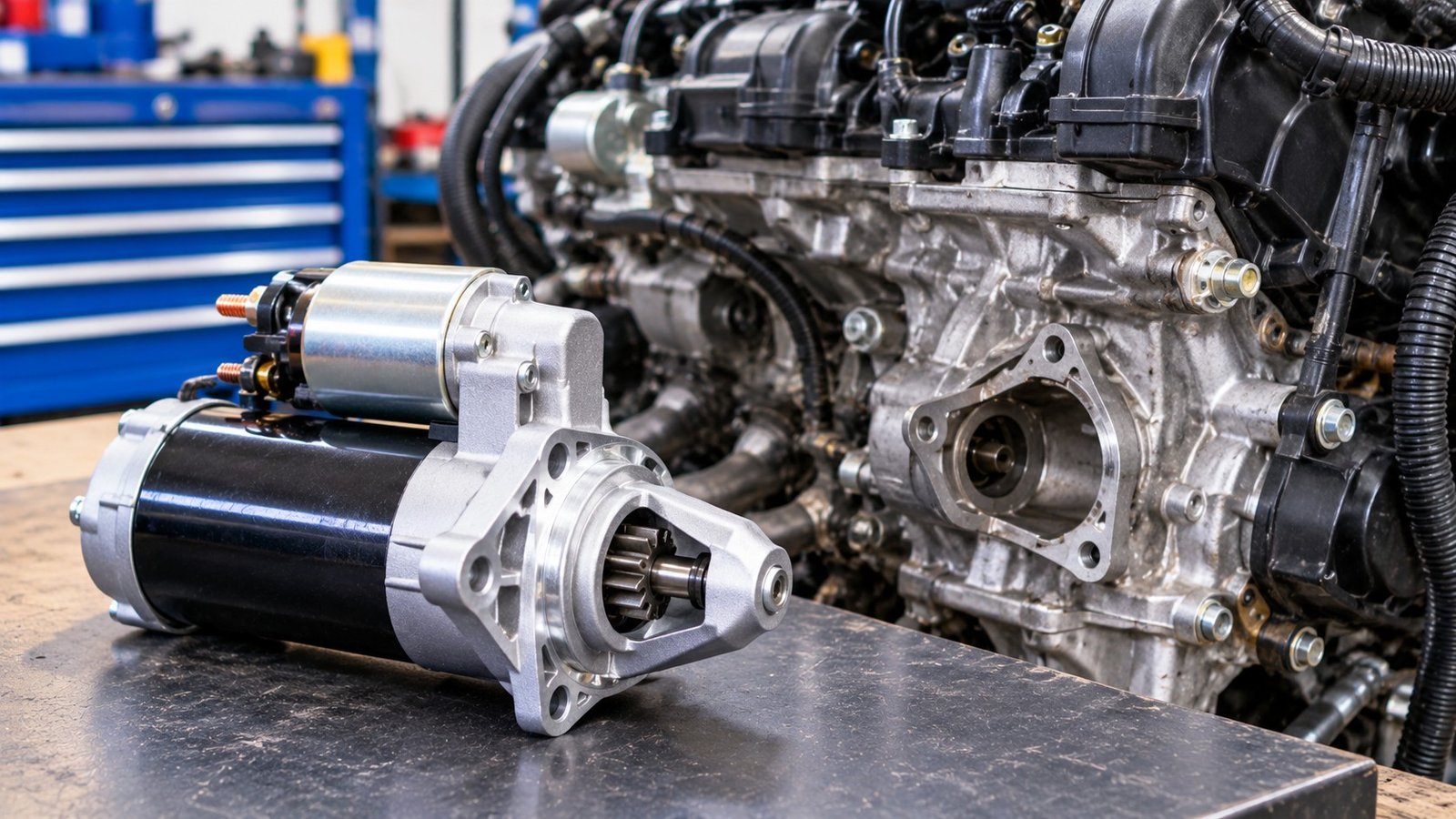
Starter cost by type
There are three main ways to buy a replacement starter. Here are typical 2026 US prices for the part itself, before installation.
| Starter Type | Typical Cost | What It Is |
|---|---|---|
| Remanufactured | $100 to $350 | Rebuilt to spec with new wear parts, tested |
| New aftermarket | $120 to $450 | New unit from an aftermarket manufacturer |
| New OEM | $250 to $650+ | New factory part from the manufacturer |
As with alternators, remanufactured starters are mainstream rather than a budget compromise, because a starter has a well-understood set of wear parts and a standardized rebuild process. For most buyers the practical choice is between remanufactured and new.
Cost by vehicle example
Here is roughly what a single starter replacement runs across vehicle categories, part plus typical installation. The wide ranges are mostly about access, covered in the next section.
| Vehicle Category | Typical Total (Part + Labor) |
|---|---|
| Compact or mid-size car (accessible) | $250 to $550 |
| Full-size truck or SUV | $300 to $700 |
| Vehicle with a buried starter | $450 to $1,000 |
| European or luxury vehicle | $500 to $1,200 |
Why installation cost varies so much
The starter part itself is not especially expensive, so on many vehicles what really drives the total is labor, and labor is almost entirely about access. This is the biggest difference between a cheap starter job and an expensive one.
On some vehicles the starter is bolted to the engine in an open, reachable spot, and replacement takes under an hour: disconnect the battery, unbolt the wiring, remove two or three bolts, and swap it. On other vehicles the starter sits under the intake manifold, above the exhaust, or in a location that requires removing other components to reach. On those, labor can run several hours, and the labor exceeds the price of the part.
This is why two people with the same vehicle value can get very different quotes. Before authorizing the work, ask the shop where the starter is located on your vehicle and how many hours they estimate. It explains most of the price, and it tells you whether a quote is reasonable.
Remanufactured vs new
A quality remanufactured starter has its wear parts replaced, the brushes, solenoid contacts, and bearings that account for most failures, and is tested before sale. For most vehicles it performs comparably to new at a lower price, which is why reman is a common choice for shops and DIYers.
New makes sense when remanufactured availability is limited for your vehicle, or when you want maximum service life on a vehicle you plan to keep a long time. Given that labor can be significant on hard-to-reach starters, some owners prefer a new unit specifically to reduce the chance of doing that labor-intensive job twice. As with any rebuilt part, choose a reman starter with a solid warranty from a reputable source.
Make sure it is the starter first
The starter, the battery, and the alternator get confused constantly, and replacing the wrong one is a costly mistake, especially when the starter is buried and the labor is high. A quick pattern check helps.
- Points to the starter : a single click or rapid clicking when you turn the key, or nothing at all, while the lights and electronics are clearly strong. There is power, but the engine will not crank.
- Points to the battery : slow or no cranking with dim lights, especially after the car sat, that resolves with a jump-start.
- Points to the alternator : the car starts fine but then dims and dies while running, or the battery keeps going dead.
Because the battery is the cheapest and easiest to test, and many parts stores test it for free, confirming the battery is good is a smart first step before buying a starter. The starter itself is harder to test at home, so if the pattern points to the starter, a shop test is often the practical way to confirm. Our guide on the alternator, starter, and battery walks through the full three-way distinction.
One more note specific to starters: repeated starter failures can sometimes be caused by damage to the flywheel or ring gear, the toothed ring the starter engages. If a new starter fails again, that is worth having checked so you are not simply replacing starters against an underlying problem.
The full cost picture
Here is what a complete starter replacement typically looks like. Figures below are illustrative for a common vehicle with a reasonably accessible starter.
| Line Item | Illustrative Cost |
|---|---|
| Remanufactured starter, delivered | $180 |
| Installation labor (1.5 hours at $125 per hour) | $190 |
| Total | About $370 |
Illustrative example only. Actual costs vary widely by vehicle, starter type, and especially access, which can add several hours of labor on some vehicles.
On a vehicle with an accessible starter, this is a moderate repair well worth doing. On a vehicle where the starter is buried, the labor can push the total much higher, which is worth knowing before you are surprised by the quote.
Need the right starter for your vehicle?
Call Vaz Auto Solutions at (240) 301-0095 with your VIN. We will match the correct starter to your specific vehicle, help you choose between remanufactured and new, quote a delivered price with free US shipping, and email the warranty terms before you pay. If you are not sure whether the starter, battery, or alternator is the real problem, we can help you sort that out first.
