
The three options, briefly
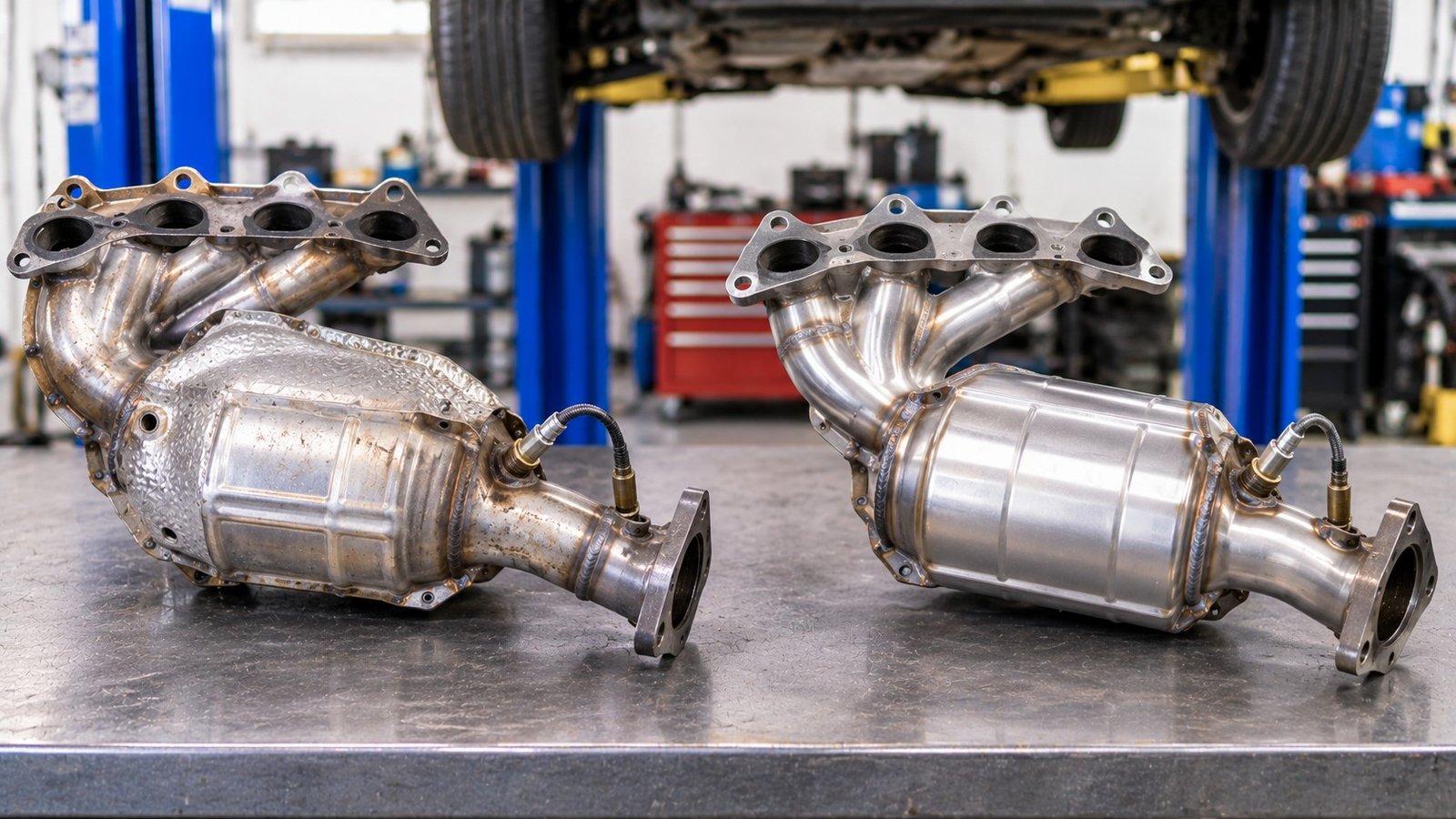
OEM converter
The exact converter your vehicle came with from the factory, bought through the manufacturer or a dealer. Fit is guaranteed and emissions compliance is built in. It is the most expensive option, sometimes by a wide margin.
Direct-fit aftermarket converter
A converter made by an aftermarket manufacturer to fit a specific vehicle. It bolts into the same location as the original with the same flanges and sensor ports. It costs less than OEM and installs about as easily. This is the option most owners and shops choose when a quality compliant unit is available for the vehicle.
Universal aftermarket converter
A generic converter that is not vehicle-specific and must be cut into the exhaust and welded in place by a shop. It is the cheapest part, but the added labor and the need to match it correctly to your emissions standard mean it is best installed by a professional. Common when no direct-fit unit exists for a vehicle.
The factor that matters most: compliance
Before you weigh OEM against aftermarket, you need to know which emissions standard applies to you, because buying the wrong one means a failed emissions test and wasted money.
Federal EPA standard
- Most US states follow federal EPA emissions rules. A converter marked EPA-compliant is legal for use in these states. Aftermarket converters meeting the federal standard are widely available and are the normal choice for federal-emissions vehicles.
California CARB standard
- California sets stricter emissions rules through the California Air Resources Board, and several other states have adopted the CARB standard. If your vehicle is registered in one of these states, the replacement converter must be CARB-compliant and carry the required identification. A federal EPA converter is not legal for a CARB-standard vehicle and will fail a smog check. CARB-compliant converters cost more, which is part of why converter prices vary so much by state.
OEM converters meet whichever standard your vehicle was originally certified to. The compliance question is really an aftermarket question: when buying aftermarket, you must select the version that matches your state. A reputable seller confirms this by VIN and state before selling you a unit.
Side-by-side comparison
| Factor | OEM | Direct-Fit Aftermarket | Universal Aftermarket |
|---|---|---|---|
| Cost | Highest | Moderate | Lowest part cost |
| Fit | Exact | Vehicle-specific | Requires cutting and welding |
| Installation | Bolt-in | Bolt-in | Professional weld-in |
| Emissions compliance | Built in | Must match your state | Must match your state |
| Availability | Most vehicles | Most common vehicles | Nearly universal |
| Warranty | Manufacturer | Varies by brand | Varies by brand |
| Best for | Newer or specialized vehicles | Most vehicles on a budget | Vehicles with no direct-fit option |
When OEM is the right choice
OEM is not necessary for every vehicle, but it is the better choice in specific situations.
- Newer vehicles under or near warranty. An OEM converter avoids any question about whether an aftermarket part affects a powertrain or emissions warranty.
- Vehicles with no quality direct-fit option. Some models, particularly newer or specialized ones, do not yet have a reliable aftermarket converter. OEM may be the only unit that fits and complies.
- Complex multi-converter emissions systems. On some vehicles the converter is closely integrated with sensors and the emissions system, and the factory part is the safest way to keep everything working correctly.
- When you plan to keep the vehicle long term. If you intend to own the vehicle for many years, the higher upfront cost of OEM can be worth the guaranteed fit and durability.
When aftermarket is the right choice
For a large share of vehicles on the road, a quality compliant aftermarket converter is the sensible choice.
Older vehicles
When an OEM converter would cost a significant fraction of the vehicle value, a compliant aftermarket unit is the practical path.
Common vehicles with strong aftermarket support
Popular models have well-established direct-fit converters from reputable manufacturers.
Budget-conscious repairs
A compliant aftermarket converter delivers the emissions function at a lower price than OEM.
After a theft
When replacing a stolen converter, a compliant aftermarket unit, paired with a shield and marking, is often the most cost-effective way to get back on the road.
The one rule that overrides all of this: the aftermarket converter must be compliant with your state's emissions standard. A cheap non-compliant converter is not a saving. It fails emissions testing, is not legal for road use, and has to be replaced again with a compliant unit. Compliant aftermarket is the goal, not simply cheap aftermarket.
How to buy the right converter
Whichever type you choose, these steps get you the correct unit the first time.
Start with your VIN and your state
Together these determine the exact converter and the emissions standard you need.
Confirm EPA or CARB compliance
Ask the seller directly which standard the converter meets and that it matches your state.
Confirm how many converters your vehicle needs
Many vehicles have more than one. Replacing only part of the system may not clear the problem.
Match direct-fit to your exact configuration
Engine size, drivetrain, and emissions family all affect which direct-fit unit is correct.
Get the warranty in writing
Converter warranties vary by brand. Know the terms before you pay.
Not sure whether OEM or aftermarket is right for your vehicle?
Call Vaz Auto Solutions at (240) 301-0095 with your VIN and your state. We will identify the correct converter and emissions standard for your vehicle, tell you honestly whether a compliant aftermarket unit will serve you or whether OEM is the better call, quote a delivered price with free US shipping, and email the warranty terms before you pay. We sell compliant replacement converters only.
