
The seven most common symptoms
These are the signs drivers and shops associate with a failing ECM. Note that most of them can also come from other causes, which is the central theme of this artic
Engine will not start
A failed ECM may not manage fuel and ignition, so the engine cranks but does not start, or does not crank at all. This is one of the more serious signs.
Persistent check engine light
A check engine light that will not clear, especially with codes pointing to the module or its circuits, can indicate an ECM problem.
Stalling or rough running
An ECM that is not managing the engine correctly can cause stalling, rough idle, or misfire-like behavior.
Erratic or unexplained behavior
Surging, hesitation, or the engine behaving inconsistently without a clear mechanical cause can point to the module.
Sudden drop in performance or fuel economy
If the ECM defaults to a fallback mode, the engine may run poorly or use more fuel.
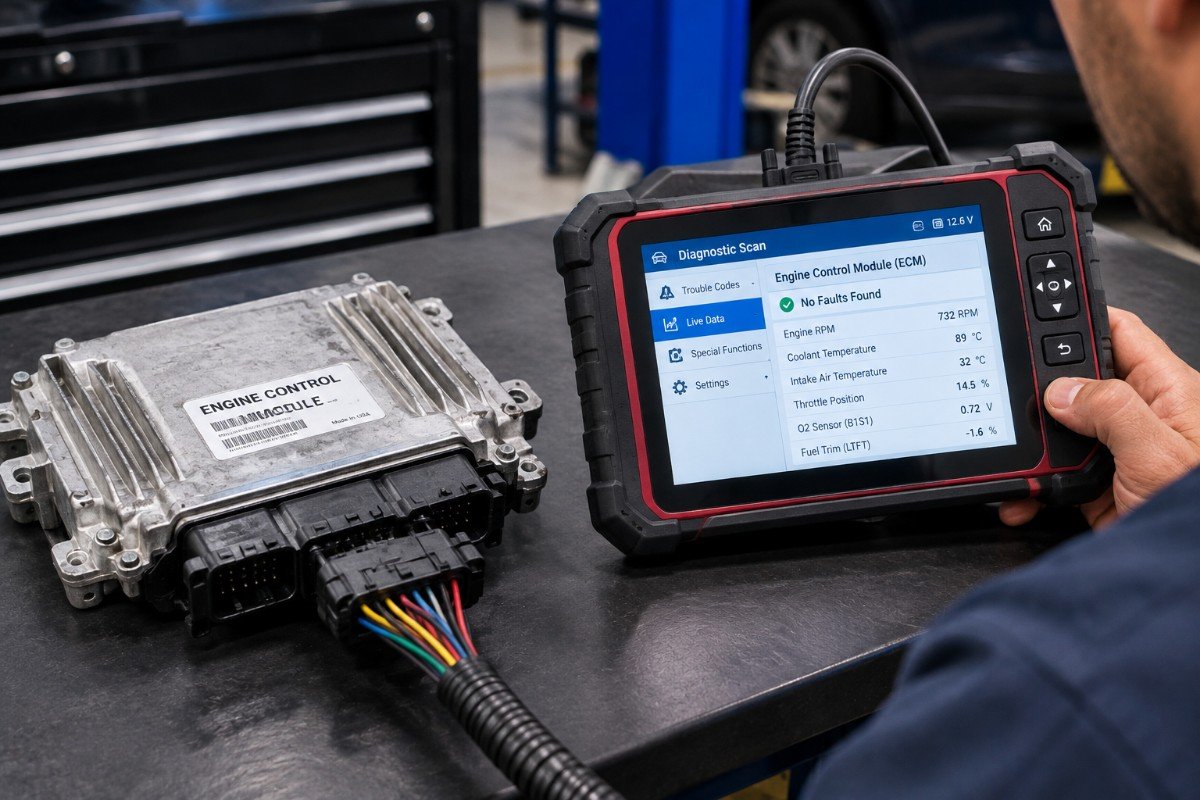
No communication with a scan tool
If a scan tool cannot communicate with the module at all, that is a stronger sign of an ECM or wiring problem than most other symptoms.
Multiple unrelated trouble codes
A flood of codes across unrelated systems at once can indicate the module itself rather than each individual system.
Why ECMs actually fail
ECMs are solid-state computers with no moving parts, so they do not wear out the way mechanical components do. When they fail, it is usually from one of a few specific causes. Knowing these helps you judge whether an ECM failure is even plausible for your situation.
Water or moisture intrusion
Water reaching the module, from a leak, flooding, or a poor seal, is a leading cause of ECM failure and corrosion.
Voltage problems
Jump-starts done incorrectly, a failing alternator, a bad battery, or a voltage spike can damage the module.
Corrosion at the connectors
Corroded or damaged connector pins can mimic or cause module problems.
Heat and vibration over time
Long-term heat cycling and vibration can eventually cause internal solder or component failures, though this is less common.
Symptom Blamed on ECM
- No-start
- Check engine light
- Stalling or rough running
- No scan tool communication
- Multiple codes
Often Actually Is
- Dead battery, bad ground, crank sensor, or fuel
- A specific sensor the code actually names
- Sensors, vacuum leaks, fuel delivery, or ignition parts
- A blown fuse, wiring, or connector rather than the module
- A single failed sensor or a ground problem affecting many systems
A bad ground or a corroded connector deserves special mention. A poor ground can cause bizarre, wide-ranging symptoms and a flood of unrelated codes that look exactly like a failing computer, while the ECM is fine. Because grounds and connectors are cheap to inspect and repair, they are worth checking before condemning the module.
What to check before replacing an ECM
Given the cost of an ECM, these steps are worth taking before you buy one. They frequently reveal a cheaper cause.
- Read the codes and address what they name first. If a code names a specific sensor, diagnose that sensor before assuming the module. Codes point to circuits, not always to the module itself.
- Check the battery, charging system, and grounds. Voltage and ground problems cause many ECM-like symptoms and are far cheaper to fix.
- Inspect the module connectors and wiring. Look for corrosion, damage, water intrusion, and loose pins before condemning the module.
- Have a qualified technician confirm the diagnosis. Diagnosing a failed module correctly usually takes proper equipment and experience. Given the cost, a professional diagnosis is worth it.
- Ask whether the module can be tested. In some cases a module can be bench-tested to confirm failure rather than replaced on suspicion.This article describes common symptoms for general information. It is not a diagnosis of your specific vehicle. A qualified technician with the vehicle in front of them is the right person to confirm whether the ECM has actually failed.
What replacing the ECM actually involves
If the ECM is confirmed bad, replacing it is different from replacing a mechanical part. The module itself usually just plugs in, but it must be programmed to your vehicle's VIN, and on many vehicles synced to the anti-theft immobilizer, or the engine will not start. A used module carries the donor vehicle's programming and needs reflashing to your vehicle. Some suppliers pre-program a replacement to your VIN before shipping, which simplifies the job. Confirm the programming and immobilizer requirements before you buy, so there are no surprises at installation.
Once the ECM is confirmed as the problem, call Vaz Auto Solutions at (240) 301-0095 with your VIN. We will identify the correct module for your vehicle, tell you plainly whether it needs programming and immobilizer syncing, let you know if a pre-programmed option is available, quote a delivered price with free US shipping, and email the warranty terms before you pay.
