

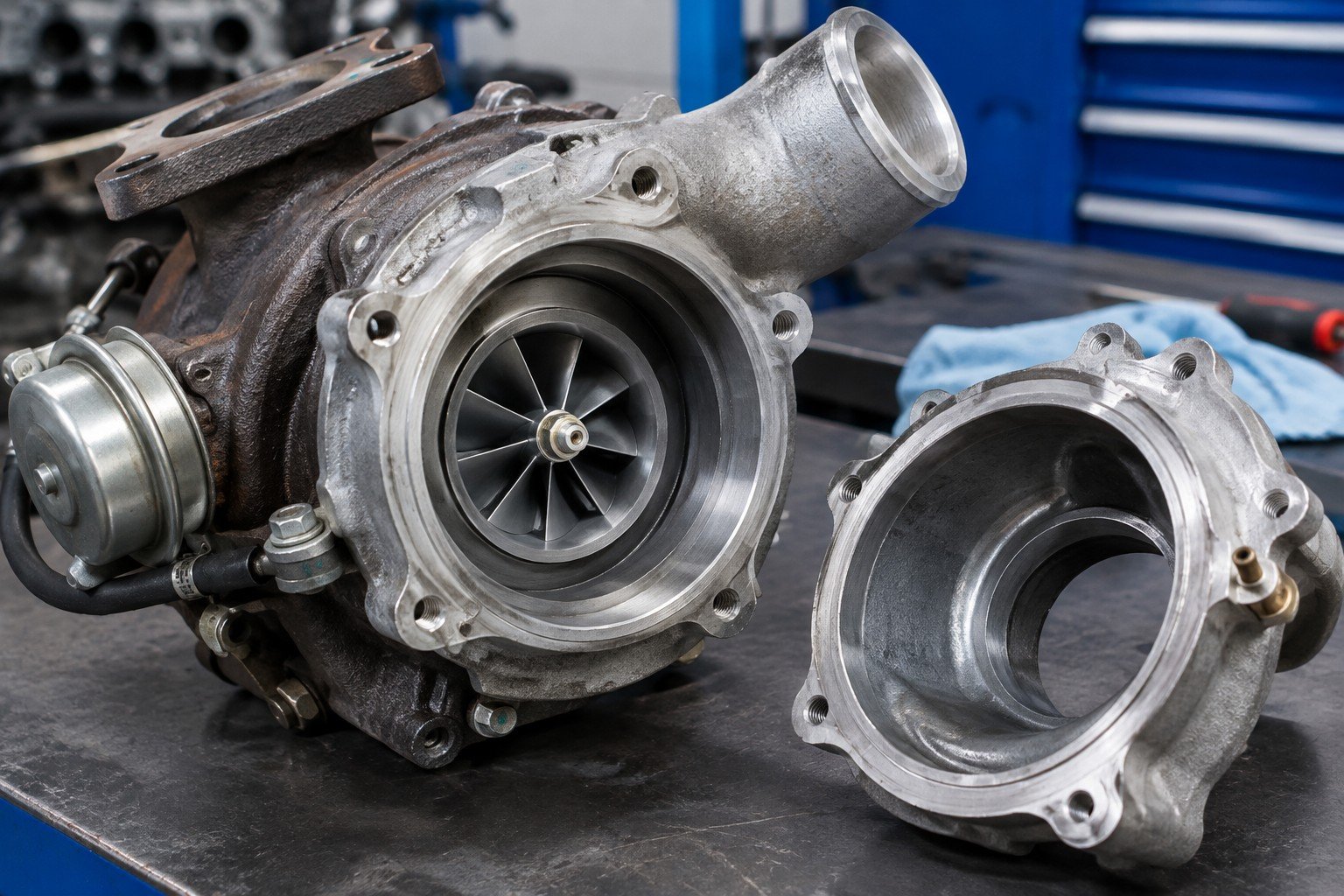
The seven most common symptoms
These are the signs drivers notice most often when a turbocharger is failing. One symptom alone is rarely conclusive, but several together point toward the turbo.
Loss Of Power
The clearest sign. A failing turbo does not deliver its normal boost, so the engine feels sluggish, especially under acceleration or when climbing.
Blue or gray exhaust smoke
When turbo seals fail, oil leaks into the exhaust or intake and burns, producing blue or gray smoke, often most visible under acceleration.
Loud whining or siren noise.
A failing turbo can produce a high-pitched whine or a sound like a siren that rises with engine speed, usually caused by worn bearings or damaged blades.
Excessive oil consumption
A turbo with failing seals draws engine oil into the intake or exhaust, so the engine burns through oil faster than normal.
Check engine light
Boost pressure outside the expected range, or a related fault, often triggers a check engine light with a boost or turbo-related code.
Whistling or hissing from a boost leak
A hissing or whistling under acceleration can indicate a leak in the boost plumbing, which makes the turbo work harder and can mimic turbo failure.
Slow throttle response or boost that comes and goes
Erratic boost, or boost that builds slowly, can point to a failing turbo or its boost control system.
How a turbocharger fails
Understanding how turbos fail helps make sense of the symptoms and helps you talk to a shop. A turbo spins on a shaft supported by bearings and lubricated by engine oil, at very high speed and temperature. Failures usually fall into a few categories.
- Bearing wear. The bearings that support the shaft wear out, often from oil problems, producing noise and eventually letting the shaft move enough to damage the wheels.
- Seal failure. The seals that keep oil out of the intake and exhaust fail, letting oil burn and producing blue smoke and oil consumption.
- Compressor or turbine wheel damage. Debris entering the turbo, or shaft play from worn bearings, can damage the spinning wheels, causing noise and loss of boost.
- Boost control or wastegate problems. The mechanism that regulates boost can stick or fail, producing too little or too much boost and often a check engine light.Behind most of these, especially bearing wear, is an oil-related cause: a restricted oil feed line, dirty or degraded oil, oil starvation at startup, or contamination from a failing engine. This connects directly to why turbos fail in the first place, which is worth keeping in mind before you replace one.
What the color of the smoke tells you
| Smoke Color | Often Indicates |
|---|---|
| Blue or gray | Oil burning, commonly failed turbo seals or an engine oil issue |
| Black | A rich fuel mixture or a boost or sensor problem, not always the turbo |
| White | Coolant burning or, on diesels, unburned fuel, usually not the turbo |
What often gets misdiagnosed as a bad turbo
Turbos are expensive, so a wrong diagnosis is costly. Several cheaper problems produce turbo-like symptoms.
| Symptom | Could Also Be |
|---|---|
| Loss of power | A boost leak, clogged air filter, or fuel delivery problem |
| Whistling or hissing | A leak in the boost plumbing rather than the turbo itself |
| Blue smoke | Worn engine components such as valve seals or rings |
| Black smoke | A sensor, fuel, or intake issue |
| Check engine light | A boost sensor, wastegate actuator, or vacuum leak |
A boost leak deserves special mention. A leak in the pipes and hoses that carry pressurized air can produce a loss of power and odd noises that feel exactly like a failing turbo, while the turbo itself is fine. Because a boost leak is far cheaper to fix, it is worth ruling out first.
What to do before you replace it
Before spending money on a turbo, take these steps. They can save you from replacing a part that was not the real problem, and from installing a new turbo into the same conditions that killed the old one.
Get any codes read
Boost-related trouble codes are a starting point for diagnosis, not a final answer.
Have a mechanic check for boost leaks first
A pressure test of the boost system can reveal a leak that mimics turbo failure at a fraction of the cost.
Ask the shop to inspect the turbo directly
Checking for shaft play, wheel damage, and oil in the intake or exhaust confirms whether the turbo itself has failed.
Ask why it failed
If the turbo is genuinely bad, the cause is usually oil-related. Fixing that root cause protects the replacement.
Confirm your vehicle configuration
Single or twin turbo, and the exact unit for your engine, so any replacement is matched correctly.
This article describes common symptoms for general information. It is not a diagnosis of your specific vehicle. A qualified mechanic with the car in front of them is the right person to confirm what is actually wrong.
