

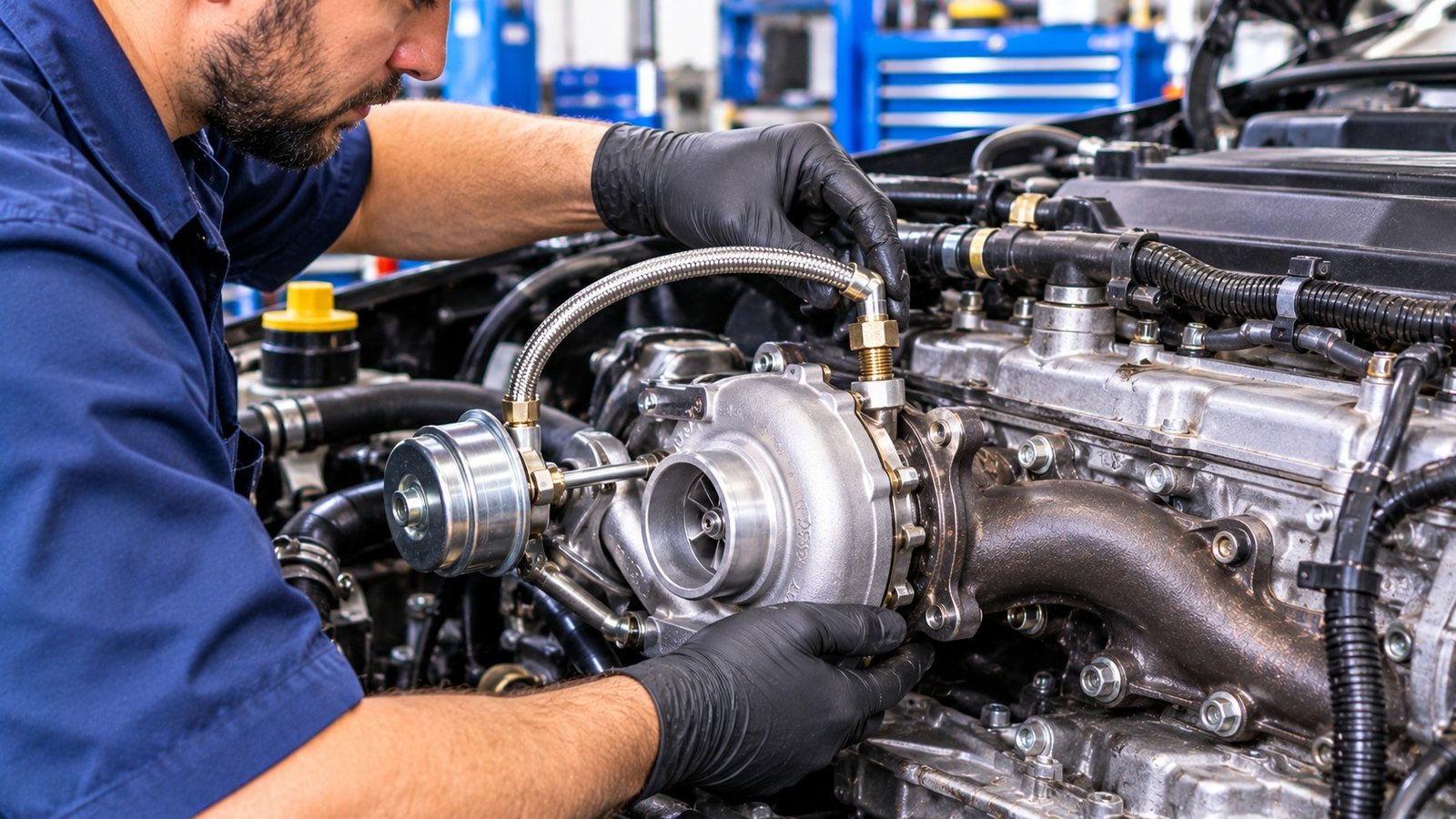
Installation labor cost by vehicle type
Most independent shops bill turbo replacement at flat rate, a published book time multiplied by their hourly rate. Here are typical US ranges for the labor alone, excluding the turbo and parts.
| Vehicle Type | Typical Labor Hours | Typical Labor Cost |
|---|---|---|
| Compact turbo car (accessible) | 3 to 6 hours | $400 to $900 |
| Mid-size or performance car | 4 to 8 hours | $500 to $1,200 |
| European vehicle (buried turbo) | 6 to 12 hours | $700 to $1,800 |
| Diesel truck (single turbo) | 6 to 12 hours | $700 to $1,800 |
| Twin-turbo vehicle (both units) | 10 to 18 hours | $1,200 to $2,700 |
Independent shop rates across the US commonly run between $90 and $160 per hour, with dealers and major metro shops charging more. Ask any shop for both figures, the estimated hours and the hourly rate, so you can compare quotes on the same basis.
What drives labor cost up or down
How buried the turbo is
Access is the biggest factor. Some turbos are reachable from above with modest disassembly. Others sit low against the block, behind the exhaust, or under the intake, requiring the removal of many components to reach. Labor hours follow access directly.
Single vs twin turbo
A twin-turbo vehicle can require roughly double the labor, and when one turbo fails, shops often recommend replacing both while everything is apart. That decision affects both parts and labor.
Diesel and variable-geometry turbos
Diesel turbos, and variable-geometry units common on diesels, tend to involve more plumbing, actuators, and heat-related hardware, which adds time.
Corrosion and heat-seized hardware
Turbo bolts and exhaust fasteners live in an extreme heat environment and often seize. Broken studs and stubborn fasteners add hours that a shop cannot always predict, which is why a quote may carry a range.
Associated parts
Oil feed and drain lines, gaskets, and sometimes charge pipes or the intercooler are replaced or inspected during the job. These add to both the parts bill and the labor.
The oil-side steps that protect a new turbo
This is the part of a turbo installation that matters most and gets underpriced most often. A turbocharger lives or dies by its oil supply, so the oil-side work done during the install directly determines whether the new turbo survives. These steps are inexpensive relative to the turbo itself, and skipping them is a common reason a new turbo fails early.
Replace the oil feed line
The oil feed line delivers pressurized oil to the turbo bearings. Over time it can partially clog with baked-on oil deposits, especially after a turbo has failed and shed debris. Installing a new turbo onto an old, restricted feed line starves the new unit of oil, and it can fail the same way the last one did. A new oil feed line is cheap insurance and should be in the quote.
Change the oil and filter
A failed turbo can send debris into the oil. Fresh oil and a new filter from the start give the new turbo clean lubrication and remove contamination that could damage it. This is standard on a proper turbo job.
Prime the turbo before the first start
When a new turbo is installed dry, it can spin up to very high speed on first start before oil reaches the bearings, causing immediate wear. Priming the oil system, so the turbo has oil before it spins under load, protects those first critical seconds. A careful installer does this as a matter of course.
Address the reason the old turbo failed
If the original turbo failed from an oil-related cause, and most do, the underlying problem needs to be corrected during the job, not just the turbo swapped. A good shop identifies why the turbo failed and fixes that as part of the install. This is the single most important thing you can confirm before authorizing the work.
The full cost picture
The turbo price is not the repair price. Here is what a complete replacement typically looks like once everything is counted. Figures below are illustrative for a mid-size single-turbo vehicle.
| Line Item | Illustrative Cost |
|---|---|
| Remanufactured turbocharger, delivered | $900 |
| Installation labor (6 hours at $125 per hour) | $750 |
| New oil feed line | $90 |
| Oil and filter change | $90 |
| Gaskets and hardware | $120 |
| Total | About $1,950 |
Illustrative example only. Actual costs vary by vehicle, turbo type, access, region, and shop rate.
Compare the total against what the vehicle is worth. On a turbocharged vehicle in good condition otherwise, a turbo replacement usually makes sense. On a high-mileage vehicle with other problems, weigh the repair against the vehicle value the same way you would a major engine or transmission repair.
Questions to ask a shop before you book
- Will you install a customer-supplied turbo, and does that change your labor rate or warranty? Ask first. Policies vary and the answer affects where you should buy the turbo.
- What is your hourly rate and how many hours do you estimate? Both numbers, so you can compare quotes fairly.
- Does the quote include a new oil feed line, an oil change, and priming the turbo? A shop that raises these before you ask understands turbo work.
- Have you identified why the old turbo failed? If the cause is oil-related and not addressed, the new turbo is at risk.
- Do you warranty your labor, and for how long? Labor warranty is separate from the turbo warranty. Get the term in writing.
Budgeting a turbo replacement and want a firm number on the unit itself?
Call Vaz Auto Solutions at (240) 301-0095 with your VIN. We will match the correct turbo to your vehicle, help you weigh used, remanufactured, or new, quote a delivered price with free US shipping, and email the warranty terms before you pay. We will also flag the oil-side parts worth replacing at the same time so your shop can quote the whole job accurately.
