

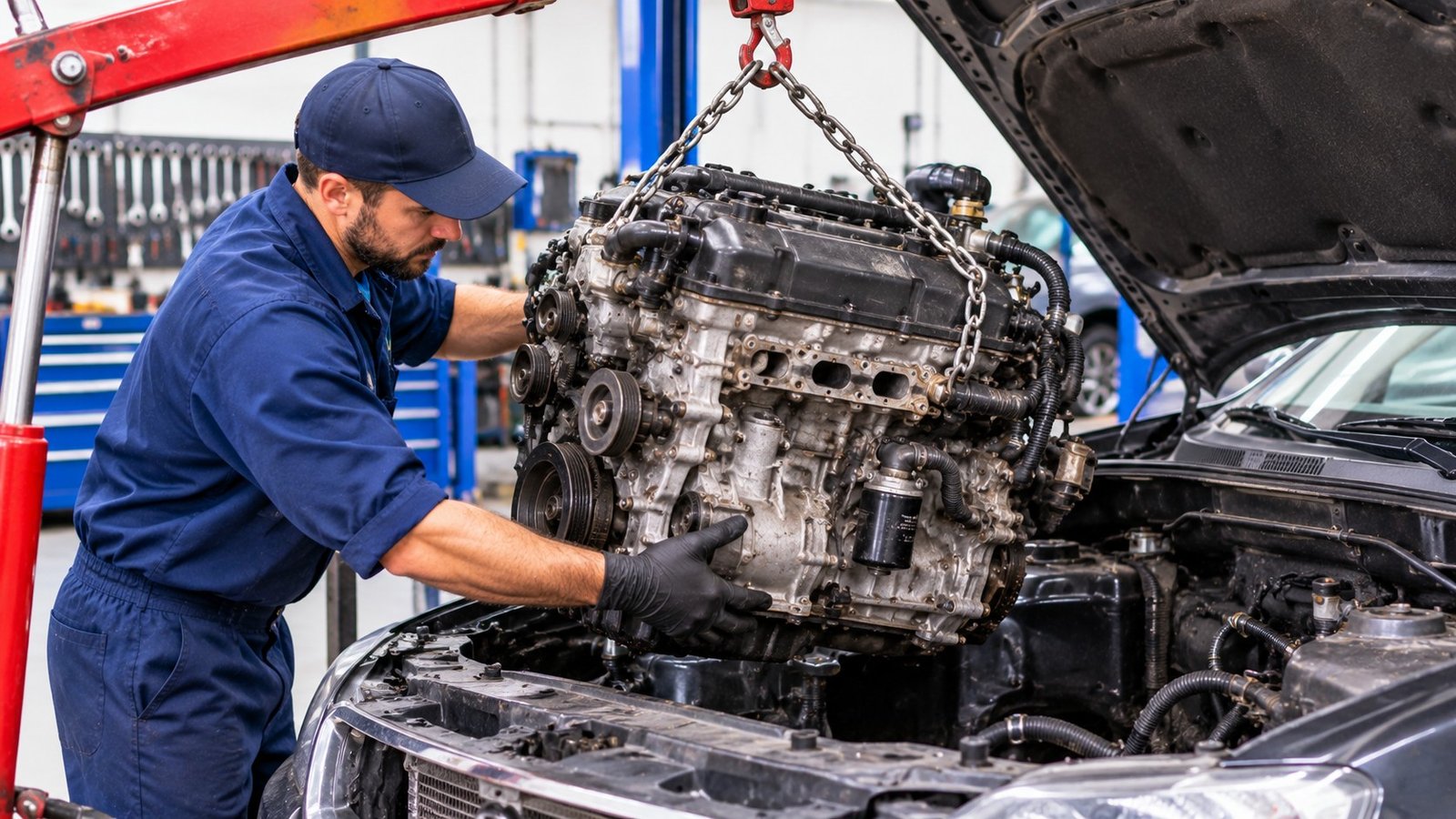
Installation labor cost by vehicle type
Engine replacement labor is billed either by flat rate (a book time multiplied by the shop hourly rate) or by actual hours. Most independent shops use flat rate. Here are typical US labor ranges for a used engine swap, excluding the engine and parts.
| Vehicle Type | Typical Labor Hours | Typical Labor Cost |
|---|---|---|
| Compact car (4-cylinder, FWD) | 8 to 12 hours | $800 to $1,400 |
| Mid-size sedan (V6, FWD transverse) | 10 to 16 hours | $1,000 to $1,900 |
| Rear-wheel-drive sedan or coupe | 10 to 14 hours | $1,000 to $1,700 |
| Full-size truck or SUV (V8) | 12 to 18 hours | $1,200 to $2,200 |
| Diesel truck | 15 to 25 hours | $1,800 to $3,000 |
| Premium European or AWD | 15 to 22 hours | $1,800 to $2,800 |
Labor cost is hours multiplied by the shop rate. Independent shop rates across the US commonly fall between $90 and $160 per hour, with dealers and metro-area shops charging more. Ask any shop for both numbers, the estimated hours and their hourly rate, so you can compare quotes on the same basis.
What drives labor cost up or down
Two vehicles with the same engine size can have very different swap costs. These are the factors that move the number.
Engine bay access
A rear-wheel-drive truck with a longitudinal V8 and plenty of room around it is straightforward. A transverse V6 packed into a front-wheel-drive sedan, where the engine and transaxle come out together from underneath, takes far longer. Access is the single biggest driver of labor hours.
Long block vs complete engine
A complete engine arrives with the intake, exhaust manifolds, and accessories already attached. A long block requires the shop to transfer all of those from your old engine, which adds hours. Paying more for a complete engine often reduces the labor bill by more than the price difference.
All-wheel drive and drivetrain complexity
AWD systems, transfer cases, and complex exhaust routing all add disassembly time. Turbocharged engines add plumbing, intercooler piping, and oil and coolant lines that must come off and go back on.
Condition of surrounding components
Seized bolts, corroded exhaust fasteners, and rusted subframe hardware add real hours, especially on vehicles from road-salt regions. A shop cannot always predict this before the job starts, which is why the quote may carry a range.
Shop hourly rate and location
The same job costs meaningfully more in a major metro area than in a smaller market. Dealer rates typically run well above independent shop rates for identical work.
How long an engine swap takes
Labor hours and calendar time are not the same thing. A job booked at 12 labor hours rarely means your car is back the next day.
| Stage | Typical Time |
|---|---|
| Engine delivery to the shop | 3 to 10 business days from order |
| Removal of the old engine | 4 to 8 hours of labor |
| Transfer of accessories (long block only) | 2 to 5 hours of labor |
| Installation and reconnection | 5 to 10 hours of labor |
| Fluid fill, start-up, and testing | 1 to 3 hours of labor |
| Total calendar time at the shop | 3 to 7 business days typical |
Most shops schedule an engine swap across several days because the bay is tied up and parts may need to be ordered mid-job. Ask for an estimated completion date, not just labor hours, and ask what happens if a seized fastener or a missing accessory extends the job.
Parts to replace during the swap
This is where installation quotes commonly fall short. Several parts are far cheaper to replace while the engine is already out. Skipping them is the most common reason a good used engine fails early or the car comes back to the shop within months.
Replace these while the engine is out:
- Timing belt or chain and tensioner. If the engine uses a belt and its history is unknown, replace it. Doing this later means pulling much of the front of the engine apart again.
- Water pump and thermostat. Overheating is a leading cause of engine failure. These are inexpensive parts with high labor cost if done separately.
- Clutch (manual transmission only). The transmission is already separated from the engine. Replacing the clutch now costs a fraction of what it costs as its own job.
- Rear main seal and oil pan gasket. Accessible only with the engine out. A leak here after installation is an expensive repeat job.
- Engine and transmission mounts. Old mounts transmit vibration and shorten the life of the new engine.
- Spark plugs, belts, and hoses. Inexpensive, and the labor is already covered by the swap.
- All fluids and filters. Fresh oil and filter, coolant, and a new air filter from the first start.
Budget roughly $200 to $600 for these items on a typical gasoline engine, more on a diesel or European application. It is the best money in the entire job.
The full cost picture, worked through
Here is what a complete used engine replacement typically looks like when everything is counted. Numbers below are illustrative for a mid-size vehicle with a V6, using an independent shop.
| Line Item | Illustrative Cost |
|---|---|
| Used OEM engine, delivered | $1,800 |
| Installation labor (12 hours at $125/hr) | $1,500 |
| Timing components, water pump, thermostat | $250 |
| Mounts, seals, gaskets | $150 |
| Fluids, filters, plugs, belts | $150 |
| Shop supplies and disposal | $100 |
| Total | About $3,950 |
In this example the engine is under half the total and labor is most of the rest, which is common on engine replacement jobs. That is why paying slightly more for a complete engine, a lower-mileage donor, or a longer warranty usually makes sense: the labor cost is the same either way, and redoing the job is what actually hurts.
Illustrative example only. Actual costs vary by vehicle, region, shop rate, and the condition of surrounding components.
Independent shop vs dealer vs doing it yourself
Three ways to get a used engine installed. Each fits a different situation.
Independent shop
The right answer for most drivers. Independent shops charge meaningfully less per hour than dealers and are generally willing to install a customer-supplied engine. Not all shops will, so confirm before you order. Ask whether they warranty their labor, and for how long.
Dealer service department
Highest labor rate, and many dealers will not install a customer-supplied used engine at all. Dealers usually want to sell and install their own new or remanufactured unit. If a dealer is your only option, get their total quote and compare it against an independent shop before committing.
Doing it yourself
Viable if you have engine hoist access, a factory service manual for your vehicle, a full metric and standard socket set including a torque wrench, and somewhere to work for several days. The savings are real, often the entire labor cost. The risk is also real: an installation error is almost never covered by a used engine warranty, so a mistake means buying a second engine. If you have not done a swap before, a first attempt on your only vehicle is not the place to learn.
Questions to ask a shop before you book
Ask these five questions before you commit to a shop. The answers tell you a great deal about how the job will go.
Will you install a customer-supplied engine?
Ask first. Some shops only install engines they source themselves, and some charge a higher rate or decline labor warranty on customer-supplied parts.
What is your hourly rate and how many hours do you estimate?
Both numbers, not just the total. This is the only way to compare quotes fairly.
What parts do you recommend replacing during the swap, and are they in this quote?
A shop that names timing components, water pump, and seals unprompted is thinking about the job correctly.
Do you warranty your labor, and for how long?
Labor warranty is separate from the engine warranty. Get the term in writing.
What happens if the job takes longer than estimated?
Seized bolts and corroded hardware are common. Know in advance whether extra hours are billed and how you will be notified.
Budgeting an engine replacement and want a firm number on the engine itself?
Call Vaz Auto Solutions at (240) 301-0095 with your VIN. We will match a used OEM engine to your vehicle, quote a delivered price with free US shipping, tell you whether it is a long block or complete so your shop can estimate labor accurately, and email the warranty terms before you pay.
