

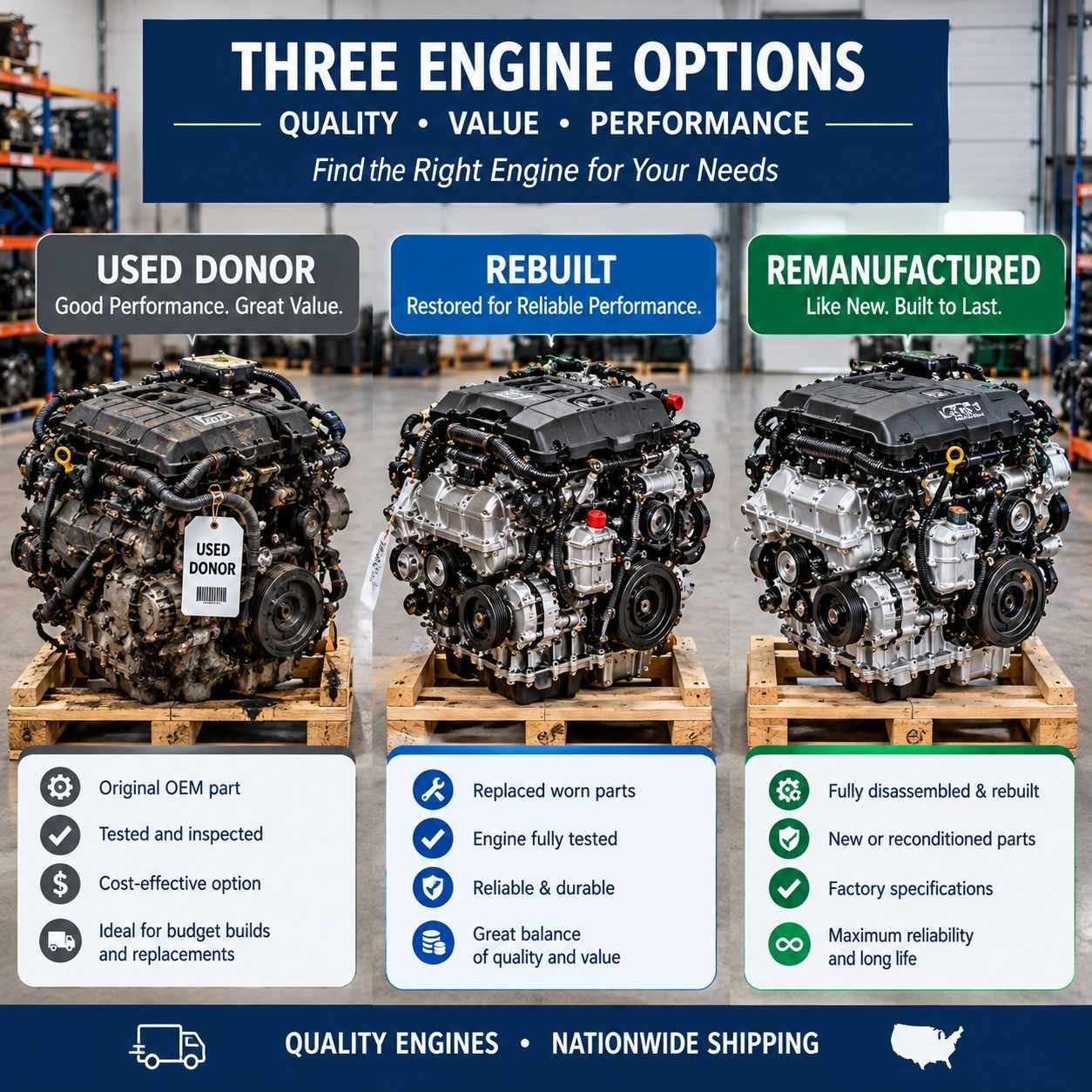
A used engine is pulled from a donor vehicle with no work done to internals and is the cheapest option, typically $500 to $4,000. A rebuilt engine has been disassembled with worn parts replaced by a shop or specialist and runs $1,800 to $6,000. A remanufactured engine is rebuilt to factory specs by a large facility with standardized machine work and comes with the longest warranty, typically $2,500 to $7,500. For most drivers with a car 8 to 15 years old, used OEM is the right answer. For newer vehicles or when the longest warranty matters, remanufactured wins. Rebuilt sits between the two and only makes sense in specific situations. Here is the honest breakdown of each.
The Three Options at a Glance
Before the deep comparison, here is the quick version. If one of these matches your situation clearly, you might not need the full breakdown.
Used OEM Engine
Lowest total cost
Rebuilt Engine
Quality varies by shop
Remanufactured Engine
Highest upfront cost
Used OEM Engine: What You Actually Get
A used engine is exactly what it sounds like. An engine assembly pulled from a donor vehicle that was retired for reasons other than engine failure. Typical donor sources are vehicles totaled in accidents, taken off the road by insurance, or scrapped due to non-engine issues like transmission failure, flood damage, or accident damage that made repair uneconomical.
Key traits:
Engine internals are original from the donor vehicle. No work has been done to pistons, rings, bearings, or crankshaft.
Donor mileage should be documented from the salvage title or auction sheet. Under 100,000 miles is the market sweet spot.
Warranty ranges from 15 days at bare-minimum sellers to 1 year at premium specialty retailers. Labor is almost never covered.
Price is the lowest of the three options because there is no rebuild labor built into the cost.
Fit verification by VIN is critical because you are getting an engine from a specific donor vehicle. VIN matching catches engine variant, transmission pairing, and emissions family.
Where a used engine makes the most sense: cars 8 to 15 years old, where the value of the vehicle does not justify spending on a remanufactured or new engine. Given the average US light vehicle is 12.8 years old according to S&P Global Mobility, this describes most of the fleet on the road today.
Rebuilt Engine: What You Actually Get
A rebuilt engine has been disassembled, worn parts replaced, and put back together. The critical thing to understand about rebuilt engines is that "rebuilt" has no standardized definition. Two shops can both call an engine "rebuilt" and mean very different things.
What a minimum rebuild includes:
Piston rings, main and rod bearings, oil pump, timing components, and gaskets replaced
Head reconditioning (valve seals, valve grind, sometimes new valves)
Basic cleaning and inspection
What a thorough rebuild adds:
Cylinder block boring and honing to factory tolerance
Crankshaft turning if the journals show wear
Head resurfacing (skimming) and pressure testing
New camshaft and lifters if the originals show wear
New water pump, oil pump, and timing chain or belt
The gap between the minimum and the thorough rebuild is enormous, and it is largely invisible to the buyer once the engine is painted and sitting on a pallet. Two "rebuilt" engines at the same price can be very different products.
Where a rebuilt engine makes the most sense: when you want to keep the original engine (numbers-matching for a collector vehicle, sentimental attachment, or matching serial number for legal purposes), when donor supply is limited for your specific engine, or when you have a trusted local rebuilder who documents exactly what work was done.
The rebuilt engine risk: quality varies dramatically by rebuilder. Ask what specific work was performed, request the parts list, and check the shop's reputation before committing.
Remanufactured Engine: What You Actually Get
A remanufactured engine is rebuilt to factory specifications by a large facility with standardized machine work. Unlike "rebuilt," the term "remanufactured" is more standardized in the industry because major remanufacturers follow published rebuild specifications and quality processes.
What a remanufactured engine typically includes:
Full disassembly to bare block
Machine work performed to factory tolerances (block boring, deck resurfacing, crankshaft grinding)
All bearings, rings, gaskets, and seals replaced with new
Cylinder heads rebuilt, resurfaced, and pressure tested
New timing components, oil pump, and often a new water pump
Standardized dyno or run-in testing before shipping
Major US remanufacturers: Jasper Engines & Transmissions is the largest and most widely known, with a nationwide dealer network. ATK Engines, Promar, Marshall, and several regional remanufacturers also produce OE-quality reman engines. Not all remanufacturers are equal, and dyno testing plus published rebuild specs are the two markers of a serious facility.
Warranty: this is where remanufactured engines pull ahead. Jasper's standard warranty on most remanufactured gas engine applications runs 3 years or 100,000 miles including parts and labor coverage, transferable to subsequent owners. Commercial applications (fleet, tow, police, and vehicles over 1 ton) receive an 18-month or 100,000-mile warranty. Other major remanufacturers offer similar terms. That is dramatically longer than any used or rebuilt engine warranty.
Where a remanufactured engine makes the most sense: Newer vehicles (5 to 10 years old) that you plan to keep for another 8 to 10 years, work trucks or fleet vehicles where downtime is expensive, and any situation where a long warranty carries real value.
Side-by-Side Comparison
Here is how the three options compare on the factors that actually drive the decision.
| Factor | Used OEM | Rebuilt | Remanufactured |
|---|---|---|---|
| Price range | $500 – $4,000 | $1,800 – $6,000 | $2,500 – $7,500 |
| Warranty length | 15 days to 1 year | 90 days to 1 year | 3 years / 100,000 miles typical |
| Labor covered | Almost never | Rarely | Often included |
| Internal parts | Original from donor | Wear parts replaced | All wear parts new |
| Machine work | None | Sometimes | Full to factory spec |
| Quality consistency | Varies by donor | Varies dramatically by shop | Standardized by facility |
| Expected lifespan | 60,000 – 120,000 miles | 80,000 – 150,000 miles | 150,000 miles or more |
| Lead time | 3 – 10 business days | 2 – 6 weeks | 5 – 15 business days |
| Best fit vehicle age | 8 – 15 years | 10+ years or specialty | 5 – 10 years |
Which One Is Right for Your Situation
Use this quick decision framework. Start with your vehicle and your goal for it.
Choose a Used OEM Engine If
- Your vehicle is 8 to 15 years old
- The vehicle is worth $4,000 to $10,000 with a working engine
- You want the lowest total cost of repair
- You plan to keep the car another 3 to 6 years, not another 15
- You have a trusted independent shop to install it
Choose a Rebuilt Engine If
- You want to keep the original engine block (numbers-matching, collector vehicle)
- Used donor supply is limited for your specific engine
- You have a trusted local rebuilder who documents exactly what work was done
- You are willing to accept variable quality in exchange for controlling the work
Choose a Remanufactured Engine If
- Your vehicle is 5 to 10 years old
- The vehicle is worth $10,000+ with a working engine
- You plan to keep the vehicle another 8 to 10 years
- You want the longest warranty and can absorb the higher upfront cost
- The vehicle is a work truck or fleet vehicle where downtime is expensive
Skip All Three and Go New If
- The vehicle is still under factory powertrain warranty
- The vehicle is a rare specialty application with no used or reman supply
- You are keeping a low-mileage luxury or performance vehicle for the long term
How buyers typically weigh each option
A few patterns come up regularly when drivers compare these three options. Worth flagging before you decide.
Used OEM buyers care most about total delivered cost. The question that usually drives the used engine decision is not "which option is best," it is "how do I keep this car running for the least money." When you walk through the math, used almost always wins on total cost for cars 8 to 15 years old.
Rebuilt buyers usually have a specific reason to keep their engine. Buyers who choose a rebuild are usually not doing it to save money. They want to keep an original engine for a classic vehicle, need to match a serial number, or have a difficult-to-source powertrain. If a used replacement is not available for your specific engine, a trusted local rebuilder is often the right next step.
Remanufactured buyers care most about warranty length. The 3-year, 100,000-mile warranty on a Jasper or ATK reman is the single biggest reason drivers pay the higher upfront cost. For a work truck that has to stay on the road, the longer warranty often justifies the higher upfront cost.
Confusion between rebuilt and remanufactured is common. The terms are often used interchangeably by both buyers and sellers. The difference matters. "Rebuilt" is a shop-level process with wide quality variance. "Remanufactured" is a facility-level process with standardized machine work and testing. Ask which one you are actually being quoted before you agree to a price.
Cost Math Worked Through for Each
Here is what the total repair typically looks like for the same vehicle across all three options. Numbers below are illustrative for a mid-size sedan or truck with a V6 engine.
Used OEM
Lowest total cost
Rebuilt (Local Shop)
Mid-range cost
Remanufactured
Highest cost, longest warranty
Cost difference between used and remanufactured on this example is about $2,700. What you get for that $2,700 is a 3-year warranty instead of a 15-day-to-1-year warranty, standardized machine work, and a longer expected lifespan. Whether that trade is worth it depends entirely on how long you plan to keep the vehicle.
Get Honest Guidance
Call Vaz Auto Solutions with your VIN and a rough sense of how long you plan to keep the vehicle. We stock used OEM engines and can quote them directly. For rebuilt or remanufactured, we can point you to reputable sources including Jasper, ATK, and local rebuilders. If a used engine is not the right answer, we will tell you honestly.
