

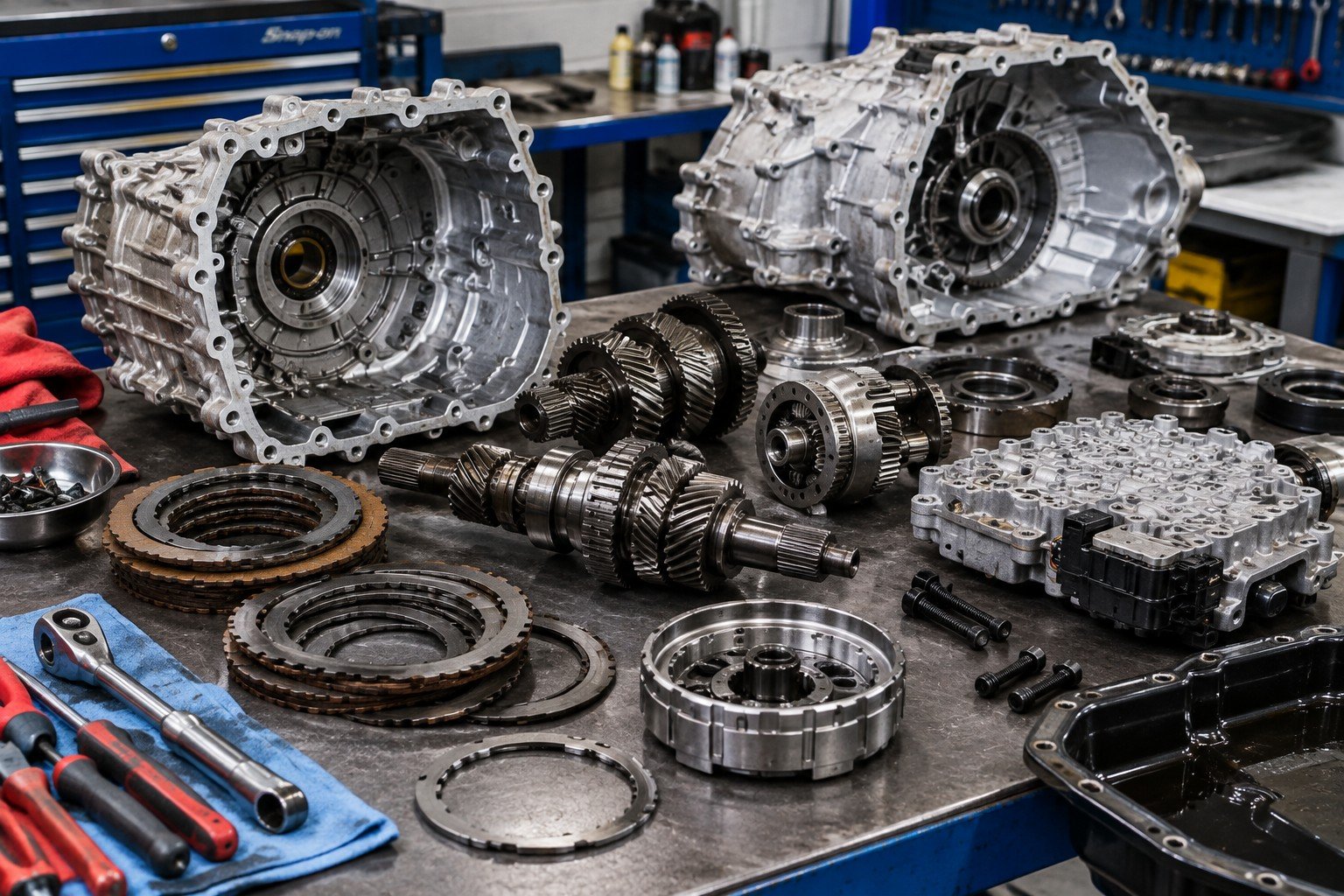
What each option actually means
Used
A complete transmission removed from a donor vehicle, typically one retired for accident damage, body damage, or engine failure rather than transmission failure. Nothing internal has been opened or replaced. What you are buying is the remaining life the unit had when the donor came off the road, which makes documented donor mileage the number that matters most. The torque converter may or may not be included, so confirm before comparing prices.
Rebuilt
A transmission taken apart by a shop, with worn components replaced and the unit reassembled. Commonly replaced are clutch packs, bands, seals, gaskets, and the filter. The important thing to understand is that "rebuilt" has no standardized definition. One shop may replace only the obvious wear items. Another may replace the same parts plus the pump, solenoids, and torque converter, and machine the valve body. Two rebuilt units at similar prices can be very different products, so ask for the parts list.
Remanufactured
A transmission rebuilt to factory specification at a dedicated facility using standardized processes. Unlike "rebuilt," remanufacturing follows published specs, and major remanufacturers test units before shipping. The meaningful advantage on transmissions is that reman units frequently incorporate updated internal parts that correct known weaknesses in the original design, which a straight rebuild using original-specification parts does not do. Warranty terms are the longest of the three and sometimes include labor coverage.
Side-by-side comparison
| Factor | Used | Rebuilt | Remanufactured |
|---|---|---|---|
| Typical cost | $400 to $4,000 | $1,200 to $3,500 | $1,800 to $5,000 |
| Internal parts | Original from donor | Wear items replaced | All wear items new |
| Design updates | None | Rarely | Often included |
| Quality consistency | Varies by donor | Varies widely by shop | Standardized |
| Typical warranty | 15 days to 1 year | 90 days to 2 years | 2 to 3 years or longer |
| Labor coverage | No | Sometimes, if shop installs | Sometimes included |
| Torque converter | Often separate | Usually included | Usually included |
| Core charge | Sometimes | Usually | Usually |
| Lead time | 3 to 10 business days | 1 to 3 weeks | 3 to 10 business days |
| Best fit vehicle age | 8 years and older | Any age, situational | 3 to 10 years |
Why rebuilding is a stronger option on transmissions than on engines
If you researched engine replacement first, you may have concluded that rebuilt engines are a niche choice. That conclusion does not carry over to transmissions, and the reason is worth understanding.
Transmission rebuilding is an established specialist trade. Most metro areas have shops that do nothing else, with technicians who work on the same handful of transmission families every day. That depth of specialization is far less common in engine rebuilding, where the work is usually one service among many at a general machine shop.
Two practical consequences follow. First, a competent local transmission shop can often rebuild your existing unit for less than a comparable used unit plus installation, because your old transmission is already in the vehicle and does not need to be shipped. Second, when a shop rebuilds and installs, one party is accountable for both the parts and the setup, and their warranty usually covers both. On transmissions that matters, because installation and setup errors are a common cause of early failure and are excluded from every parts-only warranty.
The trade-off is variability. A rebuild is only as good as the shop performing it, and quality across shops ranges more widely than it does across remanufacturers. Check reviews, ask what the rebuild includes, and get the warranty in writing.
Which one fits your situation
Choose used if
- Your vehicle is 8 years or older and you want the lowest total repair cost
- The vehicle is worth roughly $3,000 to $8,000 with a working transmission
- You plan to keep it another 3 to 5 years, not another 10
- A low-mileage donor unit with documented mileage is available for your transmission code
Choose rebuilt if
- You have a trusted local transmission shop with a track record you can verify
- Used donor supply is thin for your specific transmission code
- You want one party accountable for both the unit and the installation
- Your existing transmission is a good core, meaning the case and major hard parts are undamaged
Choose remanufactured if
- Your vehicle is roughly 3 to 10 years old and you plan to keep it for years
- Your transmission model has a known design weakness that a reman unit addresses with updated parts
- The vehicle is a work truck or family vehicle where a second failure would be costly
- You want the longest warranty available and can absorb the higher upfront cost
A note on CVTs. Continuously variable transmissions narrow this decision. Rebuilding a CVT is often impractical or uneconomical compared with a conventional automatic, so for most CVT vehicles the real choice is between a used unit and a remanufactured one. If you drive a CVT vehicle, get quotes on both before assuming a rebuild is available.
What to confirm before you commit
Whichever option you choose, five things should be settled in writing before money changes hands.
- The transmission code matches your VIN. A single model year can carry several codes depending on engine, drivetrain, and trim. Year, make, and model is not enough.
- Whether the torque converter is included. This differs by option and by seller and is the most common reason two quotes are not comparable.
- What the warranty covers and excludes. Ask specifically whether labor is covered and whether installation by a licensed facility is required. Some remanufacturer warranties are void if you install the unit yourself.
- The core charge and return terms. Amount, return window, who pays return freight, and what condition the core must be in.
- That the cooler lines and radiator cooler will be flushed. Debris from the failed unit travels into the cooler circuit. Most warranties exclude failures traced to skipping this step, regardless of which option you bought.
Not sure which option makes sense for your vehicle?
Call Vaz Auto Solutions at (240) 301-0095 with your VIN and a rough idea of how long you plan to keep the car. We stock used OEM transmissions and can quote one directly, including whether the torque converter is included and what the delivered price is. If a local rebuild or a remanufactured unit is the better answer for your situation, we will tell you that instead.
