About the Ford F350 Super Duty Running Boards
Direct fit Ford F-350 Super Duty heavy-duty pickup truck 1999-current (25+ years US production, 5 generations). Super Duty introduced 1999 as separate model from F-150 light-duty line, establishing distinct heavy-duty truck line for commercial/heavy-duty applications including heavy towing (up to 35,000+ lbs gooseneck/5th wheel), construction, agriculture, fleet/utility work, heavy camper applications.
F-350 positioning: 1-ton heavy-duty pickup truck above F-250 (3/4-ton) and below F-450 (medium-duty heavy) in Super Duty hierarchy. Designed for maximum-capability heavy-duty work including both construction/commercial and recreational towing (RV/5th wheel/boat).
Five generations: 1st gen 1999-2007 (original Super Duty established the line), 2nd gen 2008-2010 (6.4L Power Stroke era), 3rd gen 2011-2016 (ALL-NEW ALUMINUM BODY for weight reduction - MAJOR INDUSTRY MILESTONE, new 6.7L Scorpion Power Stroke Ford in-house diesel replacing International/Navistar engines), 4th gen 2017-2022 (introduced 7.3L Godzilla V8 gas 2020+ replacing 6.8L V10), 5th gen 2023-current (all-new major redesign).
Engines: Gas V8 (5.4L Triton 1999-2010, 6.2L Boss 2011-2022, 7.3L Godzilla 2020-current). 6.8L Triton V10 (1999-2019 heavy-duty gas workhorse). Diesel V8 Power Stroke family: 7.3L Power Stroke (1999-2003 the LEGENDARY DIESEL, International/Navistar-sourced ~250 HP/505 lb-ft, highly sought-after vintage diesel for reliability/durability/lack of modern emissions equipment), 6.0L Power Stroke (2003-2007 problematic era with EGR cooler failures/head gasket issues/class-action lawsuit), 6.4L Power Stroke (2008-2010 brief twin-turbo era), 6.7L Scorpion Power Stroke (2011-current Ford in-house design, modern emissions compliant).
Transmissions: 4R100 4-speed (1st gen), 5R110W TorqShift 5-speed (2003-2010), 6R140 TorqShift 6-speed (2011-2019), 10R140 10-speed TorqShift modern (2020+). ZF 6-speed manual early diesel only. 4x2 or 4x4 with transfer case. Body styles: Regular Cab (commercial), SuperCab (extended), Crew Cab (full 4-door). Bed lengths 6.75 ft or 8 ft. DUALLY (DRW) option available for maximum payload.
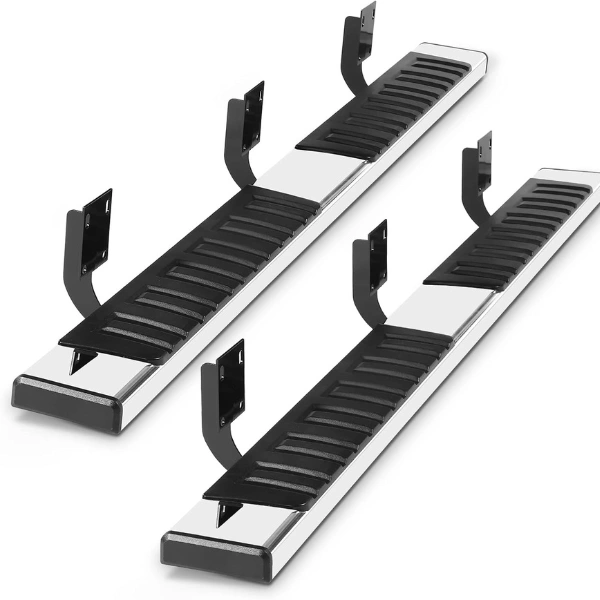
Running boards: side step rails mounted along vehicle side below doors for cab access. CRITICAL for heavy-duty trucks because cab floor entry height is 28-32 inches above ground (significantly higher than sedan/standard SUV). Functions: entry assistance for driver/passengers, door sill protection from mud/debris, styling element, platform for roof access, improved safety especially children/elderly, rocker panel protection from rocks/debris. Steel or aluminum construction. Fixed or power-retracting types (power motor component Batch 56 vaz516). Aftermarket brands include AMP Research (premium power), N-Fab, Westin, Lund, Carr.
F-350 Super Duty Heritage
- Production: 1999-current (25+ years, 5 generations)
- Position: 1-ton heavy duty (above F-250, below F-450)
- 3rd Gen Milestone: All-aluminum body 2011+
- Legendary Diesel: 7.3L Power Stroke 1999-2003
- Modern Gas: 7.3L Godzilla V8 2020+
- Dually Variant: F-350 DRW for maximum capability
Vehicle Compatibility
F-350 Coverage:
| Detail | Description |
|---|
| Ford F-350 Super Duty 1999-2007 (1st Gen) | Original Super Duty era |
| Ford F-350 Super Duty 2008-2010 (2nd Gen) | 6.4L Power Stroke era |
| Ford F-350 Super Duty 2011-2016 (3rd Gen) | All-aluminum body milestone |
| Ford F-350 Super Duty 2017-2022 (4th Gen) | Updated, 7.3L Godzilla introduced 2020+ |
| Ford F-350 Super Duty 2023-Current (5th Gen) | All-new major redesign |
| Cab Styles: | |
| Regular Cab (2-Door) | Commercial/work configuration |
| SuperCab (4-Door Extended) | Most common family/crew |
| Crew Cab (4-Door Full) | Premium family use |
| Bed Lengths: | |
| 6.75 ft Short Bed | Crew Cab and SuperCab |
| 8 ft Long Bed | All cabs |
| Drivetrains: | |
| 4x2 RWD | Same running boards |
| 4x4 4WD | Same running boards |
| Dually (DRW) Variants | F-350 DRW maximum capability |
| Sister Vehicles: | |
| Ford F-250 Super Duty (3/4-Ton) | Many running boards interchange |
| Ford F-450 Super Duty (Medium-Duty Heavy) | Some applications |
| NOT Compatible: Ford F-150 (Light-Duty) | Different platform |
| NOT Compatible: Different Generations Without Verification | Mounting differences |
Fitment Assistance
Call (240) 301-0095. Critical questions: (1) Year (1999-current). (2) Generation (1st-5th gen, different mounting). (3) Cab style (Regular, SuperCab, Crew Cab - different lengths). (4) Type (fixed or power-retracting). (5) Style preference (chrome, black, body-color, with/without LED). (6) Trim level (some trims have specific running board styles).
Condition and Inspection
- Structural integrity verified No bends or major damage
- Mounting brackets intact Critical for installation
- Step pad surface condition Non-slip surface present
- No rust holes in salt-belt areas
- Welds sound
- All mounting hardware present or replaceable
- Power motor functional if power-retracting Batch 56 vaz516
- LED lighting tested if equipped
- Year/generation/cab style verified
- Donor vehicle disclosed
- Cleaned of mud/debris
Why Buy from Us
- For Ford F-350 Super Duty running boards
- 25+ year production coverage
- 5 generations expertise
- Heavy-duty truck specialty
- Super Duty 1999 launch context
- F-350 1-ton positioning knowledge
- Aluminum body 3rd gen milestone context
- Power Stroke diesel heritage (7.3L legendary, 6.0L problematic, 6.7L Scorpion modern)
- Triton V8/V10 gas heritage
- Godzilla 7.3L modern gas V8 knowledge
- TorqShift transmission generations
- ZF manual early diesel context
- Cab style variations (Regular/SuperCab/Crew Cab)
- Bed length options (6.75 ft and 8 ft)
- Dually (DRW) variant expertise
- Trim level differentiation (XL/XLT/Lariat/King Ranch/Platinum/Limited/Tremor)
- Running board types (fixed vs power-retracting)
- Power motor component Batch 56 vaz516 reference
- Aftermarket brand knowledge (AMP Research, N-Fab, Westin)
- Structural integrity verification
- Mounting bracket inspection
- Donor vehicle disclosed
- Excellent salvage donor pool
- Free shipping all 50 states
- 15 day warranty
- No core charge
What's the difference between F-150, F-250, F-350, F-450?
Ford's F-Series PICKUP TRUCK LINEUP spans light-duty to medium-duty heavy: (1) F-150 - LIGHT-DUTY pickup (1/2-ton), Ford's BEST-SELLING vehicle for decades, 14th gen current 2021+, payload ~1,500-3,500 lbs, towing ~7,000-14,000 lbs, separate F-Series Light-Duty line, gas engines (3.3L V6, 2.7L EcoBoost V6, 3.5L EcoBoost V6, 5.0L Coyote V8, hybrid), aluminum body 2015+, family/commuter/light commercial use. (2) F-250 SUPER DUTY - 3/4-TON HEAVY-DUTY pickup, Super Duty line starts 1999+, payload ~3,500-4,500 lbs, towing ~15,000-22,000 lbs gooseneck/5th wheel, mid-tier heavy duty. (3) F-350 SUPER DUTY (this listing) - 1-TON HEAVY-DUTY pickup, payload ~4,500-7,800 lbs (depending on configuration), towing ~21,000-37,000+ lbs gooseneck/5th wheel, DUALLY (DRW) variant available for maximum capability, heavy commercial/recreational towing. (4) F-450 SUPER DUTY - MEDIUM-DUTY heavy (between Super Duty and F-550+ Class), payload ~6,000-8,500 lbs, towing ~24,000-40,000+ lbs, COMMERCIAL/HEAVY APPLICATIONS like contractors, heavy 5th wheels, commercial fleet. (5) F-550 and higher - COMMERCIAL CHASSIS CAB (medium-duty truck classification, often used for tow trucks, dump trucks, commercial flatbeds). (6) SUPER DUTY DISTINCTION - F-250/F-350/F-450 share Super Duty platform and are separate from F-150. Super Duty trucks have: (a) Heavier-duty frame, suspension, brakes. (b) Larger engines (heavy-duty gas V8/V10 plus diesel V8 options). (c) Higher towing/payload capabilities. (d) Commercial-oriented features. (e) Higher cab/entry heights requiring running boards. (7) RUNNING BOARDS FOR F-350 - this listing's product. F-250 running boards typically interchange with F-350 (similar cab heights and rocker panel mounting). F-450 may use similar but verify (different chassis cab applications). F-150 running boards are different (lighter duty, different mounting). (8) USED MARKET - F-350 popular among: heavy haulers, RV owners, contractors, ranch/farm users, commercial fleets. F-350 dually especially valuable for 5th wheel/gooseneck pulling. (9) MODERN F-350 - 5th gen 2023+ has: pro trailer backup assist, onboard generator option, 10-speed TorqShift automatic, 6.7L Power Stroke or 7.3L Godzilla V8, maximum technology integration.
What was the 7.3L Power Stroke diesel?
The Ford 7.3L POWER STROKE DIESEL V8 (1999-2003 Super Duty era) is LEGENDARY in diesel pickup truck history: (1) BACKGROUND - 7.3L Power Stroke (444 cubic inches) was actually INTERNATIONAL T444E ENGINE built by INTERNATIONAL/NAVISTAR for Ford under contract. Earlier 7.3L IDI (Indirect Injection) used in F-Series 1988-1994 was different engine. The 'Power Stroke' name applied to direct-injection turbo version 1994.5+ in older F-Series and continued into Super Duty 1999-2003. (2) SPECIFICATIONS: 7.3L (444 CI) V8 direct-injection turbodiesel, ~250 HP (lower than modern but adequate), ~505 lb-ft torque (significant for era), cast-iron block and heads, hydraulic-electric unit injection (HEUI), single turbocharger, conservative ratings allowed massive aftermarket potential. (3) WHY LEGENDARY - the 7.3L Power Stroke has CULT FOLLOWING because: (a) LEGENDARY RELIABILITY - many engines run 500,000+ miles with proper maintenance. (b) MASSIVE TOWING CAPABILITY relative to power output. (c) EASE OF SERVICE - simpler than modern emissions-laden diesels. (d) NO DPF (Diesel Particulate Filter) - no regen cycles or DEF (Diesel Exhaust Fluid). (e) NO EGR ISSUES - much simpler emissions. (f) AFTERMARKET TUNING POTENTIAL - cold air intake, exhaust, tuner box can yield 350-400 HP easily. (g) MANUAL TRANSMISSION OPTION - ZF 6-speed manual available. (h) IRON BLOCK CONSTRUCTION durability. (4) PROBLEMS (Minor Compared to Successors): (a) Camshaft Position Sensor (CPS) failures. (b) Injector Pressure Regulator (IPR) valve issues. (c) Glow plug relays. (d) Fuel system issues with bad fuel. (e) Generally easy fixes. (5) DISCONTINUATION 2003 - Ford ended 7.3L production for: (a) Emissions regulations forcing newer designs. (b) Power output couldn't keep up with competitors' newer diesels. (c) Replaced by 6.0L Power Stroke 2003-2007. (6) 6.0L SUCCESSOR PROBLEMS - the 6.0L Power Stroke 2003-2007 was VERY PROBLEMATIC with: EGR cooler failures (constant), head gasket failures, oil cooler problems, FICM (fuel injection control module) failures. Class-action lawsuit settled with Ford. Many 6.0L owners installed 'bulletproofing' upgrades to address these issues. (7) USED MARKET - 7.3L Power Stroke F-Series and Super Duty trucks (1994.5-2003) command PREMIUM PRICES in used market because: limited production years (about 9 years total including F-Series), legendary reliability, no modern emissions, growing collector/enthusiast appeal, simplicity for owner service. (8) IDENTIFICATION - 7.3L has: 7.3L badging on engine cover, no DEF tank, no urea injection, basic emissions system, single turbocharger visible. (9) FOR RUNNING BOARDS specifically - engine doesn't affect running board compatibility. 7.3L Power Stroke Super Duty trucks 1999-2003 use same running board mounting as other Super Duty trucks of era.
What was the 3rd gen aluminum body milestone?
Ford's 3rd GEN SUPER DUTY 2011-2016 introduced ALL-ALUMINUM BODY construction MAJOR INDUSTRY MILESTONE: (1) ALUMINUM BODY HERITAGE - Ford's bold strategy to use aluminum for full-size truck bodies: (a) F-150 launched aluminum body 2015 (13th gen). (b) F-Series Super Duty followed with 2011-2016 generation. (c) Ford was FIRST major manufacturer to do this on volume pickup trucks. (2) WHY ALUMINUM: (a) WEIGHT REDUCTION - aluminum approximately 50% lighter than steel. (b) FUEL ECONOMY IMPROVEMENT - weight reduction helps mpg. (c) PAYLOAD CAPACITY INCREASE - lower curb weight allows more payload. (d) CORROSION RESISTANCE - aluminum doesn't rust like steel. (e) RECYCLABILITY - aluminum highly recyclable. (3) CHALLENGES - aluminum brought challenges: (a) HIGHER MATERIAL COST than steel. (b) NEW MANUFACTURING TECHNIQUES needed (rivets and adhesive bonding instead of welding). (c) BODY SHOP REPAIR COMPLEXITY - aluminum needs different repair techniques, special equipment, certified technicians. (d) INSURANCE PREMIUMS sometimes higher due to repair complexity. (e) CUSTOMER ACCEPTANCE - some traditional truck buyers skeptical. (4) MARKET RECEPTION - mixed initially but ultimately accepted: (a) Performance benefits validated. (b) Reliability proved over time. (c) Resale value held up. (d) Other manufacturers eventually followed (Chevy/GMC kept steel but added aluminum panels). (5) 3RD GEN SUPER DUTY SPECIFIC - 2011-2016 had: aluminum cab body panels, aluminum hood, aluminum doors, aluminum bedside panels, STEEL FRAME (always steel frame on Super Duty for strength), STEEL BED FLOOR most models. (6) WEIGHT SAVINGS - typically 700+ lbs lighter than steel equivalent body. (7) FUEL ECONOMY - 3rd gen Super Duty achieved better mpg than 2nd gen despite similar engines. (8) PAYLOAD INCREASE - higher payload ratings possible due to lower curb weight. (9) CONTINUING ALUMINUM ERA - all Ford F-Series 2015+ uses aluminum bodies. 4th gen Super Duty 2017+ continued aluminum body construction. (10) FOR RUNNING BOARDS specifically - aluminum body doesn't change running board mounting points significantly. Running boards still bolt to frame/rocker panel structure. However: aluminum rocker panels require attention to galvanic corrosion if steel bolts/brackets used (use aluminum or stainless fasteners). Steel running boards may show wear/marks on aluminum body if installation contact points aren't protected.
How is the F-350 dually different?
The F-350 DUALLY (DRW = Dual Rear Wheel) is MAXIMUM-CAPABILITY F-350 variant: (1) DRW DESIGNATION - Dual Rear Wheel configuration with TWO TIRES on each side of rear axle (4 total rear tires + 2 front = 6 wheels visible). Vs SRW (Single Rear Wheel) standard configuration with 2 rear tires + 2 front = 4 wheels. (2) DESIGN: (a) WIDER REAR FENDERS - the famous 'dually' bulging rear fenders to accommodate dual tires. (b) WIDER REAR AXLE for tire spacing. (c) DIFFERENT REAR SUSPENSION often. (d) DIFFERENT BED widths some configurations. (e) HEAVIER FRAME RATINGS. (3) WHY DUALLY: (a) MAXIMUM PAYLOAD - F-350 DRW reaches 7,800+ lbs payload (vs ~5,500 SRW). (b) MAXIMUM TOWING - F-350 DRW reaches 35,000-37,000+ lbs gooseneck/5th wheel (vs ~21,000 SRW). (c) HEAVY 5TH WHEEL/GOOSENECK STABILITY - dual rear tires provide better trailer stability. (d) HEAVY CAMPER SUPPORT - large slide-in campers benefit from dually capacity. (e) COMMERCIAL APPLICATIONS - towing heavy equipment, construction trailers. (f) RV PULLING - large 5th wheels (40+ foot) often require dually capability. (4) APPLICATIONS: (a) Construction/landscaping companies. (b) Horse trailer hauling. (c) Large 5th wheel RV pulling. (d) Commercial flatbed/cargo. (e) Heavy equipment transport. (f) Cattle/livestock hauling. (5) DRAWBACKS: (a) WIDER VEHICLE - harder to park in standard spaces. (b) ROUGHER RIDE - empty truck rides poorly due to high spring rates. (c) FUEL ECONOMY WORSE than SRW. (d) HIGHER OPERATING COST - 6 tires to maintain. (e) HIGHER PURCHASE PRICE. (f) Some daily driving inconvenience. (6) RUNNING BOARDS ON DUALLY - Dually F-350s use same running board mounting points as SRW F-350s. Running boards are same length and design. However: (a) Some buyers add 'rocker guards' or step bars in addition. (b) Larger fenders don't affect running board mounting. (c) Same cab heights regardless of dually status. (7) F-350 SRW vs DRW PRICING - DRW typically $2,500-5,000 premium over SRW depending on year/trim. (8) USED MARKET - F-350 Dually trucks particularly valuable for: maximum towing buyers, large RV haulers, commercial users. Limited supply maintains values. (9) FOR RUNNING BOARDS specifically - same running boards work on SRW and DRW F-350. No 'dually-specific' running boards needed.
How do fixed vs power-retracting running boards differ?
Ford F-350 Super Duty running boards come in TWO MAIN TYPES with different characteristics: (1) FIXED RUNNING BOARDS: (a) PERMANENT POSITION extending from below doors. (b) ALWAYS VISIBLE both driving and parked. (c) NO MOVING PARTS - simpler construction. (d) LOWER COST - typically $200-500 aftermarket or OEM. (e) EASIER INSTALLATION - bolt on, done. (f) LOWER MAINTENANCE - no motors to fail. (g) GROUND CLEARANCE REDUCED slightly when off-road or curb parking. (h) AERODYNAMIC IMPACT minor (sticks out into airflow). (i) APPEARANCE consistent - always there. (j) ROCKER PANEL PROTECTION continuous. (2) POWER-RETRACTING RUNNING BOARDS (AMP Research and similar): (a) DEPLOY WHEN DOOR OPENS - automatic motor lowers step into position. (b) RETRACT WHEN DOOR CLOSES - motor raises step out of view. (c) HIDDEN WHEN DRIVING - clean truck appearance. (d) PREMIUM PRICING - $1,200-2,500 aftermarket. (e) MORE COMPLEX INSTALLATION - power wiring required. (f) MOTOR CAN FAIL - additional failure point (Batch 56 vaz516 documents power motor component). (g) BETTER GROUND CLEARANCE when retracted (off-road advantage). (h) BETTER AERODYNAMICS than fixed boards. (i) PREMIUM APPEARANCE - shows when needed, hidden otherwise. (j) MORE EXPENSIVE TO REPAIR if motor fails. (3) WHICH TO CHOOSE - depends on use: (a) WORK/COMMERCIAL use: fixed boards preferred (simplicity, lower cost, no power failures). (b) PREMIUM/PERSONAL use: power-retracting often preferred (appearance, ground clearance). (c) OFF-ROAD use: power-retracting better (ground clearance advantage). (d) DAILY DRIVING: either works, personal preference. (e) HEAVY SNOW/SALT: fixed boards may be more reliable (no moving parts to freeze/corrode). (4) AMP RESEARCH BRAND - the leading power-retracting brand. POWERSTEP brand the most common name. Reliable but motors can fail after years of use (Batch 56 vaz516 motor replacement). (5) OEM POWER BOARDS - Ford offered power-retracting boards as factory option on premium trim levels (Lariat, King Ranch, Platinum, Limited). Customer can identify if originally equipped by: dealer documentation, looking for motor under truck, control modules in vehicle. (6) USED MARKET - both types found in used Super Duty market. Fixed boards more common in fleet/work trucks. Power-retracting more common in premium trim levels. (7) REPLACEMENT - fixed boards relatively cheap to replace. Power-retracting more expensive due to motor/wiring complexity.
How is the Triton 5.4L V8 different from Godzilla 7.3L V8?
Ford's heavy-duty gas V8 engines for F-350 changed significantly over Super Duty production: (1) 5.4L TRITON V8 (1999-2010 Super Duty): (a) Modular Engine family (Ford 'Modular' V8 architecture started 4.6L 1991+). (b) SOHC 16-valve design (single overhead cam per bank, 2 valves per cylinder). (c) ~310-360 HP depending on year and configuration. (d) ~365-400 lb-ft torque. (e) ALUMINUM HEADS on iron block. (f) Famous SPARK PLUG BLOWOUT issues on earlier production years (thread issues in aluminum heads). (g) Generally reliable for moderate use but stressed under heavy towing. (h) PHASED OUT for Super Duty 2011 when 6.2L Boss V8 introduced. (2) 6.2L BOSS V8 (2011-2022 Super Duty): (a) Newer Ford heavy-duty gas V8. (b) SOHC 16-valve design. (c) ~385 HP and ~430 lb-ft torque (modest power increase over 5.4L). (d) Iron block with aluminum heads. (e) More reliable than 5.4L. (f) Adequate for moderate-duty work. (g) Replaced by 7.3L Godzilla 2020+ for heaviest applications, continued some years parallel. (3) 7.3L GODZILLA V8 (2020-Current Super Duty): (a) NEW PUSHROD OHV design (return to overhead valve from overhead cam). (b) Approximately 430 HP and 475 lb-ft torque. (c) IRON BLOCK and IRON HEADS for durability. (d) Heavy-duty specifically engineered. (e) Why pushrod design returned: simpler, more compact, easier to package, robust for heavy use. (f) Successor to BOTH 5.4L/6.2L Triton/Boss AND 6.8L Triton V10. (g) Designed for: commercial fleet, heavy towing, chassis cab applications, motorhome chassis. (h) Marketed as 'big truck' engine in modern era. (4) KEY DIFFERENCES: (a) Displacement: 5.4L < 6.2L < 7.3L (more displacement, more power). (b) Architecture: 5.4L/6.2L = SOHC overhead cam vs 7.3L = OHV pushrod. (c) Materials: 5.4L = aluminum heads on iron block, 7.3L = iron block and iron heads. (d) Reliability: 7.3L most robust for heavy use. (e) Modern: 7.3L most modern emissions/electronics. (5) FOR RUNNING BOARDS specifically - engine doesn't affect running board compatibility. Same running boards work across 5.4L Triton, 6.2L Boss, 7.3L Godzilla F-350s. (6) USED MARKET - 5.4L Triton trucks (1999-2010) most affordable used Super Duty options. 6.2L Boss trucks (2011-2019) mid-range. 7.3L Godzilla trucks (2020+) newest premium used.
How do I install running boards?
Ford F-350 Super Duty running board installation is MODERATE DIY task: (1) PREP: (a) Park on level surface, set parking brake. (b) Gather tools: socket wrench, torque wrench, jack stands optional but helpful. (c) Read manufacturer instructions specific to brand/model. (d) Verify all hardware and brackets included. (2) RAISE VEHICLE if needed for access (most can install with truck on ground if you can fit underneath). (3) LOCATE MOUNTING POINTS - Super Duty has factory mounting points along rocker panel: (a) Typically 4-6 mounting points per side. (b) Pre-drilled and threaded from factory. (c) May have plastic plugs covering unused mounting holes. (d) Remove plugs to expose threaded holes. (4) ATTACH BRACKETS TO RUNNING BOARD: (a) Verify bracket orientation per instructions. (b) Use factory hardware or premium aftermarket hardware. (c) Hand-tighten initially - don't fully torque yet. (5) POSITION RUNNING BOARD: (a) Hold or have helper hold board in place against rocker panel. (b) Align bracket holes with rocker panel mounting points. (c) Get all brackets aligned before final tightening. (6) INSTALL MOUNTING BOLTS: (a) Thread bolts through brackets into rocker panel mounts. (b) Hand-tighten all bolts to ensure alignment. (c) Once all aligned, torque to manufacturer specifications (typically 30-50 ft-lbs). (7) CHECK ALIGNMENT: (a) Running board should be level along its length. (b) Same height on both sides of vehicle. (c) Step pad facing upward/outward properly. (d) No interference with doors when opening/closing. (8) FOR POWER-RETRACTING RUNNING BOARDS: (a) Additional wiring needed to vehicle harness. (b) Power motor mounted under board. (c) Control module installation. (d) Connection to door sensors. (e) Programming/testing required. (f) Usually 3-5 hours installation. (9) TEST: (a) Step on board (carefully) - should be solid, no flex or movement. (b) Should hold weight without bracket flexing. (c) Door clearance adequate when opening. (d) For power boards: test deployment with door open/close cycles. (10) MAINTENANCE: (a) Periodically check bolts for tightness. (b) Clean step pads regularly. (c) Apply protective coatings to steel boards. (d) Lubricate power motor hinges/joints annually. 1-2 hours fixed boards, 3-5 hours power-retracting. PROFESSIONAL INSTALLATION recommended for power-retracting due to wiring complexity.
How does shipping work?
Free shipping to all 50 US states. Ford F-350 Super Duty running boards are LARGE/HEAVY components (25-50 lbs per side, typically ~6 feet long) shipped via freight or large package carrier (5-10 days transit). Pair (driver and passenger sides) shipped together when matching set sourced. Excellent salvage donor pool from 25+ years Super Duty production. Power-retracting boards (with motor Batch 56 vaz516 reference) may take slightly longer to source. Premium chrome/LED variants may take longer for specific configurations. Some aftermarket brands (AMP Research, N-Fab) available new if used OE not preferred.