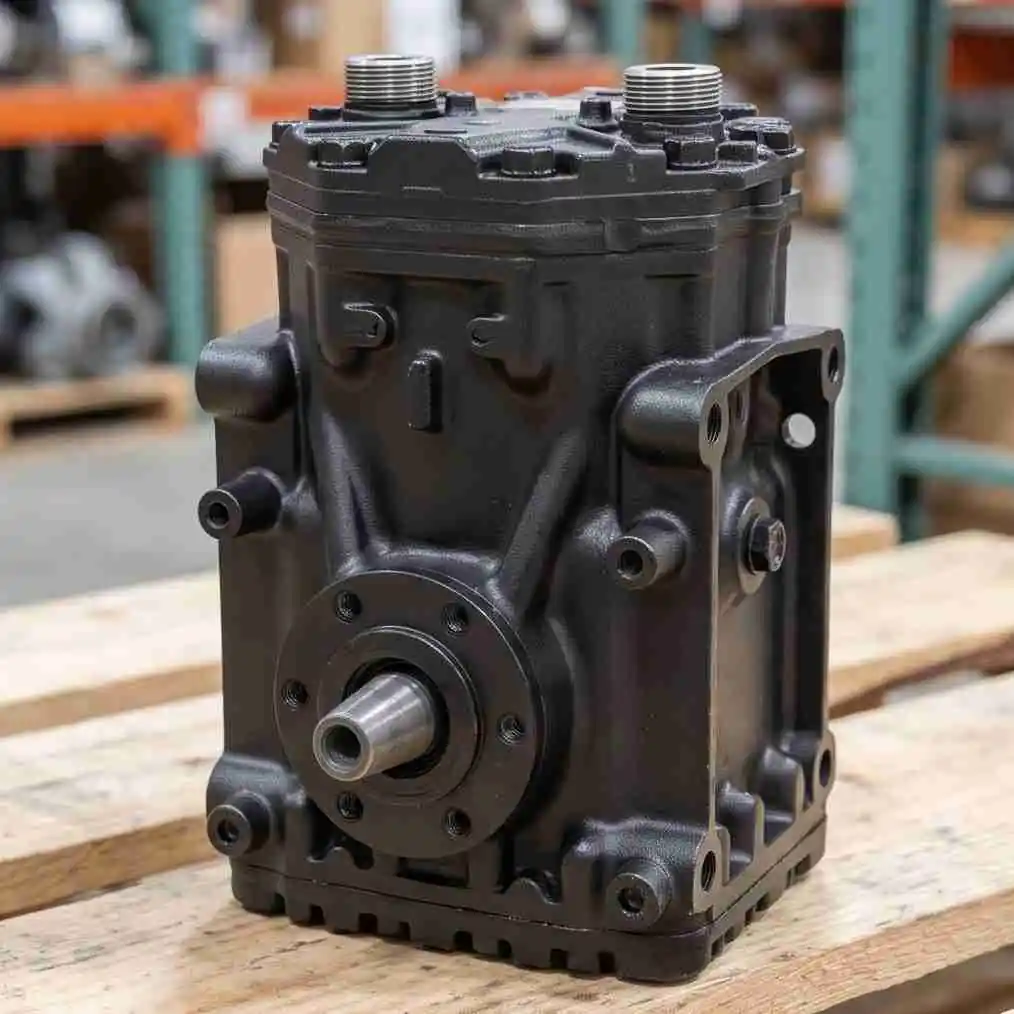
The Audi 4000 Quattro A/C compressor for sale here is one of the crucial components that maintains comfort in the classic German all-wheel drive sedan. This integral part of the vehicle's air conditioning system helps keep the cabin at optimal temperatures during warm weather driving. Designed to factory specifications for the 4000 Quattro application, this compressor fits and performs as the original equipment did. The compressor not only helps the car offer comfortable cabin temperatures but also helps maintain the iconic 4000 Quattro driving experience that classic Audi enthusiasts seek.
A fully functional A/C system enhances the driving experience significantly, allowing enthusiasts to enjoy their classic Audis comfortably regardless of outside temperature. This Audi 4000 Quattro A/C compressor for sale is essential for any 4000 Quattro owner committed to keeping their vehicle in top condition.
Compressor Overview: Audi 4000 Quattro A/C Compressor
The Audi 4000 Quattro A/C compressor is the pivotal component of the cooling system. It pressurizes and circulates refrigerant throughout the A/C system, allowing proper heat transfer to occur. This compressor is built to complement the all-wheel-drive heritage developed by Audi, providing reliable cooling in various driving conditions.
The compressor for sale here is designed for smooth operation to maintain the quiet cabin environment Audi owners expect. The compact design fits harmoniously in the engine bay, matching Audi's space-efficient engineering. Proper periodic maintenance of this part dramatically extends the life expectancy of the entire A/C system and keeps comfort features functioning for years.
While replacement requires some effort by a DIY person, this component brings new life to a classic Audi's climate control system.
About the Audi 4000 and Audi 4000 Quattro
The Audi 4000 was the US market name for the B2 generation Audi 80, sold in the United States from 1980 to 1987:
Audi 4000 Production Years (US Market)
1980-1987: Audi 4000 (B2 chassis)
1980-1983: Front-wheel drive only
1984-1987: Quattro all-wheel drive variant introduced
About Audi Quattro
The Quattro all-wheel drive system was pioneered in the 1980 Audi Quattro coupe (also known as the Ur-Quattro), revolutionizing motorsports and rally racing. The technology was brought to the more practical 4000 sedan platform starting in 1984, making the 4000 Quattro one of the most accessible AWD performance sedans of its era.
Successor Models
The Audi 4000 was replaced by:
Audi 80 (B3 chassis): 1986-1991 in some markets, US market 1988-1991
Audi 90 (B3 chassis): The premium variant with inline-5 engine
Audi 80 (B4 chassis): 1992-1995
Audi A4 (B5 chassis): 1996+ , the modern successor (see our separate Audi A4 A/C parts listings)
About the A/C Compressor
The A/C compressor is the heart of the automotive air conditioning system. Its function:
How an A/C Compressor Works
1. Intake (low-pressure side): Pulls low-pressure, low-temperature refrigerant vapor from the evaporator
2. Compression: Compresses the refrigerant, raising both temperature and pressure
3. Discharge (high-pressure side): Sends high-pressure, high-temperature refrigerant vapor to the condenser
4. Variable displacement: Adjusts cooling output based on cabin temperature demand
Belt-Driven Operation
Drive belt: Connected to engine crankshaft pulley via serpentine or v-belt
Clutch engagement: Magnetic clutch engages compressor only when A/C is needed
Power requirement: 3 to 7 horsepower depending on system load
Variable Displacement Benefits
Better efficiency: Output matches demand, not constant maximum
Smoother engine load: Less cycling on/off
Improved fuel economy: Less parasitic load
Longer compressor life: Less stress from frequent clutch engagement
Critical Disclosure: Refrigerant Type (R-12 vs R-134a)
The Audi 4000 Quattro was originally factory equipped with R-12 refrigerant. This is critical information for any buyer:
About R-12 Refrigerant
Original factory refrigerant: Used in all 1984-1987 Audi 4000 Quattro vehicles
Chemical name: Dichlorodifluoromethane (CFC-12)
EPA banned 1995: Production banned due to ozone depletion potential
Still legal to use: From existing stockpiles, but extremely expensive
Requires EPA Section 609 certification: To purchase or service R-12
About R-134a Retrofit
Most surviving Audi 4000 Quattro vehicles in the US have been converted to R-134a:
R-134a Retrofit Process
1. Recover existing R-12 (must be done by EPA-certified technician)
2. Replace receiver drier (R-12 drier desiccant incompatible with R-134a)
3. Replace o-rings throughout system with R-134a compatible material
4. Change oil from mineral oil (R-12) to PAG oil (R-134a)
5. Install R-134a retrofit service fittings (different than R-12 fittings)
6. Evacuate system under vacuum to remove moisture
7. Recharge with R-134a (approximately 75-85% of R-12 charge weight)
8. Verify operation and check for leaks
Cost of Retrofit
Professional R-12 to R-134a retrofit: $500-1,500 typical depending on shop and additional repairs needed
Why This Compressor Works for Both
The compressor itself is compatible with both refrigerants when used with the proper:
Oil type: Mineral oil for R-12 systems, PAG oil for R-134a systems
Receiver drier: Type appropriate to refrigerant
O-rings: Material compatible with refrigerant
Important Warning
Never mix R-12 and R-134a in the same system
Never mix mineral oil and PAG oil
Always recover existing refrigerant before opening system (federal law)
Always replace receiver drier when converting
EPA Section 609 Compliance (Federal Law)
The US EPA Section 609 of the Clean Air Act requires:
Federal Legal Requirements
EPA Section 609 certification for any technician servicing motor vehicle A/C
Refrigerant recovery equipment must be EPA-certified
Refrigerant recovery, recycling, and recharging must be performed by certified personnel
Penalties for non-compliance: Up to $25,000 per day per violation
Practical Impact
DIY recharge kits: Available at auto parts stores for vehicles already using R-134a (limited service only)
Major service: Must be performed by EPA-certified shop
Compressor replacement: Should always be done by certified shop due to need for vacuum evacuation and recharge
Our Recommendation
Vaz Auto Solutions strongly recommends professional installation by an EPA Section 609 certified shop for Audi 4000 Quattro A/C compressor replacement. The shop will:
Recover existing refrigerant
Replace receiver drier
Replace expansion valve if needed
Replace o-rings as needed
Install new compressor with proper PAG oil charge
Evacuate system under vacuum
Recharge with proper refrigerant charge
Verify cooling performance
Key Features of the Audi 4000 Quattro A/C Compressor
Our Audi 4000 Quattro A/C compressor for sale comes with the following features:
Variable Displacement Control: Alters cooling output based on demand for improved efficiency
Electrically Controlled Clutch: Engages and disengages based on demand from the A/C control system
Cooling Efficiency: 12,000 to 18,000 BTU per hour output capability
Noise Reduction: Pulsation dampener included to reduce operational noise and vibration
Mounting Configuration: Designed to mount in specific Audi 4000 Quattro brackets with original alignment
Build Quality: Constructed from quality materials for long service life
Signs Your Audi 4000 Quattro A/C Compressor Needs Replacement
No cold air from vents: Compressor not engaging or not pressurizing
Loud noise from compressor: Internal bearing failure or clutch issues
Clutch not engaging: Electrical issue or worn clutch
Refrigerant leaks at compressor: Failed shaft seal or housing seal
Compressor seized: Will not rotate or rotates with grinding
Check engine light related to A/C: Some failure modes trigger codes
Oil leaks from compressor: Failed seals indicate need for replacement
Other A/C System Service to Consider (Whole-System Approach)
When replacing an A/C compressor, consider servicing these components:
Receiver Drier (Must Replace)
Always replace when opening system
Desiccant absorbs moisture from system
Once exposed to air, must be replaced
Cost: $30-80 typical
Expansion Valve
Strongly recommended to replace
Controls refrigerant flow into evaporator
Internal screen can clog
Cost: $40-120 typical
O-rings Throughout System
Replace all that are accessed
New o-rings ensure leak-free seal
Use R-134a compatible material if retrofitted
Cost: $20-60 for kit
Condenser
Inspect and replace if damaged
Front-mounted, susceptible to road debris damage
Internal contamination from failed compressor requires replacement
See our Audi 80 Series A/C Condenser listing for related Audi 80/90 condenser
Evaporator
Inspect for internal cleanliness
Mold/mildew accumulation common
Internal leaks require replacement
Hoses
Inspect for cracks, bulges, deterioration
40+ year old hoses likely deteriorated
Replace as needed
Refrigerant Recharge
Federal law requires certified technician
Proper amount per manufacturer spec
Verify cooling performance after charge
Why Choose Our Used Audi 4000 Quattro A/C Compressor?
Cost savings vs new aftermarket ($209 used vs $300-500 new)
Cost savings vs reman ($209 used vs $250-400 reman)
Direct fit for B2 chassis Audi 4000 Quattro 1984-1987
R-12 and R-134a compatible , works with original or retrofit systems
Clutch engagement tested at 12V
Electrical continuity verified
Variable displacement design , more efficient than fixed-displacement
Classic Audi specialist support , our team understands B2 chassis A/C systems
Here at Vaz Auto Solutions, you'll find this Audi 4000 Quattro A/C compressor for sale at fair pricing, with clutch engagement tested at 12V, electrical continuity verified, pulley bearing rotation assessed, manifold port condition documented, residual oil presence verified, visual inspection completed, refrigerant type history disclosed where determinable, and complete inspection.
Vehicle Compatibility
Direct Fit:
Vehicle
Compatibility
Audi 4000 (B2 chassis, FWD)
1980-1987 with factory A/C
Audi 4000 Quattro (B2 chassis, AWD)
1984-1987 (the all-wheel drive variant)
Audi 4000 5+5 (Coupe)
1981-1987 (the inline-5 powered coupe variant)
Audi Coupe GT (B2 chassis)
1981-1987 in some markets
Related (Different Chassis)
Audi 80 B3 (1986-1991) , see our separate Audi 80 listings; Audi 90 B3 (1988-1991) , see our separate Audi 90 listings
Condition and Inspection
Clutch engagement tested at 12V (verifies clutch coil operation)
Electrical continuity verified at compressor coil
Pulley bearing rotation smoothness assessed
Manifold port condition documented (suction and discharge ports)
Residual oil presence verified (confirms compressor was not run dry)
Visual inspection for external damage completed
Refrigerant type history disclosed where determinable (R-12 original vs R-134a retrofit donor)
Internal seal integrity pressure tested
Mounting bracket condition inspected
Electrical connector pin condition verified
Drive belt pulley condition assessed
Compressor housing condition inspected (no cracks, no damage)
Shaft seal area inspected for oil leakage indication
Variable displacement control mechanism function verified
Specifically for Audi 4000 Quattro B2 chassis 1984-1987
Clutch engagement tested at 12V on every unit
Electrical continuity verified
Pulley bearing rotation smoothness assessed
Residual oil presence verified (compressor was not run dry)
R-12 vs R-134a refrigerant type disclosure where determinable
Compatible with both R-12 original and R-134a retrofit systems
EPA Section 609 compliance information provided
Classic Audi specialist support team
Cross-reference assistance for B2 chassis 4000 vs B3 80/90 vs A4
Free shipping all 50 states
15 day replacement warranty on internal defects
No core charge, keep your old compressor
Part Type
A/C Compressor, belt-driven variable displacement
Vehicle Application
Audi 4000 Quattro B2 chassis 1984-1987 (US market)
Compressor Type
Belt-driven variable displacement
Clutch Type
Electrically driven clutch
Cooling Capacity
12,000 to 18,000 BTU/hr
Electrical Connector
2 or 3 pin connector
Oil Type
PAG oil (R-134a systems) or mineral oil (R-12 systems)
Suction Pressure
20 to 30 PSI
Discharge Pressure
150 to 250 PSI
Rotation Direction
Clockwise when viewed from front
Refrigerant Compatibility
R-12 (original) or R-134a (retrofit)
Epa Compliance
Section 609 certification required for installation
Price
$209.00
Ethan Clark
The Audi 4000 Quattro A/C compressor from Vaz Auto Solutions is top-notch. It's been running flawlessly in my Audi, providing excellent cooling performance even on scorching days. The compressor cycles smoothly and maintains a consistent temperature, which is just what you need for comfort during long drives.
Kevin Turner
Installed the Audi 4000 Quattro A/C compressor from Vaz Auto Solutions. It does its job effectively, providing adequate cooling for the car. The performance is solid, though it can be a bit noisier than some other compressors. It may not be the quietest choice out there, but it gets the job done and keeps things cool, which is what matters most.
Will this compressor work with R-134a refrigerant?
Yes, this used Audi 4000 Quattro A/C compressor is compatible with R-134a systems after proper retrofit conversion. The compressor itself works with either refrigerant when used with the appropriate oil type (mineral oil for R-12, PAG oil for R-134a). R-12 to R-134a Retrofit Process 1. Recover existing R-12 (EPA-certified technician required) 2. Replace receiver drier (R-12 desiccant incompatible with R-134a) 3. Replace o-rings with R-134a compatible material 4. Change oil from mineral oil to PAG oil 5. Install R-134a retrofit fittings (different threads than R-12) 6. Evacuate system under vacuum 7. Recharge with R-134a (typically 75-85% of R-12 charge weight) 8. Verify operation and check for leaks Professional retrofit typically costs $500-1,500.
Do I have to replace other A/C parts when installing this compressor?
Although it is not strictly required in all cases, we strongly suggest replacing the receiver drier and expansion valve for proper operation of the system. Specifically: Receiver drier: Must replace (mandatory). Desiccant absorbs moisture and becomes saturated; opening the system requires new drier Expansion valve: Strongly recommended. Internal screen can clog with contamination O-rings: Replace all that are accessed during compressor installation System flush: Recommended if previous compressor failed catastrophically (prevents "black death" contamination of new compressor) Skipping these steps significantly reduces new compressor lifespan.
Is replacement better than repairing the compressor?
If the failure is major, replacement is typically better than repair. With a remanufactured or used replacement compressor, you can be more certain of having proper performance. Compressor repair requires: Specialized rebuild equipment Internal seal kit (not always available for older designs) Bearing replacement Pressure testing Knowledge of specific compressor variant For a 40+ year old Audi 4000 Quattro compressor, the cost and expertise required for repair often exceeds replacement cost. Replacement also provides a reset on the wear clock.
Does a seized or poorly operating A/C compressor increase stress on the engine?
Yes, a seized or poorly operating A/C compressor can put additional load on the engine, which could cause reduced performance or stalling if severe. How a Failed Compressor Affects Engine Seized compressor: Cannot rotate, but is still belt-connected; can stall engine or break belt Clutch stuck engaged: Constant load even with A/C off Internal damage: Increased mechanical resistance, higher fuel consumption Symptoms Engine stalls when A/C is turned on Reduced acceleration with A/C on Belt squealing or smoking Check engine light If you suspect compressor seizure, disconnect the compressor clutch electrical connector to prevent engagement until repair.
How long do A/C compressors last?
With proper maintenance, most A/C compressors run 8 to 12 years. However, usage patterns, climate, and maintenance frequency vary the lifespan significantly: Factors Affecting Compressor Lifespan Usage frequency: Daily use vs occasional use Climate: Hot climates strain compressor more Maintenance: Regular system service extends life Refrigerant level: Low refrigerant causes oil starvation System contamination: Moisture and debris reduce life Belt tension: Improper belt tension stresses pulley bearing For a Classic Audi 4000 Quattro At 40+ years old, the original compressor is well beyond expected lifespan. Replacement is standard maintenance for classic Audi restoration.
What maintenance is recommended for Audi 4000 Quattro A/C compressors?
Routine maintenance includes: Refrigerant level check: Annual inspection of pressure Leak inspection: Visual inspection of o-rings, connections, hoses Drive belt condition: Inspect belt for cracking, glazing, proper tension Compressor oil: Verify proper oil level when system is serviced Periodic operation: Run A/C briefly even in winter to keep seals lubricated Cabin filter: If equipped, replace regularly for airflow EPA Section 609 Reminder Any refrigerant work must be performed by EPA Section 609 certified technicians (federal law).
What is EPA Section 609?
EPA Section 609 is a federal regulation under the Clean Air Act requiring: Technician certification: Anyone servicing motor vehicle A/C systems must be EPA Section 609 certified Equipment certification: Recovery, recycling, and recharging equipment must be EPA-certified Refrigerant tracking: Records of refrigerant purchases and uses Penalties for violations: Up to $25,000 per day per violation What This Means for Buyers DIY refrigerant work: Only possible for vehicles already on R-134a using limited DIY recharge kits Major service: Must be performed by EPA-certified shop Compressor replacement: Should be done by certified shop due to vacuum/recharge requirement Federal compliance: Protects both consumer and environment We strongly recommend EPA Section 609 certified installation for all A/C compressor work.
Will this compressor fit my Audi 80 or Audi 90?
No, this is specifically for the B2 chassis Audi 4000. The B3 chassis Audi 80 (1988+) and Audi 90 (1988+) use different compressor designs with different mounting and electrical connections. Related Audi Listings Audi 80 Series A/C Condenser: See our separate Audi 80 listings for B3/B4 chassis parts Audi 90 Series A/C Condenser Fan: See our separate Audi 90 listings Audi A4 A/C Parts: For modern A4 generations (B5/B6/B7/B8/B9, 1996+) Audi A8 A/C Parts: For Audi A8 flagship sedan (1994+) Match the compressor to your specific Audi chassis generation for proper fitment.
15 Day Replacement Warranty
Covered:
Defects discovered at delivery (compressor seized
Clutch not engaging at 12v test
Electrical continuity failure at delivery
Complete failure to compress refrigerant at installation by epa-certified shop
Severe external damage discovered upon receipt)
Not Covered:
Improper installation damage (must be installed by epa section 609 certified shop
Contamination from incompatible refrigerant or oil (r-12 oil with r-134a or vice versa)
Failure due to system contamination from failed condenser/evaporator/dirty system
Refrigerant quality damage
Freight damage. note: a/c compressor failures often result from system contamination
A "black death" condition where a failed prior compressor contaminates the entire system. we strongly recommend system flush and replacement of receiver drier
Expansion valve
And o-rings when installing a replacement compressor
Contact (240) 301-0095 within 15 days.
Specifically for Audi 4000 Quattro B2 1984-1987: Classic Audi specialist part
Clutch Engagement Tested at 12V: Verifies clutch coil operation
Electrical Continuity Verified: Connector pins and coil tested