
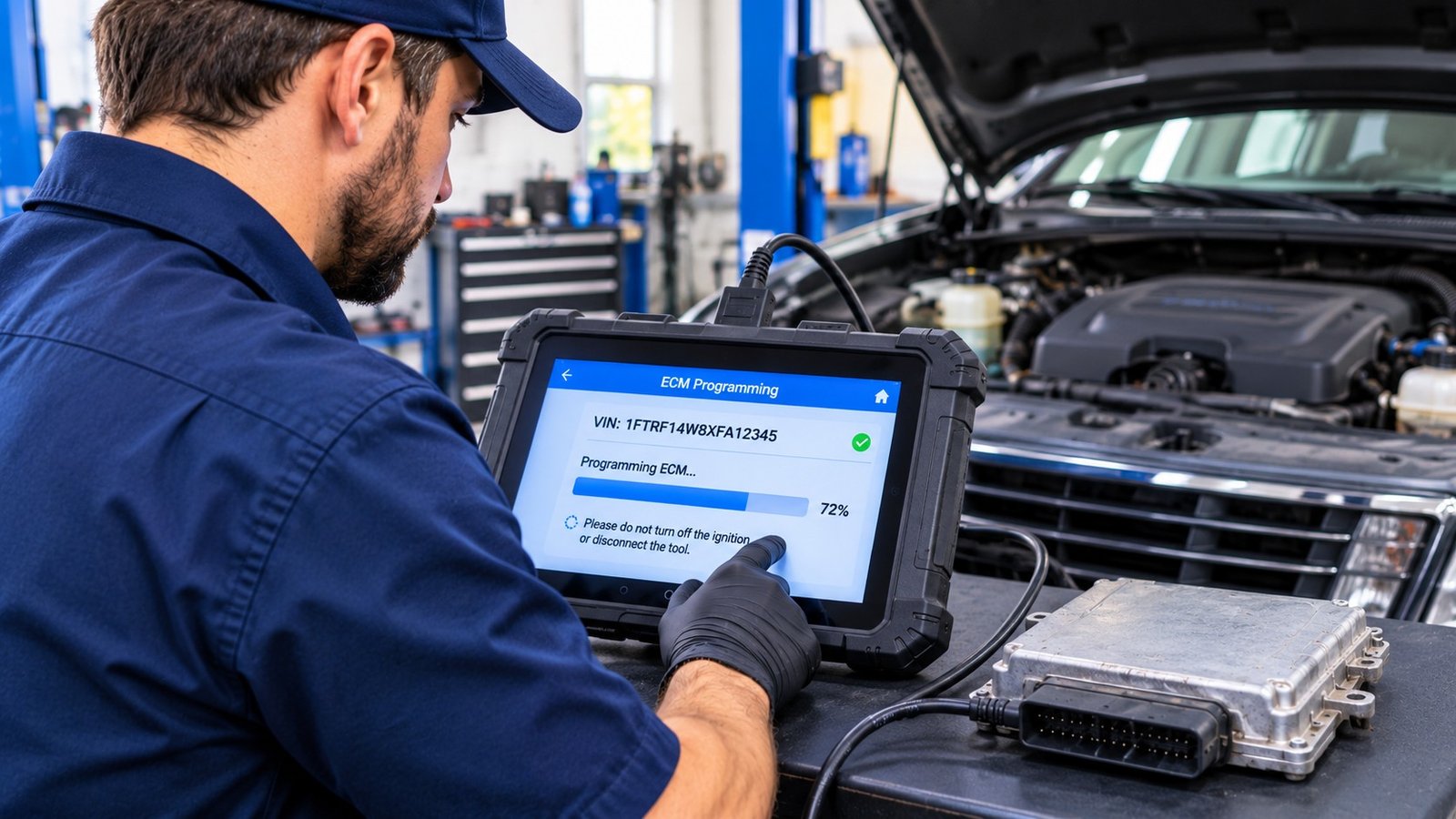
In most cases, yes. A used ECM pulled from another vehicle carries that vehicle's software and settings, so it usually has to be programmed, also called flashing, to your specific vehicle before it will run your engine correctly. On many vehicles it also has to be synced to the anti-theft immobilizer, or the engine will not start even with the correct module installed. There are exceptions, and some suppliers pre-program a module to your VIN before shipping, but you should never assume a used ECM is plug-and-play without confirming. This guide explains what programming actually is, when you can skip it, and how to avoid the no-start surprise that catches so many buyers.
What programming an ECM actually means
An engine control module runs software: the calibration that tells your engine how to run, tuned to your exact vehicle, engine, transmission, and emissions configuration. Programming, or flashing, is the process of loading the correct software and calibration onto the module so it matches your vehicle.
A used module comes with the donor vehicle's programming already on it. Even if the donor was the same year, make, and model, the calibration may differ, and the module is still tied to the donor's identity in ways that can prevent your vehicle from running correctly. Programming resolves this by writing your vehicle's correct data to the module. Think of it less like bolting in a part and more like setting up a computer to work with your specific machine.
When a used ECM needs programming
For the large majority of modern vehicles, a used ECM needs programming. This is the default assumption you should make unless a seller confirms otherwise for your specific vehicle. Programming is generally required when:
- The module stores calibration data specific to your VIN
- Your vehicle links the engine computer to the anti-theft system
- The donor module has different software or a different calibration version
- Your vehicle has had software updates the donor module does not carry
Because these conditions apply to most vehicles on the road today, treating programming as necessary, and being pleasantly surprised if it is not, is the safe way to budget and plan.
When a used ECM might be plug-and-play
Some used modules genuinely work without programming, but the circumstances are specific and worth confirming rather than assuming.
Older Vehicles Without Immobilizers
Some older vehicles use simpler modules that are not tied to an anti-theft system and can accept a matching used module more readily.
An Exact-Match Module From an Identical Vehicle
On certain vehicles, a module from an identical year, make, model, engine, and configuration may function, though immobilizer syncing can still be required.
A Module Already Programmed to Your VIN by the Supplier
This is the cleanest version of plug-and-play, where the work is done before the module ships.
The anti-theft immobilizer catch
This is the part that catches the most people. Many vehicles have an immobilizer, an anti-theft system that only lets the engine start when it recognizes the correct key. The engine computer is part of that system. When you install a replacement ECM, the module often has to be synced to your vehicle's immobilizer and keys.
If this sync is not done, the vehicle may crank but refuse to start, even with a correctly programmed module that is the right part for the vehicle. Buyers who did not know about this step often conclude the module is defective, when the real issue is that it was never synced to the immobilizer. This is a normal, expected step on many vehicles, not a sign of a bad part. It simply has to be planned for.
Who can program an ECM, and what it costs
Programming and immobilizer syncing require the right equipment and software access. Here are your options and roughly what to expect.
| Who | Typical Cost | Notes |
|---|---|---|
| Dealer | $100 to $300 | Always able to program and sync; often the priciest |
| Mobile programmer or locksmith | $75 to $250 | Comes to the vehicle; often handles immobilizer keys |
| Independent shop | $75 to $200 | If they have the tools and subscription |
| Supplier, pre-shipping | Included or small fee | Programmed to your VIN before it ships |
How to avoid the no-start surprise
The no-start after an ECM swap is almost always avoidable with a few questions up front. Before you buy a used module:
Ask the Seller Directly Whether It Needs Programming for Your Vehicle
A reputable seller will tell you plainly, based on your VIN.
Ask Whether Immobilizer or Key Syncing Is Required
This is the step most likely to cause a no-start if missed.
Ask Whether a Pre-Programmed Option Is Available
Providing your VIN at order can let some suppliers program the module before it ships.
Line Up Your Programmer Before the Part Arrives
Know who will program and sync it, so the vehicle is not sitting while you search.
Match by VIN, Not Just by Year and Model
The VIN captures the exact configuration that determines which module and calibration you need.
Handle these before the module arrives and the process is smooth. The buyers who run into trouble are almost always the ones who assumed a used module would simply plug in and start.
Skip the Programming Guesswork
Buying a used or remanufactured ECM and want to skip the guesswork? Call Vaz Auto Solutions at (240) 301-0095 with your VIN. We will identify the correct module for your vehicle, tell you plainly whether it needs programming and immobilizer syncing, let you know whether a pre-programmed option is available, quote a delivered price with 30% off US shipping, and email the warranty terms before you pay. Our goal is no surprises at installation.
