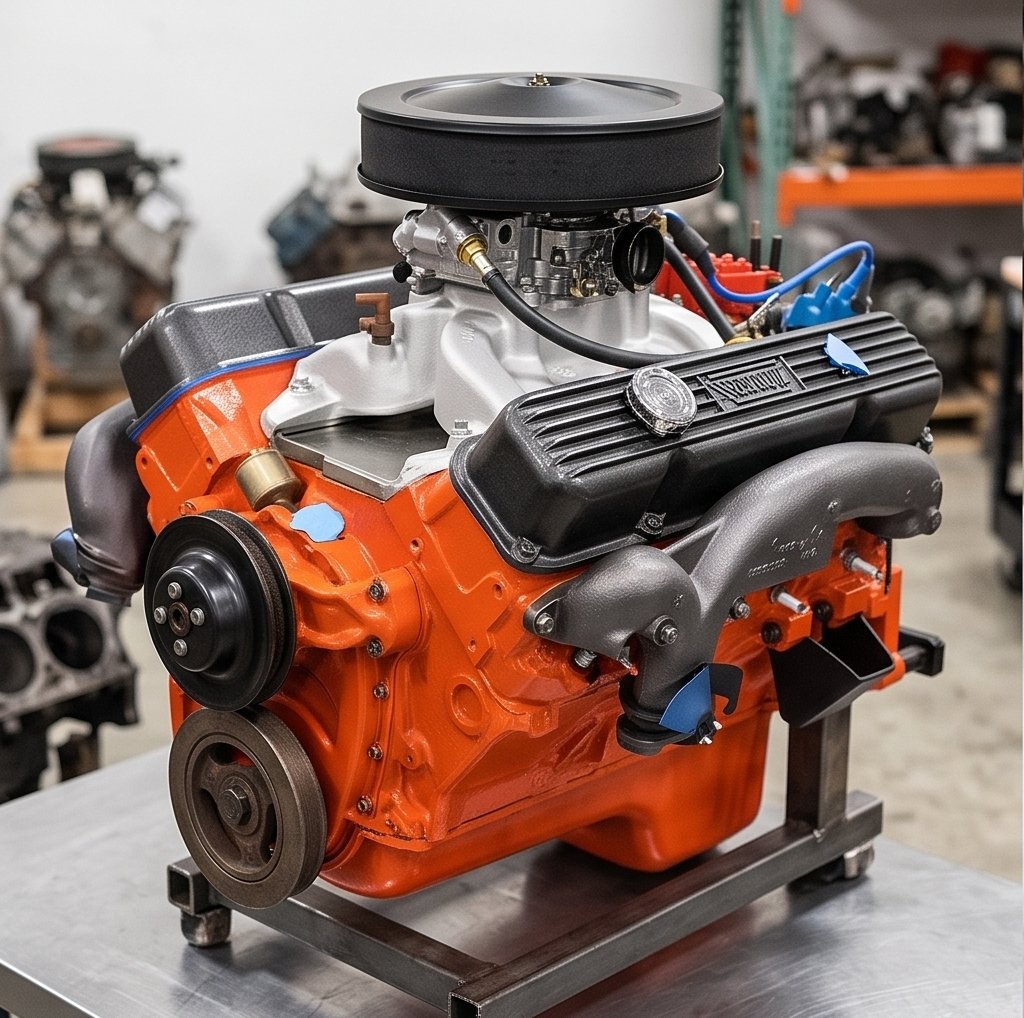
Dodge 440 Engine for Sale

RB Big Block V8 Magnum and Six Pack

Code: vaz266
  • Displacement: 440 cu in (7.2L)
  • Engine Family: Chrysler RB (Raised Block) Series
  • Configuration: V8, OHV, 16 valves
  • Horsepower: 350 to 390 hp (1966 to 1971) | declining to 275 hp by 1974
  • Condition: Used OEM, compression tested and inspected
  • In Stock - Standard, Magnum, and Six Pack Variants - Call to Confirm
  • Free Shipping to All 50 States via Freight Pallet, 5 to 10 Business Days
  • All 8 Cylinders Compression Tested - Results Available Before You Pay
  • Casting Number Documented - Year, Head Type, and Variant Confirmed
  • Six Pack vs Single 4V Configuration Confirmed Before Every Order Ships
  • No Core Charge - Keep Your Old Engine
  • 15 Day Replacement Warranty on Internal Defects
$8,499.00 In Stock

About This Engine

The Dodge 440 is one of the most iconic American muscle car engines ever built. Introduced in 1966 as the successor to the 426 Max Wedge, the 440 is a 440 cubic inch RB (Raised Block) big block V8 that Chrysler chose to build around maximum torque rather than maximum RPM. With a 4.320-inch bore and 3.750-inch stroke- oversquare dimensions that favor breathing over low-end grunt- the 440 produced 375 hp and 480 lb-ft of torque in Magnum form, making it one of the most torque-rich engines available in any American car of its era. Chrysler's philosophy was that torque wins real-world races while horsepower wins dyno comparisons.

The 440 Six Pack- introduced in 1969- took the engine to its performance peak. Three dual-throat Holley 2-barrel carburetors (hence Six Pack and Six Barrel) gave the 440 an enormous fuel delivery advantage under wide-open throttle, pushing output to 390 hp and 490 lb-ft of torque. The center carb handled everyday driving; the two outboard carbs only opened under hard acceleration. This gave the Six Pack reasonable fuel economy during normal driving while delivering brutal performance when needed. The Six Pack powered the Dodge Super Bee, Dodge Challenger, Plymouth Road Runner, Plymouth 'Cuda, and Plymouth Sport Fury GT.

The 440 powered virtually every significant Dodge and Plymouth muscle car: the Charger R/T, Coronet R/T, Super Bee, Challenger R/T, Road Runner, GTX, and Fury GT among others. It remained in production through 1978, though high-compression performance versions ended after 1971 due to tightening emissions regulations.

Signs You Need a Replacement Engine

  • Knock under load- rod or main bearing wear on high-mileage RB engines
  • Blue smoke on startup- valve stem seal deterioration on aged 440 cylinder heads
  • Loss of compression on one or more cylinders- ring wear or scored cylinder walls
  • Oil leaks at timing cover and valve covers- common on aged Mopar big blocks
  • Rough idle or carburetor stumble- accelerator pump failure or float level issues on aged Holleys
  • Low oil pressure at idle after warmup- bearing clearance wear on high-mileage engines

Known Problems With This Engine

  • Head casting compatibility: The standard 440 and the Six Pack used different cylinder head castings. Standard 440 Magnum heads and Six Pack heads use different intake manifold bolt patterns in some configurations. We document the head casting number for every unit before shipping.
  • Casting number significance for restoration buyers: For show-quality Mopar restorations, the correct casting number matching the vehicle's production date code is critical to authenticity and value. We document and disclose the block casting number, head casting numbers, and date codes for every unit.
  • High-compression emissions incompatibility: Pre-1972 high-compression 440s (9.7:1 to 10.3:1) require premium leaded fuel or a valve seat hardening conversion for use with modern unleaded fuel on extended highway runs. We note compression ratio for every unit.
  • Emissions-era detuning: Post-1972 440 engines were progressively detuned with lower compression, milder camshafts, and EGR equipment. A 1974 to 1978 440 is a stock replacement for late-model applications but is not a performance upgrade over the original high-compression versions.
  • Rear main seal seepage: The 440's rope-style rear main seal is a known seep point on aged engines. We inspect all gasket surfaces and disclose any rear main seepage before shipping.

Dodge 440 Variants by Configuration and Year

Three distinct performance configurations across the 440's 12-year production run:

VariantYearsHPTorqueNotes
440 Standard (4V)1966350 hp480 lb-ftFirst year. 4-barrel carb. Base performance version.
440 Magnum / TNT / Super Commando1967 to 1971375 hp480 lb-ftHigh-performance heads, aggressive cam profile. Powers Charger R/T, Coronet R/T, GTX.
440 Six Pack / 6-BBL1969 to 1971390 hp490 lb-ftTriple 2-barrel Holley carbs. Edelbrock aluminum intake (1969 to early 1970). Powers Super Bee, Road Runner, Challenger, Cuda.
440 Emissions Detuned1972 to 1978230 to 275 hp350 to 380 lb-ftProgressive compression reduction and EGR addition. 1978 was final production year.

Common Casting Numbers

2780559 / 2536430Early 440 blocks 1966 to 1968
2780915 / 3462346Standard 440 blocks 1968 to 1972- most common
3614230Late production 440 blocks 1973 to 1978

Casting number and date code documented on every unit before shipping.

What Is Included- What Is Not Included

INCLUDED- Long BlockBlock, crankshaft, pistons, connecting rods, camshaft, cylinder heads, valve train, oil pan, front timing cover, and water pump where present.
NOT INCLUDEDIntake manifold (varies by variant- confirm before sourcing), carburetor or carb setup (Six Pack requires specific triple-carb manifold and Holley carbs), exhaust manifolds, distributor, alternator, power steering pump, starter, flexplate or flywheel, accessory brackets.
IMPORTANTSix Pack intake manifolds and Holley carb sets are specialty items that must be sourced separately for Six Pack builds. We advise on this before shipping.
Core NoteNo core charge.

Vehicle Compatibility

The Dodge 440 was factory installed in the following vehicles:

Dodge Charger R/T1966 to 1971 (Magnum and Six Pack)
Dodge Coronet R/T1966 to 1970 (Magnum)
Dodge Super Bee1969 to 1971 (Magnum and Six Pack)
Dodge Challenger R/T1970 to 1971 (Magnum and Six Pack)
Plymouth GTX1967 to 1971 (Super Commando)
Plymouth Road Runner1969 to 1971 (Super Commando and 6-BBL)
Plymouth 'Cuda1970 to 1971 (Super Commando and 6-BBL)
Plymouth Sport Fury GT1969 to 1971 (Super Commando and 6-BBL)
Full-size Chrysler, Dodge, and Plymouth models1966 to 1978 (standard and late-emission versions)

The 440 RB uses the same Chrysler B/RB bellhousing bolt pattern as the 383, 400, and 413- making it a direct-fit swap into any vehicle originally built around a Chrysler B or RB big block. Important: The 440 RB does NOT share dimensions with the Chrysler B-block (such as the 383) in terms of deck height- the RB raised deck is 10.725 inches vs the B engine's 9.98 inches. This affects intake manifold compatibility across the B and RB families.

Transmission compatibility: Chrysler Torqueflite 727 (A727) automatic- the standard and strongest pairing for all 440 applications | Chrysler 833 4-speed manual (close and wide ratio)- performance manual option. The A727 behind a 440 is one of the most reliable drivetrain combinations Chrysler ever produced.

Not sure if this fits? Call (240) 301-0095. We verify fitment before every order ships.

Used OEM vs Rebuilt- Which Is Right for You?

Used OEM is the right choice for a Charger, Super Bee, or Road Runner restoration- particularly where a compression-tested engine with casting documentation and confirmed variant is the foundation. Our 440 units are documented with specific attention to casting number, head type, and Six Pack vs standard carb configuration.

A professionally rebuilt 440 from a Mopar specialist makes sense for a show car or a track build. Rebuilt 440 Magnums typically run $4,500 to $8,000 or more from top Mopar builders. Six Pack rebuilds with correct cast components can run higher. Call us to discuss sourcing options.

Condition and Inspection Process

  • Compression test across all 8 cylinders- pressure per cylinder recorded and shared before shipping
  • Casting number documented- block and head casting numbers with date codes confirmed
  • Variant confirmed- standard, Magnum, or Six Pack configuration documented
  • Head type confirmed- head casting numbers critical for intake manifold compatibility
  • Compression ratio estimated from casting year- high-compression (pre-1972) vs emissions-detuned noted
  • Rear main seal and timing cover gasket surfaces inspected for seepage
  • Valve cover inspection for oil burning indicators

Mileage varies by unit. Where available from the donor vehicle we provide it. Where mileage cannot be confirmed, we disclose this before your order is placed.

Buyer Tips- What to Know Before You Order

  • Casting numbers are critical for Mopar restoration: Unlike GM and Ford engines where casting numbers are important, in Mopar restoration community the casting numbers are essential to authenticity and value. We provide block and head casting numbers before you commit.
  • Six Pack intake manifold sourcing: The original aluminum Edelbrock intake used on 1969 and early 1970 Six Pack engines is rare and valuable. Later cast iron Six Pack intakes were used from late 1970 onward. Both require the specific Holley three-2-barrel carb setup. Source these before purchasing the engine.
  • Unleaded fuel conversion for high-compression units: Pre-1972 high-compression 440s may need hardened valve seat inserts added to the heads for sustained use on modern unleaded fuel. This is a machine shop operation. If the engine will see extensive high-RPM use, have the valve seats evaluated.
  • B vs RB bellhousing pattern: Both the B (383, 400) and RB (413, 426, 440) use the same external bellhousing bolt pattern, so transmission compatibility is straightforward. However B and RB engines use different intake manifolds due to the different deck heights- a B intake will NOT fit an RB 440 block.
  • Torqueflite 727: The A727 Torqueflite behind a 440 is one of the strongest and most reliable drivetrain combinations of the era. If your vehicle has one, service it at the same time as the engine replacement.

Why Buy From Vaz Auto Solutions

  • Casting number documented before you pay- block and head casting numbers with date codes confirmed
  • Variant confirmed- standard 4V Magnum or Six Pack triple-carb configuration disclosed
  • Compression ratio estimated from casting year- critical for fuel and build planning
  • Compression tested across all 8 cylinders- results shared before order confirmed
  • No core charge- keep your old engine
  • Free freight pallet delivery to all 50 states
  • 15 day replacement warranty on internal engine defects
  • Call (240) 301-0095- speak with someone who understands Mopar 440 variants, casting significance, and RB big block restoration requirements
Displacement 440 cu in (7.2L)
Engine Family Chrysler RB (Raised Block) Series
Configuration V8 | OHV | 16 valves
Bore X Stroke 4.320 in x 3.750 in
Firing Order 1-8-4-3-6-5-7-2
Deck Height 10.725 in (RB raised deck)
Aspiration Naturally Aspirated
Fuel System Single 4-barrel (standard/Magnum) | Triple 2-barrel Holley (Six Pack/6-BBL)
Block Material Cast Iron
Head Material Cast iron
Production Years 1966 to 1978
Manufacturer Chrysler Corporation (Dodge | Plymouth | Chrysler)
Known As Magnum (Dodge) | Super Commando (Plymouth) | TNT (Chrysler) | Six Pack / 6-BBL (triple carb)
Horsepower 350 to 390 hp (1966 to 1971) | declining to 275 hp by 1974
Torque 480 to 490 lb-ft
Compatible Transmissions Torqueflite 727 (A727) automatic | Chrysler 833 4-speed manual
Condition Used OEM | compression tested and inspected
What is the difference between the 440 Magnum, Six Pack, and TNT?
These are three names for the same RB 440 engine from three different Chrysler divisions. Dodge called the high-performance 4-barrel version the 440 Magnum. Plymouth called it the Super Commando (or simply 440). Chrysler vehicles used the TNT name. The Six Pack (Dodge) or 6-BBL (Plymouth) refers to the triple-2-barrel-carburetor version of the same engine, producing 390 hp. All are the same 440 RB engine architecture.
Can I put a 440 in a car that had a 383 or 400?
Why do casting numbers matter so much on a 440?
Does the 440 need premium fuel?
What transmission pairs with the 440?
Is there a core charge?

15 Day Replacement Warranty

Every used Dodge 440 Engine For Sale sold by Vaz Auto Solutions is covered by a 15 day replacement warranty from the date of delivery.

Covered

  • Internal defects present at the time of delivery
  • Part does not perform as described
  • Wrong part shipped due to our fulfilment error

Not Covered

  • Damage from improper installation
  • Damage from incompatible components
  • External components unless specifically listed
  • Labor costs of any kind

To make a claim, contact us within 15 days of delivery at (240) 301-0095 or info@vazautosolutions.com.

  • Casting Number Documented: Block and head castings with date codes confirmed before you pay
  • Variant Confirmed: Standard 4V Magnum or Six Pack triple-carb configuration documented
  • All 8 Cylinders Tested: Compression results available before your order
  • Free Shipping All 50 States: Freight pallet, no hidden fees
  • No Core Charge: Keep your old engine
  • 15 Day Warranty: Internal defects covered from delivery
Search Products
Categories
Engines Transmissions Axles Suspension Steering Racks Wheels Tires Brakes View All Parts
Chat on WhatsApp
(240) 301-0095