
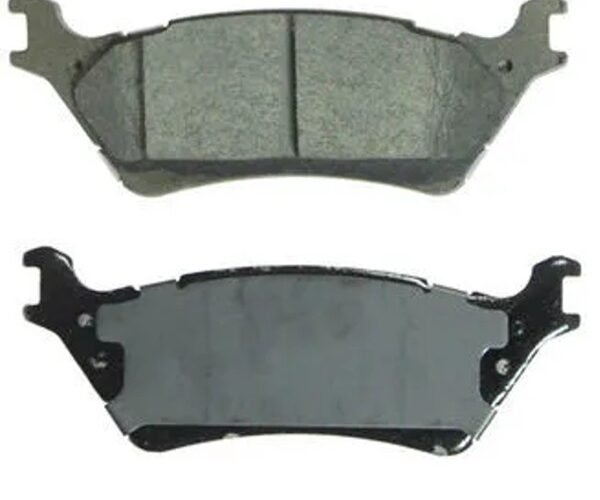

The 2018 Ford F-150 is part of the 13th generation F-150 lineup (P552 chassis, 2015 to 2020 production), and brake pads are a regular maintenance item on this truck. Most 2018 F-150 owners replace front pads every 30,000 to 50,000 miles depending on driving style, load, and terrain, with rear pads typically lasting 50,000 to 70,000 miles. Trucks used heavily for towing, hauling, or mountain driving wear pads faster than commuter trucks.
The 2018 F-150 weighs between 4,069 lbs (regular cab 4x2 XL) and 5,684 lbs (SuperCrew 4x4 Limited or Raptor), and pad wear scales with weight. Trucks pulling fifth wheels or hauling beds full of cargo go through pads faster than empty commuter trucks. Front pads carry roughly 70% of stopping force, so front pads always wear out before rear pads.
We supply OEM-specification 2018 Ford F-150 brake pads in two compound options. Ceramic pads are the right choice for daily-driver F-150s used mostly for commuting and light hauling. They produce less brake dust, run quieter, and extend rotor life. Semi-metallic pads are the right choice for towing duty, work trucks, and trucks driven hard in mountain terrain. They have stronger cold bite, better high-temperature performance, and a firmer pedal feel under heavy load. Both compounds meet OEM Ford specification, both work with Ford's electronic pad wear sensor system, and both come with anti-rattle clips and shims where applicable.
For most 2018 F-150 owners doing typical daily driving with occasional light hauling, ceramic is the better choice. For 2018 F-150 owners who tow trailers regularly, drive heavy work loads, or live in mountainous terrain, semi-metallic delivers the consistent high-temperature performance that ceramic pads cannot match. We can recommend the right compound based on your specific use case, just call.
| Item | Details |
|---|---|
| INCLUDED | Front pad set (4 pads) and / or rear pad set (4 pads) as ordered. Anti-rattle clips and shims pre-installed on the pad backing plates where applicable. |
| NOT INCLUDED | Brake rotors (sold separately), wear sensors (sold separately, single use, must be replaced with pads), brake fluid, anti-seize compound, brake cleaner, retaining hardware (typically reuses truck's hardware in good condition). |
| Tools You Need | Standard hand tools, brake caliper compression tool, torque wrench, brake cleaner, anti-seize compound for slide pins. |
These 2018 Ford F-150 brake pads are compatible with the following:
| Vehicle | Compatibility |
|---|---|
| 2018 Ford F-150 XL | Standard duty brake package |
| 2018 Ford F-150 XLT | Standard or Max Tow brake package |
| 2018 Ford F-150 Lariat | Standard or Max Tow brake package |
| 2018 Ford F-150 King Ranch | Heavy duty brake package |
| 2018 Ford F-150 Platinum | Heavy duty brake package |
| 2018 Ford F-150 Limited | Heavy duty brake package |
| 2018 Ford F-150 Raptor | High-performance brake package, larger Raptor-specific pads |
Engine and drivetrain compatibility: 3.3L V6, 2.7L EcoBoost V6, 3.5L EcoBoost V6, 5.0L V8 Coyote, and 3.0L Power Stroke diesel. The pad set is the same across engines but varies by trim and tow package.
These brake pads also fit 2015, 2016, 2017, 2019, and 2020 F-150 trucks of the same chassis (P552), with the trim package match. Tell us your year and trim and we confirm fit before shipping.
These are new 2018 Ford F-150 brake pads in OEM specification. Quality control includes:
These are new pads, not used. We do not sell used brake pads. New pads only, in OEM-equivalent quality from established brake friction manufacturers.
Why Buy From Vaz Auto Solutions
| Application | 2018 Ford F-150 (P552 chassis) |
|---|---|
| Trim Coverage | XL, XLT, Lariat, King Ranch, Platinum, Limited, Raptor |
| Sets Available | Front (4 pads), Rear (4 pads), or both |
| Compound Options | Ceramic or Semi-Metallic |
| Wear Sensor Compatible | Yes (sensor sold separately) |
| Dot Approved | Yes |
| Friction Coefficient Ceramic | 0.32 to 0.38 |
| Bedding Procedure | Standard 30 stop bed-in recommended |
| Service Life Expectation | 30,000 to 70,000 miles |
| Operating Temperature Max Ceramic | 850 degrees F |
| Price | $50.00 per axle |
Front pads were squealing at 42,000 miles, time for a swap. Vaz confirmed my XLT trim and brake package, recommended ceramic for my mostly-commuting use, shipped quickly. Independent shop installed them in about 90 minutes. Bedding in went well, no noise, and the dust on my wheels is dramatically less than the originals.
Tow a fifth wheel through the mountains, needed semi-metallic for the heat. Vaz confirmed my Max Tow brake package and shipped the heavy duty set. Slight squeak the first 100 miles then completely settled in. Strong stopping power on long descents now, exactly what I needed.
Every 2018 F-150 brake pad set sold by Vaz Auto Solutions is covered by a 15 day replacement warranty from the date of delivery.
To file a claim, contact us within 15 days of delivery at (240) 301-0095 or support@vazautosolutions.com.


