
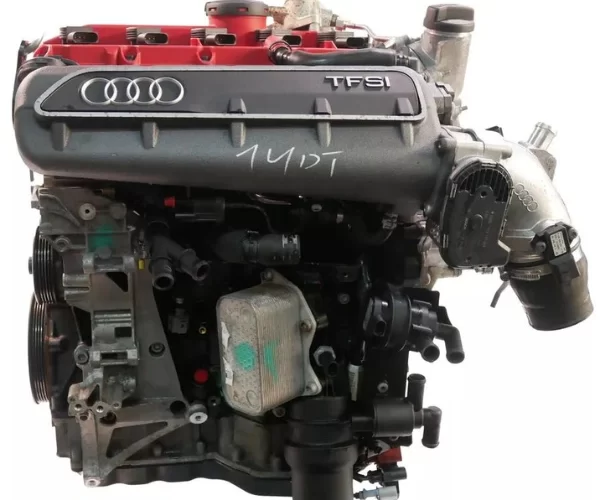
Get your car roaring back on the road with the legendary Audi RS3 2.5L TFSI engine. This turbocharged five-cylinder powerplant is renowned for its exceptional power, distinctive exhaust note, and historic significance in Audi's heritage. Producing 400 horsepower and 354 lb-ft of torque in the DAZA variant, this is one of the most celebrated 4-cylinder-class engines ever produced (despite having 5 cylinders, it competed in the 4-cylinder displacement class internationally). Whether you're thinking of replacing your existing engine or undertaking a performance build, the Audi RS3 engine for sale here is the perfect match of potency and Audi heritage.
The heart of performance in the Audi RS3 lies in its engine , a true masterpiece of engineering that seamlessly blends power, precision, and Audi's racing heritage. The essence of this fantastic car is the famous 2.5 liter five-cylinder turbocharged engine in its EVO generation, often regarded as the finest small-displacement performance engine of its era. This powerplant is not just an engine but identified to reflect the spirit of Audi's racing past , including the legendary Audi Quattro that revolutionized rally racing in the 1980s with its turbocharged 5-cylinder and all-wheel drive.
To understand why the RS3's engine matters, it helps to know Audi's 5-cylinder history , one of the most distinctive engine bloodlines in automotive history:
| Era | Vehicle | Engine | Significance |
|---|---|---|---|
| 1976-1980s | Audi 5000 (US) / 100 (Europe) | Naturally aspirated 5-cylinder | Audi's introduction of the 5-cylinder concept |
| 1980-1991 | Audi Quattro | Turbocharged 5-cylinder (200 to 600 plus HP) | Revolutionized motorsport with turbo + Quattro AWD, won Group B rally championships |
| 1984-1987 | Audi Sport Quattro S1 (Group B) | Turbocharged 5-cylinder, 600 plus HP | Legendary Group B rally car |
| 1989-1994 | Audi S2 / RS2 | Turbocharged 5-cylinder | Continued 5-cylinder performance tradition |
| 2000s | (5-cylinder went on hiatus) | Various V6 / V8 | Audi focused on V engines |
| 2011-2012 | Audi RS3 8P | CEPA 2.5 TFSI inline-5 (340 HP) | Audi revives the 5-cylinder for the RS3 |
| 2013-2016 | Audi RS3 8V pre-facelift / TT RS 8S early | CZGB / CTSA 2.5 TFSI (367 HP) | Improved 5-cylinder, still cast iron block |
| 2017-2020 | Audi RS3 8V.5 (THIS LISTING) | DAZA 2.5 TFSI EVO (400 HP) | Aluminum block EVO engine |
| 2021-Present | Audi RS3 8Y (THIS LISTING) | DNWA 2.5 TFSI EVO (401 HP) | Latest EVO with revised tuning |
The 2.5 TFSI EVO in this listing is the direct descendant of the rally Quattro engine , a turbocharged 5-cylinder that represents Audi's distinctive engineering DNA.
The EVO version of the 2.5 TFSI (DAZA introduced 2017, DNWA 2021+) represented a major upgrade over the earlier 5-cylinder TFSI engines:
| Feature | CEPA / CTSA / CZGB (2011-2016) | DAZA / DNWA EVO (2017-Present) |
|---|---|---|
| Block Material | Cast iron | Aluminum (cast-in iron liners) |
| Weight | Approximately 173 kg | Approximately 147 kg (26 kg / 57 lbs lighter) |
| Output | 340 HP (CEPA) to 367 HP (CTSA) | 400 HP (DAZA), 401 HP (DNWA) |
| Torque | 332-343 lb-ft | 354 lb-ft |
| Firing Order | Traditional 5-cyl | Revised 1-2-4-5-3 for improved acoustics |
| Compression | 10.0:1 | 10.0:1 |
| Bore x Stroke | 82.5 x 92.8 mm | 82.5 x 92.8 mm (same) |
The aluminum block represents a significant engineering achievement , Audi engineered cast-in iron cylinder liners to provide the durability of iron without the weight penalty.
| Model | Engine Code | Years | Output | Notes |
|---|---|---|---|---|
| Audi RS3 8V.5 (Sedan / Sportback) | DAZA | 2017-2020 | 400 HP / 354 lb-ft | First aluminum block 2.5 TFSI |
| Audi RS3 8Y (Sedan / Sportback) | DNWA | 2021-Present | 401 HP / 369 lb-ft (some markets) | Refined DAZA with revised electronics |
| Audi TT RS 8S | DAZA / DNWA | 2016-2022 | 400 HP / 354 lb-ft | Coupe / Roadster body, same engine |
| Audi RS Q3 | DAZA / DNWA | 2020-Present | 400 HP / 354 lb-ft | SUV body with same 2.5 TFSI |
All four vehicles share essentially the same engine with minor application-specific differences (ECU tune, exhaust routing, etc.).
Revolutionary engineering that delivers the durability of iron cylinder walls with the weight savings of aluminum. The 26 kg weight reduction over the earlier iron-block 5-cylinder dramatically improves response and weight distribution.
The EVO engine uses a distinctive firing order (1-2-4-5-3) that produces the signature offset rhythm exhaust note that has become iconic. The earlier 5-cylinders had different firing patterns; the EVO firing order was specifically engineered for acoustic character.
Compact, responsive turbocharger with twin-scroll design that uses dual exhaust pulses (from grouped cylinder pairs) for efficient spool-up. Capable of significantly more boost with aftermarket modifications.
Primary fuel delivery via high-pressure direct injectors firing into the combustion chamber. Some markets and later variants add port injection in parallel for reduced carbon buildup.
Continuous variable timing on both camshafts for optimized performance and efficiency across the RPM range.
Two-stage valve lift profiles on the intake side for optimized breathing across load conditions.
Modern multi-valve cylinder head for optimal flow.
Heavy-duty forged crankshaft and connecting rods designed to handle 400 HP and tunable to 500+ HP.
The RS3's 2.5 TFSI EVO produces remarkable real-world performance:
The 2.5 TFSI EVO is one of the most tuneable European performance engines:
The forged crank and rods support significant power increases with proper supporting modifications.
Here at Vaz Auto Solutions, you'll find this Audi RS3 2.5 TFSI engine for sale at the most reasonable price possible, with engine code verification (DAZA vs DNWA) and aluminum block EVO confirmation.
| Vehicle | Compatibility |
|---|---|
| Audi RS3 8V.5 Facelift Sedan / Sportback | 2017-2020 production with DAZA engine code, 400 HP / 354 lb-ft |
| Audi RS3 8Y Sedan / Sportback | 2021-present with DNWA engine code, 401 HP / 369 lb-ft (some markets) |
| Audi TT RS 8S Coupe / Roadster | 2016-2022 with DAZA (early) and DNWA (late) engines, same 400 HP rating |
| Audi RS Q3 | 2020-present with DAZA / DNWA, 400 HP / 354 lb-ft, SUV body |
| Vehicle | Compatibility |
|---|---|
| Audi RS3 8P (2011-2012) | Uses CEPA engine (340 HP, cast iron block) , earlier 5-cylinder generation, NOT the EVO |
| Audi RS3 8V Pre-Facelift / TT RS Early 8J | Uses CTSA / CZGB engines (367 HP, cast iron block) , predecessor to EVO |
| Engine Type | Inline 5-cylinder turbocharged petrol |
|---|---|
| Engine Family | Audi 2.5 TFSI inline-5 (EA855 evo) |
| Engine Codes | DAZA (2017-2020) and DNWA (2021-present) |
| Horsepower | 400 HP (DAZA) to 401 HP (DNWA) |
| Displacement | 2.5 liters (2,480 cc / 151 cubic inches) |
| Bore X Stroke | 82.5 mm x 92.8 mm |
| Compression Ratio | 10.0:1 |
| Torque | 354 lb-ft (DAZA), 354-369 lb-ft (DNWA depending on market) |
| Aspiration | Single twin-scroll turbocharger with intercooling |
| Fuel System | Direct injection FSI (some markets add port injection) |
| Fuel Type | Premium Gasoline (93 octane recommended) |
| Valvetrain | DOHC, 20 valves total, variable valve timing, Audi Valvelift System (AVS) |
| Firing Order | 1-2-4-5-3 (distinctive EVO firing pattern) |
| Block Head Material | Aluminum block with cast-in iron liners (EVO upgrade from earlier cast iron), aluminum cylinder head |
| Manufacturer | Audi AG (Györ Engine Plant, Hungary) |
| Redline | 7,000 RPM |
| Production Years | 2017 to present (EVO variants) |
| Compatibility | Audi RS3 8V.5 / 8Y, Audi TT RS 8S, Audi RS Q3 |
| Historical Significance | Continuation of Audi Quattro 5-cylinder heritage; multiple International Engine of the Year wins |
Contact (240) 301-0095 within 15 days.


