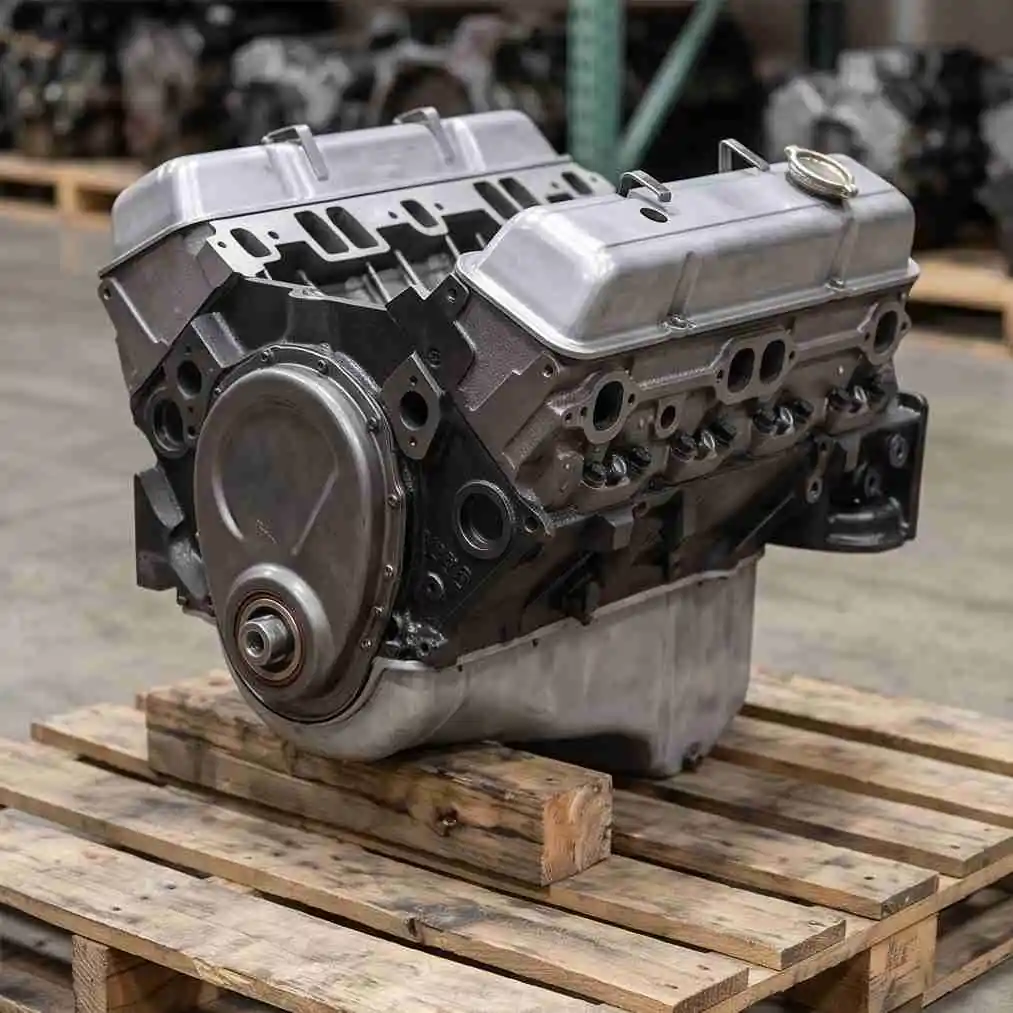
Direct-fit Cadillac Cimarron engine core for model years 1982 to 1988. The Cimarron was Cadillac's entry into the compact luxury car market and was built on GM's J-body platform, sharing many components with other General Motors vehicles of the era.
Available engine options include the 1.8L OHV 4-cylinder (1982 to 1985), 2.0L OHV 4-cylinder (1986 to 1988), and the optional 2.8L V6 introduced in 1985. Engine cores are available as either short blocks or long blocks for rebuilding or replacement applications.
Each engine core is inspected for compression, cracks, bearing condition, and overall rebuildability. Mileage and donor vehicle information are documented whenever available.
Cadillac Cimarron Historical Background
The Cadillac Cimarron was produced from 1982 through 1988 and is notable for being based on GM's J-body platform. While the vehicle remains a unique chapter in Cadillac history, its shared platform provides excellent parts interchangeability with other GM J-body vehicles.
Shared Platform: Chevrolet Cavalier, Pontiac J2000/2000/Sunbird, Buick Skyhawk, and Oldsmobile Firenza
Production Years: 1982 to 1988
Body Style: Compact four-door sedan
Engine Availability: 1.8L I4, 2.0L I4, and 2.8L V6
GM J-Body Family Cross-Reference
Because the Cimarron shares its platform with other J-body vehicles, engine sourcing opportunities can be significantly expanded through cross-referencing compatible donor vehicles.
Chevrolet Cavalier (1982 to 2005)
Pontiac J2000 (1982 to 1983)
Pontiac 2000 (1984 to 1986)
Pontiac Sunbird (1986 to 1994)
Buick Skyhawk (1982 to 1989)
Oldsmobile Firenza (1982 to 1988)
Cadillac Cimarron (1982 to 1988)
Engine Options
Engine
Description
1.8L OHV 4-Cylinder
Base engine used from 1982 to 1985
2.0L OHV 4-Cylinder
Updated engine used from 1986 to 1988
2.8L V6
Optional V6 engine introduced in 1985
Short Block
Engine block assembly without cylinder heads
Long Block
Complete engine assembly with cylinder heads
Vehicle Compatibility
Vehicle
Compatibility
Cadillac Cimarron (1982 to 1988)
Direct fit
Chevrolet Cavalier
Cross-reference donor platform
Pontiac J2000 / 2000 / Sunbird
J-body sibling vehicles
Buick Skyhawk
J-body sibling vehicle
Oldsmobile Firenza
J-body sibling vehicle
Condition and Inspection
Every Cadillac Cimarron engine core undergoes a thorough inspection process before shipment.
Compression testing on all cylinders
Visual inspection for cracks in block and heads
Bearing condition assessment where accessible
Mileage verification and documentation
Casting number verification
Cylinder bore inspection
Oil pan and crankshaft seal inspection
Timing component inspection (long blocks)
Donor vehicle information recorded
External cleaning and preparation
Freight-safe packaging on crate or pallet
Why Buy From Vaz Auto Solutions?
Cadillac Cimarron engine cores for 1982 to 1988 models
Support for all available engine options
Short block and long block configurations available
Extensive GM J-body platform expertise
Comprehensive cross-reference support
Compression-tested and inspected engines
Mileage verified and documented
Donor vehicle information provided
Vintage vehicle restoration support
Free freight shipping to all 50 states
15-day replacement warranty
Part Type
Engine core (short block or long block)
Vehicle Application
Cadillac Cimarron 1982-1988
Historical Significance
Infamous worst Cadillac, badge engineering
Brand Impact
Damaged Cadillac luxury reputation
Platform
GM J-body
Donor Vehicle
Chevrolet Cavalier (highest volume)
Engine 1 8l Ohv
1982-1985 base, ~88 HP
Engine 2 0l Ohv
1986-1988 updated base
Engine 2 8l V6
1985+ optional, ~125 HP
Engine Core Types
Short block or long block
Approximate Weight
200 to 350 lbs (engine assembly)
Installation Difficulty
Significant, 8-15+ hours
Sourcing
US salvage J-body cross-reference
Donor Disclosed
Year, model, displacement, mileage
Price
$1,600.00
Polychronios Anagnostopoulos-Pavlopoulos
Replacing the engine in my 1987 Cadillac Cimarron (2.8L V6 optional engine, J-body) for full restoration project. Vaz educated me on the Cimarron's infamous history (badge-engineered Cavalier, damaged Cadillac brand reputation, contributed to 1980s decline) and the GM J-body sibling cross-reference. They sourced a 2.8L V6 long block from a 1988 Pontiac Sunbird donor (J-body sister, same engine, more abundant donor pool). Compression tested all cylinders, no cracks visible, mileage documented at
Gunhilde Schweighofer-Hartmann
Bought 2.0L OHV 4-cyl short block for my 1987 Cadillac Cimarron (the updated base engine that replaced the underpowered 1.8L). Vaz emphasized the J-body sibling cross-reference (Cavalier, Sunbird, Skyhawk, Firenza all shared same engines) and helped source from a 1988 Oldsmobile Firenza donor (J-body sister, same 2.0L OHV engine). Compression tested before shipping. One star off because freight shipping had additional liftgate fee at my residential address that wasn't immediately clear. The Nort
Why is the Cadillac Cimarron infamous?
The Cadillac Cimarron 1982-1988 is widely cited as one of Cadillac's worst-received products and a textbook example of bad badge engineering. Reasons: (1) BADGE-ENGINEERED CHEVROLET CAVALIER - the Cimarron was fundamentally a Cavalier with Cadillac trim (leather, sound insulation, Cadillac badges), same J-body platform, same engines, same architecture. (2) PRICED ROUGHLY DOUBLE the equivalent Cavalier despite being mechanically identical. (3) Marketed as luxury compact when customers perceived it as overpriced economy car. (4) UNDERPOWERED ENGINES (1.8L 4-cyl at 88 HP was inadequate for marketing as luxury). (5) WIDELY MOCKED by automotive press at the time. (6) DAMAGED CADILLAC'S BRAND REPUTATION significantly during the 1980s. The Cimarron is frequently cited in business school case studies as cautionary tale of brand dilution and inappropriate badge engineering.
How is the Cimarron related to Chevrolet Cavalier?
The Cimarron was BADGE-ENGINEERED from the Chevrolet Cavalier - they share the GM J-body platform completely. Similarities: (1) Same chassis and platform. (2) Same engines (1.8L/2.0L OHV 4-cyl, 2.8L V6). (3) Same transmissions. (4) Same basic body structure. (5) Same suspension. (6) Same brakes. Differences (Cadillac trim only): (1) Cadillac wreath-and-crest badging. (2) Leather seats standard. (3) Additional sound insulation. (4) Wood-look interior trim. (5) Cadillac-style instrument cluster. (6) Slightly different exterior trim. The Cavalier was the HIGHEST-VOLUME J-body vehicle - this makes Cavalier excellent cross-reference donor for Cimarron engine cores (same engines, much more abundant donors).
What are the GM J-body sister vehicles?
The GM J-body platform 1982-1994 was one of the largest J-body families in GM history. Five vehicles shared the platform: (1) CHEVROLET CAVALIER (1982-2005, longest production, multiple generations, highest volume - the platform's flagship). (2) PONTIAC J2000 (1982-1983), Pontiac 2000 (1984-1986), Pontiac Sunbird (1986-1994) - all same vehicle with three name changes during production. (3) BUICK SKYHAWK (1982-1989). (4) OLDSMOBILE FIRENZA (1982-1988). (5) CADILLAC CIMARRON (1982-1988). All shared platform, engines, transmissions, and many components. Brand-specific differentiation was primarily trim, badging, marketing positioning. Cross-reference among siblings significantly expands parts availability.
How did Cadillac recover from the Cimarron?
Cadillac's recovery from the Cimarron and the broader 1980s decline took over a decade and involved several initiatives: (1) NORTHSTAR V8 ENGINE PROGRAM (introduced 1993 in Allante, then Eldorado and Seville) - sophisticated DOHC V8 reestablished Cadillac engineering credibility. (2) CATERA (1997-2001) - imported Opel Omega rebadge, modest success but unique German-built Cadillac. (3) CADILLAC CTS (2003+) - true Cadillac sport sedan with rear-wheel-drive, sigma platform shared with corvette, established the modern Cadillac CTS lineup that continues today. (4) CADILLAC ESCALADE (1999+) - luxury SUV/truck cash cow. (5) ART AND SCIENCE DESIGN LANGUAGE (early 2000s) - distinctive Cadillac styling that broke from generic American luxury. (6) CADILLAC V-SERIES PERFORMANCE (CTS-V, etc.). Modern Cadillac is significantly different brand than 1980s Cimarron-era Cadillac.
What's the difference between short block and long block?
Two engine core configurations: SHORT BLOCK includes: (1) Engine block (cylinder block casting). (2) Crankshaft. (3) Connecting rods. (4) Pistons with rings. (5) Main bearings and rod bearings. (6) Sometimes oil pump. SHORT BLOCK does NOT include heads, valvetrain, intake/exhaust manifolds, accessories. Customer adds heads from old engine (or new) and external components. LONG BLOCK includes: All short block components PLUS: (1) Cylinder heads (with valves, springs, retainers). (2) Camshaft. (3) Timing chain or belt and gears. (4) Valve covers. (5) Sometimes intake manifold. LONG BLOCK does NOT include external items like alternator, starter, water pump, exhaust manifold, distributor, fuel system. Long block is closer to complete engine, requires fewer additional parts from old engine.
How do I install an engine core?
Engine R&R (remove and replace) is significant work, typically 8-15+ hours at shop: (1) Drain all fluids (coolant, oil, transmission fluid if needed). (2) Disconnect battery, remove battery and tray for access. (3) Disconnect all engine electrical (alternator, starter, sensors, ignition). (4) Disconnect fuel lines and fuel system components. (5) Disconnect cooling system hoses, remove radiator. (6) Disconnect A/C compressor (without breaking refrigerant lines if possible). (7) Disconnect exhaust at manifold. (8) Disconnect transmission from engine (bell housing bolts, torque converter if automatic). (9) Support engine with hoist, support transmission separately. (10) Remove engine mount bolts. (11) Lift engine out of vehicle. (12) Transfer all external components to engine core (alternator, starter, power steering pump, A/C compressor, fuel system, exhaust manifold, intake, distributor, etc.). (13) Install assembled engine. (14) Reverse all disconnections. (15) Add fluids, prime oil, initial startup with careful break-in procedure. Significant project requiring engine hoist, transmission jack, and proper tools.
Can I use a Cavalier engine core in my Cimarron?
YES, very likely - this is a major advantage of the J-body platform sharing. The Chevrolet Cavalier and Cadillac Cimarron used IDENTICAL engines in their J-body production years: 1.8L OHV 4-cyl (1982-1985), 2.0L OHV 4-cyl (1986-1988), 2.8L V6 (1985+). Engine cores from Cavalier of matching year and displacement will install in Cimarron with same external components, same mounts, same transmission interface. The Cavalier was sold in MUCH higher volume than Cimarron - this makes Cavalier-sourced engine cores significantly more available than Cimarron-specific donors. Similar cross-reference applies to Pontiac Sunbird, Buick Skyhawk, Oldsmobile Firenza of matching years/engines.
How does shipping work for engine cores?
Engine cores are HEAVY and require FREIGHT SHIPPING (not standard UPS/FedEx Ground). Specifications: Engine weight 200-350 lbs (varies by long/short block and displacement). Shipped on pallet or in engine crate. FREIGHT carrier (R+L, FedEx Freight, or similar) for US transit. Free shipping to all 50 US states still applies but delivery time is 7-14 business days (slower than ground shipping). Delivery is to commercial address or freight terminal with liftgate service (residential delivery may have additional fees from carrier). Customer responsible for unloading equipment at delivery point.
15 Day Replacement Warranty
Covered:
Defects at delivery (compression failure not disclosed, cracked block, severe internal damage)
Not Covered:
Damage from improper installation
Damage from inadequate cooling system maintenance
Normal wear on 35+ year-old engine internals
Rebuild work
Labor costs (engine r&r typically 8-15+ hours). engine cores are sold as rebuild project bases - some refurbishment work expected
Contact (240) 301-0095 within 15 days.
For Cadillac Cimarron Engine Core: 1982-1988
Compression testing on: All cylinders
Visual inspection for: Cracks in block and heads
Bearing condition assessment: Where accessible
Mileage verification and: Documentation
Casting number verification: Inspected
Cylinder bore inspection: Inspected
Oil pan and: Crankshaft seal inspection
Timing component inspection: (long blocks)
Fitment Verified: Confirm by VIN before order
Photos Available on Request: Actual unit condition