






Description
About This Engine
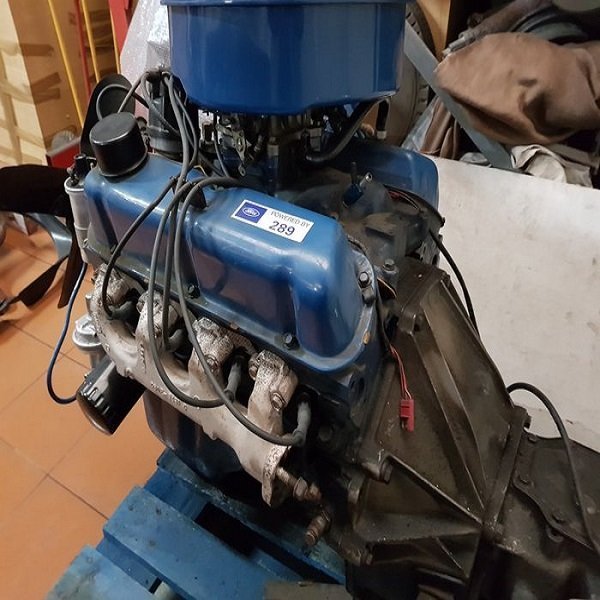
The Ford 289 is one of the most historically significant small block V8 engines ever produced. Introduced in 1963 as the third displacement in the Windsor V8 family, the 289 used a 4.00 inch bore with a 2.87 inch stroke – creating an engine that favored high-RPM output. In standard 2-barrel form it produced 195 to 200 hp. With a 4-barrel it produced 210 to 225 hp. The legendary HiPo K-code version produced 271 hp at 6,000 rpm using solid lifters, an aggressive camshaft, and 10.5:1 compression.
The 289 earned its enduring reputation through what it powered. Carroll Shelby used the 271 hp K-code as the basis for the Shelby GT350 Mustang, adding headers, an aluminum intake manifold, and a Holley 715 cfm carburetor to produce 306 hp. The same engine powered the AC Cobra in various states of tune. About 25,000 K-code engines were built between 1963 and 1967 – a small number for an engine with such outsized historical significance.
The 289 was replaced by the 302 in 1968 but remains one of the most desirable small block Ford engines for restoration. A documented, compression-tested 289 – particularly a K-code HiPo – is among the most sought-after Ford V8s in the collector market.
Signs You Need a Replacement Engine
- Oil burning on startup – worn valve stem seals, common on older small block Windsor engines
- Knocking under load – bearing wear on the rod journals of high-mileage units
- Loss of compression on one or more cylinders – ring wear or scored cylinder walls
- Solid lifter tick becoming a knock on K-code engines – cam lobe wear
- Oil leaks at the front timing cover – a common small block Ford seep point
- Low oil pressure at idle after warm-up – bearing clearance issues
Known Problems With This Engine
- Nylon cam gear failure: Earlier 289 engines used a nylon timing gear on the camshaft that degrades with age and heat. It can fail suddenly. We check timing gear condition and age indicators during inspection.
- K-code identification: A genuine HiPo K-code 289 requires checking the engine code stamp, the type of valve lifters (solid vs hydraulic), main cap configuration (4-bolt vs 2-bolt), and the crankshaft casting. We document all of these for every K-code unit.
- Valve guide wear on high-mileage units: The small block Windsor head uses integral valve guides that wear over time causing oil burning. We inspect for valve guide wear indicators on every unit.
- Freeze plug condition: Older 289 blocks used cup-style freeze plugs that can rust on aged engines. We inspect all freeze plug areas and report on condition.
Known Variants by VIN Code
The Ford 289 was offered in four main factory configurations. The C-code (1965-1968) was the base 289 producing 200 hp / 282 lb-ft at 9.3:1 with a 2-barrel – the most common, used in Mustang, Fairlane, and Falcon. The A-code (1965-1968) made 225 hp / 305 lb-ft at 10.0:1 with a 4-barrel and flat-top pistons. The K-code (HiPo, 1963-1967) produced 271 hp / 312 lb-ft at 10.5:1 with a 595 cfm 4-bbl, solid lifters, 4-bolt mains, nodular iron crank, and dual-point distributor – only ~25,000 built. The Shelby GT350 (1965-1967) took the K-code and added headers, an aluminum intake, and a Holley 715 cfm Holley carb to produce 306 hp / 329 lb-ft, with an optional Paxton supercharger.
What Is Included
Included – Long Block: Block, crankshaft, pistons, connecting rods, camshaft, cylinder heads, valve train, oil pan, front timing cover, and water pump. Not Included: Intake manifold, carburetor, exhaust manifolds, distributor, ignition system, alternator, power steering pump, starter. No core charge.
Vehicle Compatibility – Direct Fit
The Ford 289 was factory installed in the Ford Mustang (1964.5 to 1968 – base 2V, 4V, and HiPo K-code), Fairlane (1963-1968), Falcon (1963-1968), Galaxie 500 (1963-1967), Mercury Comet (1963-1967), Mercury Cyclone (1965-1967), Ford Thunderbird (1964-1966 A-code 4V), and AC Cobra Shelby (1963-1965 with 289 HiPo). Shares Windsor small block external dimensions and bellhousing pattern with the 260, 302, and 351W – fits as a direct swap in any vehicle originally equipped with any of those engines.
Why Buy From Vaz Auto Solutions
- Variant documented before you pay – K-code, A-code, or C-code confirmed including engine stamp and main cap configuration
- Compression tested across all 8 cylinders – results shared before order confirmed
- Nylon cam gear condition noted during inspection – important pre-purchase information
- Fitment verified for your specific Ford or Mercury vehicle
- No core charge – keep your old engine
- Free freight pallet delivery to all 50 states, no hidden fees
- 15 day replacement warranty on internal engine defects
- Call (240) 301-0095 – speak with someone who understands 289 variants and Ford restoration
Bill H. –
Needed a 289 4V A-code for my 1966 Ford Mustang Fastback restoration. Vaz confirmed the A-code stamp and the 4-barrel intake provisions before I paid. Compression came back solid across all 8. Engine is installed and running great. They also flagged that the nylon cam gear should be replaced during install – good advice I followed.
Pete M. –
Got a 289 2V C-code for my 1965 Ford Fairlane project. Vaz disclosed one cylinder reading slightly lower compression (148 vs 158 average) before I bought it. Said it was borderline – honest of them. Decided to buy it and the car runs fine. Appreciate the transparency.