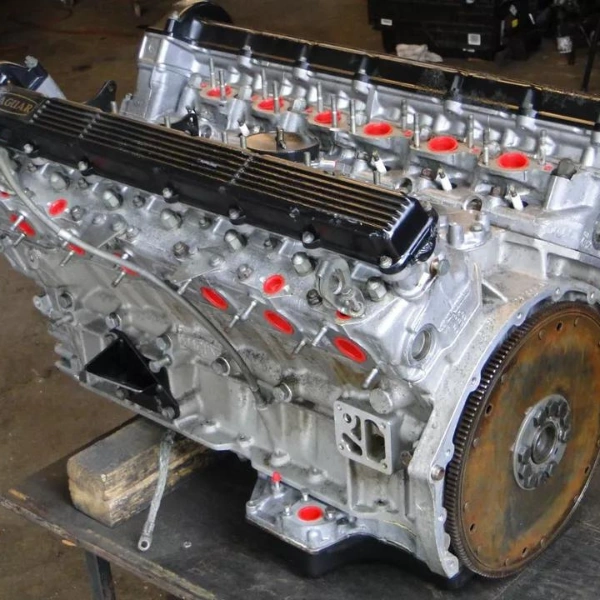
About the Jaguar V12 Engine
The V12 is not just an engine; it is the centerpiece of the Jaguar powerplant lineage. This engineering marvel is a study in British luxury and performance combined. This aluminum and steel masterpiece tells a story of country winding roads and elegant European getaways. When you purchase a Jaguar V12, you are buying not only an engine but a piece of automotive history that has graced some of the most elegant and coveted vehicles ever made , the E-Type Series 3, the XJ12, the XJS, and the Daimler Double Six. Drop this Jaguar V12 engine for sale under the hood of a classic Jaguar, and ordinary transportation becomes a sublime experience , an intoxicating combination of speed, smoothness, and sophistication that only Jaguar's twelve-cylinder masterpiece delivers.
The Legendary Jaguar V12: A Brief Overview
The Jaguar V12 represents elegance in British automotive engineering design. First developed for the Jaguar E-Type Series 3 in 1971, this silky-smooth powerplant propelled Jaguar's flagship cars through 1997 , a remarkable 26-year production span. The V12 was a labor of love: race-bred technology coupled with luxurious refinement. From the XJS sports coupe to the XJ12 luxury sedan to the Daimler Double Six, this engine defined an era of opulent V12 performance.
The Jaguar V12 captured the imagination of enthusiasts worldwide, capturing the very spirit of Jaguar: "Grace, Space, and Pace" (Jaguar's traditional brand motto). Its heritage still fuels passion for classic Jaguars today.
Variant Evolution: 5.3L (1971-1992) and 6.0L (1993-1997)
The Jaguar V12 was produced in two major displacement variants:
5.3 Liter V12 (1971-1992) , The Original
The original Jaguar V12, designed for the E-Type Series 3:
- Displacement: 5.3 liters (5,343 cc)
- Bore x Stroke: 90.0 mm x 70.0 mm (short-stroke design)
- Compression Ratio: 9.0:1 (early), 10.0:1 (later)
- HP: 241 HP (US-spec early) to 263-280 HP (later versions)
- Torque: 285-302 lb-ft
The 5.3L V12 was used in:
- E-Type Series 3 (1971-1975): The original V12 application
- XJ12 (XJ Series 1, 2, 3) (1972-1992): The luxury sedan flagship
- XJS / XJ-S (1975-1992): The XJ-derived grand tourer
- Daimler Double Six (1972-1992): The luxury Daimler version of XJ12
5.3 Liter HE V12 (1981-1992) , The "High Efficiency" Refresh
A major mid-cycle improvement introduced in 1981:
- HE = "High Efficiency": Revised combustion chamber design ("May Fireball" combustion, designed by Michael May)
- Compression Ratio: 11.5:1 (up from 9.0-10.0:1) , significantly higher
- HP: 295 HP UK / 263 HP US (federalized)
- Torque: 318 lb-ft
- Improved fuel economy despite higher output (the "high efficiency" name)
- Smoother power delivery through improved combustion
- Used in: XJ12, XJS (mid-cycle refresh), Daimler Double Six
The HE update extended the V12's competitive life through the 1980s when fuel economy regulations were tightening.
6.0 Liter V12 (1993-1997) , The Final Evolution
The final and most powerful Jaguar V12:
- Displacement: 6.0 liters (5,994 cc)
- Bore x Stroke: 90.0 mm x 78.5 mm (longer stroke than 5.3L)
- Compression Ratio: 11.0:1
- HP: 308 HP (XJ12) to 318 HP (XJS Final variant) , the most powerful production Jaguar V12 ever made
- Torque: 339 lb-ft at low 2,850 RPM
- Fuel Injection: Marelli electronic fuel injection
- Used in: XJ12 (X305 final variant 1995-1997), XJS Final Edition (1993-1996), Daimler Double Six final variants
The 6.0L V12 was Jaguar's final V12 before the V12 was discontinued in 1997. The final XJS V12 (1996) and XJ12 (1997) represent the apex of Jaguar V12 development.
Jaguar V12 Variant Comparison Chart
| Variant | Years | Compression | HP (UK) | HP (US) | Common Applications |
|---|
| 5.3L Pre-HE | 1971-1980 | 9.0-10.0:1 | 272-285 HP | 241-262 HP | E-Type S3, XJ12 S1/S2/S3, early XJS |
| 5.3L HE | 1981-1992 | 11.5:1 | 295 HP | 263 HP | XJ12 S3, XJS HE, Daimler Double Six HE |
| 6.0L | 1993-1997 | 11.0:1 | 308-318 HP | 308-318 HP | XJ12 X305, XJS Final, Daimler Double Six final |
Vehicle Applications
The Jaguar V12 engine powered some of the most acclaimed Jaguar (and Daimler) vehicles ever made:
| Vehicle | Years | Engine Variants | Significance |
|---|
| Jaguar E-Type Series 3 | 1971-1975 | 5.3L pre-HE | The first V12 application, capped the legendary E-Type series |
| Jaguar XJ12 Series 1, 2, 3 | 1972-1992 | 5.3L pre-HE, then 5.3L HE | The V12 luxury sedan |
| Jaguar XJ12 (X305 final) | 1995-1997 | 6.0L | Final V12 sedan |
| Jaguar XJS / XJ-S | 1975-1996 | 5.3L pre-HE, 5.3L HE, 6.0L Final | The grand tourer, longest V12 production |
| Daimler Double Six | 1972-1997 | All V12 variants | Luxury XJ12 version |
| Daimler Sovereign V12 | Limited | Various | Rare V12 luxury |
The XJS is by far the most common Jaguar V12 application due to its 21-year production run with the V12.
Key Engineering Features
- 60-Degree V12 Configuration: Standard V12 angle for inherent primary and secondary balance
- All-Aluminum Construction: Aluminum block AND aluminum cylinder heads , extraordinary for 1971 engineering
- SOHC Per Bank (24 Valves Total): Single overhead camshaft per cylinder bank, 2 valves per cylinder
- Hydraulic Lifters: Self-adjusting hydraulic lifters reduce maintenance
- Twin Timing Chains: One timing chain per cylinder bank
- Lucas Mechanical Fuel Injection (Early): Innovative for 1971
- Lucas / Bosch L-Jetronic Electronic Fuel Injection (Mid-Production): Updated electronic fuel management
- Marelli Electronic Fuel Injection (Late 6.0L): Modern fuel management for final production
- Naturally Aspirated: No turbocharging or supercharging
- Cross-Bolted Main Bearings: Heavy-duty bottom end for V12 smoothness
- Twin Distributors (Early): Two distributors for 12-cylinder ignition
- Electronic Ignition (Later): Single coil-per-cylinder or distributor-based electronic ignition
Why the Jaguar V12 is Acclaimed
The Jaguar V12 has earned its reputation as one of the smoothest road car engines ever produced:
- Inherent V12 Balance: 12-cylinder configuration is naturally balanced (no primary or secondary vibrations)
- Long-Stroke Smoothness: Slow-revving by V12 standards, emphasizing torque and refinement
- Refined Idle: Many describe Jaguar V12 idle as imperceptible , the car appears to be off
- Linear Power Delivery: Smooth pull from low RPM through redline
- Distinctive Sound: A refined, sophisticated note rather than aggressive , the V12 was tuned for luxury character
The combination of these factors makes the Jaguar V12 a favorite among luxury car enthusiasts and collectors.
Common Jaguar V12 Service Items (Honest Disclosure)
Honest disclosure of the V12's reputation for complexity and maintenance:
- Complex Cooling System: The V12's cooling system is critical. Cracked or rotted cooling system components (hoses, water pump, thermostat housing) can lead to overheating. Always inspect cooling system thoroughly when buying a used Jaguar V12.
- Lucas Fuel Injection Issues (Pre-1981 5.3L): The early Lucas mechanical fuel injection is troublesome and parts are scarce. Many owners convert to later L-Jetronic or modern EFI.
- Vacuum Hose Failures: The V12 has many vacuum hoses that fail with age, causing rough running.
- Carbon Buildup: Especially in HE variants, carbon buildup in the "May Fireball" combustion chambers can affect performance.
- Ignition Issues: Early twin-distributor systems require careful timing and synchronization. Many owners upgrade to modern electronic ignition.
- Oil Leaks: Various seal locations develop oil leaks at high age. Rear main seal is a major service item.
- Repair Cost: All V12 maintenance is roughly 2x V8 cost due to twice the cylinders, valves, ignition components, etc.
- Specialist Required: Qualified Jaguar V12 specialists are rare and command premium pricing.
- Fuel Economy: 12-16 MPG average , the V12 was never designed for efficiency
Premium Fuel Mandatory: All Jaguar V12 variants require minimum 91 octane premium fuel. The HE variant especially (with 11.5:1 compression) is sensitive to fuel quality. Regular 87 octane WILL cause detonation and damage.
The Jaguar V12 is a labor of love. Owners who maintain them carefully are rewarded with exceptional driving experiences, but expect higher costs and complexity than a typical V8.
Why Choose a Used Jaguar V12 Engine?
- Cost savings vs reman ($12,000 used vs $18,000-$35,000 reman plus core, when available)
- Variant matching , we identify whether you need 5.3L early, 5.3L HE, or 6.0L
- Direct OEM fit for E-Type Series 3, XJ12, XJS, Daimler Double Six
- Heritage , one of the most acclaimed V12 engines ever produced
- Classic car restoration , essential for proper Jaguar V12 restoration
- Custom builds , Jaguar V12s are sometimes used in custom builds and kit cars
- Smoothness , unmatched naturally aspirated V12 character
Here at Vaz Auto Solutions, you'll find this Jaguar V12 engine for sale at the most reasonable price possible, with variant identification (5.3L pre-HE vs 5.3L HE vs 6.0L), donor vehicle confirmation, all 12 cylinders compression tested, cooling system condition assessed (critical Jaguar V12 service area), and complete inspection.
Vehicle Compatibility
Direct Fit:
| Vehicle | Compatibility |
|---|
| Jaguar E-Type Series 3 | 1971-1975 with 5.3L V12 (pre-HE) , the first Jaguar V12 application |
| Jaguar XJ12 Series 1 / 2 / 3 | 1972-1992 with 5.3L V12 (pre-HE 1972-1981, HE 1981-1992) |
| Jaguar XJ12 X305 (Final XJ12) | 1995-1997 with 6.0L V12 |
| Jaguar XJS / XJ-S | 1975-1996 with 5.3L V12 (pre-HE 1975-1981, HE 1981-1992, then 6.0L 1993-1996) |
| Daimler Double Six | 1972-1997 across all V12 variants (5.3L pre-HE, 5.3L HE, 6.0L) , the luxury XJ12 variant |
| Daimler Sovereign V12 | Limited applications across V12 variants |
Condition and Inspection
- Variant verified (5.3L pre-HE 1971-1980, 5.3L HE 1981-1992, or 6.0L 1993-1997)
- Donor vehicle confirmed (E-Type S3, XJ12, XJS, or Daimler Double Six)
- All 12 cylinders compression tested
- Oil pressure verified at idle and operating speed
- Cooling system condition assessed (critical Jaguar V12 service area)
- Cooling system hoses and pipes inspected
- Water pump condition assessed
- Thermostat housing condition checked
- Fuel injection system tested (Lucas mechanical, L-Jetronic, or Marelli per year)
- Ignition system verified (twin distributors on early, electronic on later)
- Spark plug condition documented (12 plugs)
- Coil and ignition wire condition assessed
- Timing chain condition assessed (twin chains, one per bank)
- Hydraulic lifter function verified
- Vacuum hose system inspected (common high-age failure point)
- Rear main seal condition assessed where observable
- Oil leak inspection performed
- Carbon buildup assessed in combustion chambers (HE variants especially)
- Miles from donor vehicle documented where available
- Variant correctly identified (5.3L pre-HE vs 5.3L HE vs 6.0L)
- All 12 cylinders compression tested
- Cooling system condition assessed (critical Jaguar V12 service area)
- Fuel injection system tested (year-appropriate system)
- Ignition system verified (twin distributors or electronic per year)
- Vacuum hose system inspected (common high-age failure)
- Donor vehicle and mileage documented
- Cross-reference assistance across E-Type S3 / XJ12 / XJS / Daimler Double Six applications
- Free freight pallet delivery to all 50 states
- 15 day replacement warranty on internal defects
- Jaguar V12 specialist support team (rare expertise for this complex engine)