






Description
About This Engine
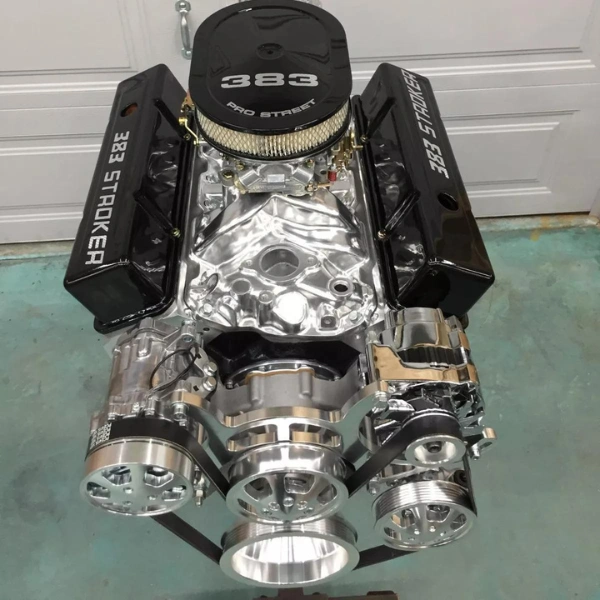
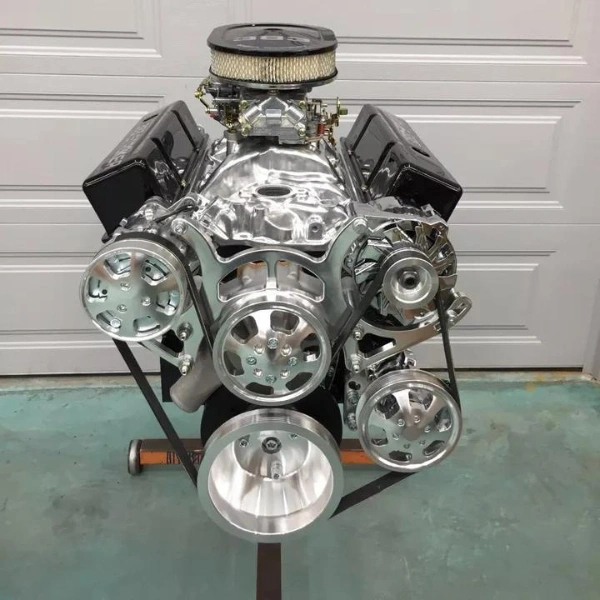
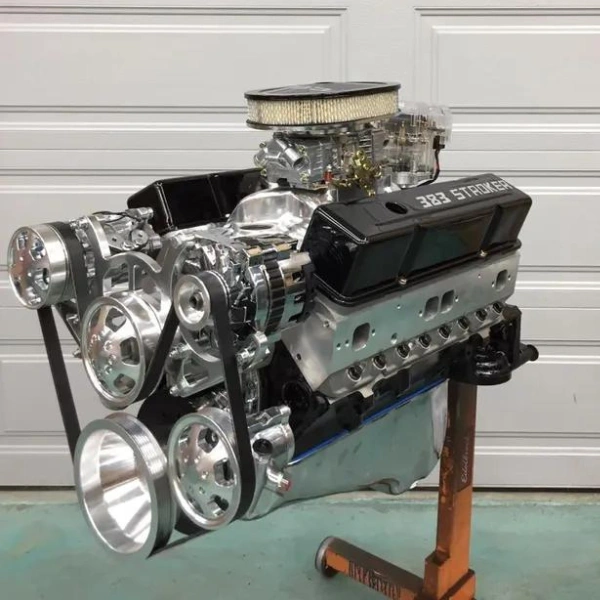
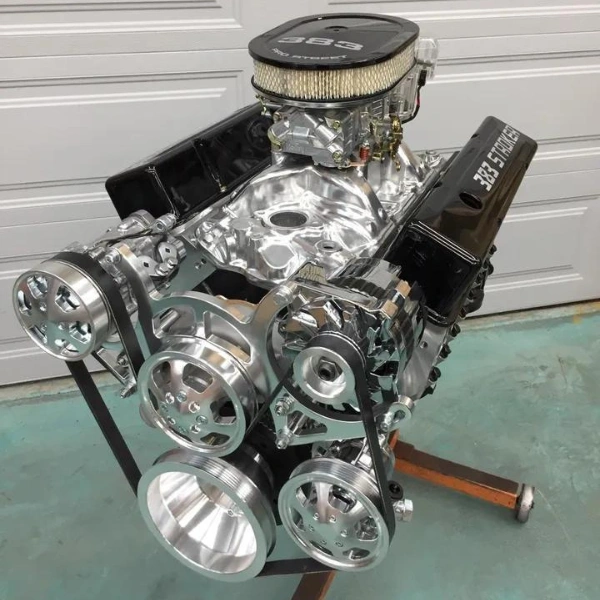
The 383 stroker is the most popular performance small block build in American hot rodding history. It starts with the proven GM Small Block Chevy 350 block- bored 0.030 inch over to 4.030 inches- then receives a crankshaft with a 3.750 inch stroke. The combination produces 383 cubic inches in a package that retains the SBC's compact dimensions, widespread parts support, and easy bolt-in fitment to any vehicle that originally carried a small block Chevy.
The appeal of the 383 over simply building a high-output 350 comes down to torque. The longer stroke- from 3.480 inches on a 350 to 3.750 inches- increases piston velocity and improves cylinder fill at low engine speeds. The result is a broad, flat torque curve that makes the 383 feel significantly larger than its cubic inches suggest. Well-built street 383 engines with hydraulic roller cams and aluminum heads consistently produce 420 to 500 horsepower and 430 to 475 lb-ft of torque on pump gas- numbers that rival many big block combinations at a fraction of the weight and cost.
The 383 fits directly into any vehicle built around an SBC- no custom mounts, no bellhousing changes, no chassis modifications. For Camaro, Chevelle, Nova, Corvette, C/K truck, El Camino, and countless custom builds, the 383 stroker is the most proven and most supported high-performance V8 available today.
Signs You Need a Replacement Engine
- Oil consumption above expected levels- ring seal issue on high-mileage assembled units or improper ring gap on new builds
- Detonation or pinging under load- compression too high for fuel being used, or timing not optimized for the specific cam and compression combination
- Lifter tick on startup- common on roller cam builds that sat for extended periods, typically resolves after a few heat cycles
- Loss of compression on one or more cylinders- ring or valve issue on assembled units
- Excessive blow-by past PCV- ring seal not seated properly on a new or rebuilt unit that needs break-in miles
Known Problems With This Engine
- Rod ratio and piston to wall clearance: The 383 uses a longer stroke than the 350, which increases piston side loading in the cylinder. Proper piston to wall clearance and the correct connecting rod length (5.700 or 6.000 inch) are critical for longevity. We document rod length on every unit.
- Crankshaft compatibility: Using a reworked GM 400 SBC crankshaft in a 350 block requires the 400's external balance to be corrected- the 400 is externally balanced while most 350 applications are internally balanced. A 383 built with an aftermarket internally balanced forged crank avoids this issue. We document crankshaft type and balance specification for every unit.
- Head selection and output: A 383 with stock cast iron Vortec heads and a mild hydraulic roller cam produces approximately 380 to 420 hp. Aftermarket aluminum heads with larger ports and valves push output to 450 to 500 hp or more. We document head specification- cast iron or aluminum, casting number where available- before every order ships.
- Break-in procedure: New assembled 383 engines require a proper break-in procedure to seat rings correctly. We provide break-in instructions with every new-build unit.
383 Stroker Output by Build Level
Output varies significantly by component selection. Typical street build ranges:
| Build Level | HP Range | Torque Range | Typical Specs |
|---|---|---|---|
| Entry Street | 350 to 400 hp | 400 to 430 lb-ft | Cast iron heads, hydraulic roller cam, 9.5:1 compression, 750 cfm 4-barrel carb. |
| Mid Performance | 400 to 450 hp | 430 to 460 lb-ft | Aftermarket aluminum heads, hydraulic roller cam, 10.0:1 compression, 750 to 850 cfm carb. |
| High Performance | 450 to 500 hp | 450 to 475 lb-ft | High-flow aluminum heads, aggressive hydraulic or solid roller cam, 10.5:1 compression, 850 cfm carb. |
| Forced Induction | 500 to 700+ hp | 500+ lb-ft | Lower compression (8.5 to 9.0:1), turbo or supercharger, upgraded internals. Build-specific. |
What Is Included- What Is Not Included
| INCLUDED- Long Block (standard) | Assembled block, crankshaft, pistons, connecting rods, camshaft and lifters, cylinder heads, valve train, timing set, oil pan, front cover, and valley cover or intake gaskets. |
|---|---|
| INCLUDED- Dressed Versions (call to confirm) | Some units include intake manifold, carburetor, valve covers, distributor, and accessories. Confirm at time of order. |
| NOT INCLUDED (standard long block) | Carburetor or EFI system, intake manifold, exhaust manifolds or headers, distributor, ignition system, alternator, power steering pump, starter, accessories. |
| Core Note | No core charge on complete assembled units. |
Vehicle Compatibility- Direct Fit
The 383 stroker fits any vehicle originally equipped with a GM Small Block Chevy engine, including:
| Chevrolet Camaro | 1967 to 2002 (all SBC-equipped years) |
|---|---|
| Chevrolet Chevelle and Malibu | 1964 to 1977 |
| Chevrolet Nova | 1962 to 1979 |
| Chevrolet Corvette | 1955 to 1996 (SBC years) |
| Chevrolet C/K Truck and Suburban | 1967 to 1999 |
| GMC C/K Truck | 1967 to 1999 |
| El Camino and Monte Carlo | Various SBC years |
| Custom and Kit Car Applications | Universal SBC fitment- most common performance swap engine |
The 383 uses the standard SBC bellhousing bolt pattern and motor mount locations. It drops into any SBC application without modification. The only clearance consideration is the larger displacement- verify oil pan clearance with stock chassis crossmembers on some early applications.
Transmission compatibility: Turbo-Hydramatic 350 (TH350)- light-duty auto | Turbo-Hydramatic 400 (TH400)- heavy-duty preferred for high-output builds | 700R4 or 4L60E- overdrive auto | Muncie 4-speed or T56 6-speed- manual performance applications.
Not sure if this fits? Call (240) 301-0095. We verify fitment before every order ships.
Common Names and Search Terms
| 383 stroker | Most common buyer search |
|---|---|
| 383 SBC | SBC abbreviation buyer |
| 383 small block Chevy | Full designation buyer |
| 383 crate engine | Crate and builder buyer |
| 383 stroker motor | Motor vs engine term |
| Chevy 383 engine | Brand-specific buyer |
| 383ci engine | Displacement format |
| 383 stroker 400 hp | Output-specific buyer |
| 383 performance engine | General performance buyer |
| 383 assembled engine | Assembled ready-to-install buyer |
Used OEM vs Rebuilt- Which Is Right for You?
A new-build 383 stroker is the right choice for any performance application where known output and fresh tolerances are required. Every major specification is documented and the engine is compression tested before shipping.
A used assembled 383 from a running application is a lower-cost option for a budget build- compression tested and component-documented before shipping. Call (240) 301-0095 and we will advise on what is currently available and what best fits your budget and power goals.
Condition and Inspection Process
- Compression test across all 8 cylinders on assembled units- results per cylinder recorded before shipping
- Crankshaft type confirmed- reworked 400 crank or aftermarket forged stroker crank documented
- Rod length confirmed- 5.700 or 6.000 inch documented
- Head specification confirmed- cast iron or aluminum, flow level documented
- Cam profile documented- hydraulic roller, flat tappet, or solid roller noted
- Compression ratio calculated and confirmed before shipping
- Balance specification confirmed- internally or externally balanced noted
Mileage varies by unit. Where available we provide it. Where it cannot be confirmed, we disclose this before your order is placed.
Buyer Tips- What to Know Before You Order
- Confirm the balance specification: A 383 built with a reworked GM 400 crankshaft may retain external balance- requiring an externally balanced flexplate or flywheel and harmonic balancer. A 383 built with a modern aftermarket internally balanced stroker crank is internally balanced and uses standard SBC accessories. Mixing these up causes severe vibration. We document this for every unit.
- Rod length selection: 5.700-inch rods are more common and lower cost. 6.000-inch rods offer better rod ratio and reduced cylinder wall side loading at the cost of slightly higher piston compression height requirements. Tell us your intended use and we will advise on which to specify.
- Break-in oil: New assembled 383 engines should be broken in with a conventional (not full synthetic) oil containing ZDDP additive for the first 500 to 1,000 miles if using a flat-tappet cam. Roller cam builds can use full synthetic from the start.
- Carburetor sizing: A 750 cfm 4-barrel is appropriate for most street 383 builds up to approximately 450 hp. High-output builds above 450 hp benefit from 850 cfm or larger carburetors.
- Head bolt torque: The SBC aluminum head requires different torque values and sequence than cast iron heads. If receiving an aluminum head unit, follow the aluminum head torque procedure specifically.
Why Buy From Vaz Auto Solutions
- All major build specifications documented before you pay- no buying blind
- Compression tested across all 8 cylinders on assembled units
- Balance specification confirmed- internally or externally balanced disclosed to prevent accessory mismatches
- Crankshaft type and rod length documented
- No core charge on complete assembled units
- Free freight pallet delivery to all 50 states
- 15 day replacement warranty on internal engine defects
- Call (240) 301-0095- discuss your build requirements and we will match the right 383 to your application

Jeff Daniels (verified owner) –
383 Stroker from Vaz Auto Solutions. Torque monster. Needs cooling upgrade. Worth it.
Mike Ramirez (verified owner) –
383 kit from Vaz Auto Solutions. Small block, big power. Tricky build, great results.
Jason B., Dallas TX –
Bought a 383 long block for my Camaro build. Vaz documented the aluminum head spec, confirmed the internally balanced forged crank, and noted the hydraulic roller cam profile before I paid. Compression came back 175 to 182 across all 8. Engine is installed and on the dyno it made 468 hp. Exactly what was promised.
Rob T., Nashville TN –
Got a 383 long block for my C10 truck project. Vaz confirmed the cast iron Vortec heads and mild hydraulic roller cam. Good honest mid-range build. Compression was consistent. One note — break-in instructions could have been more detailed for a first-time builder. Engine is running strong after 500 miles.