










Description
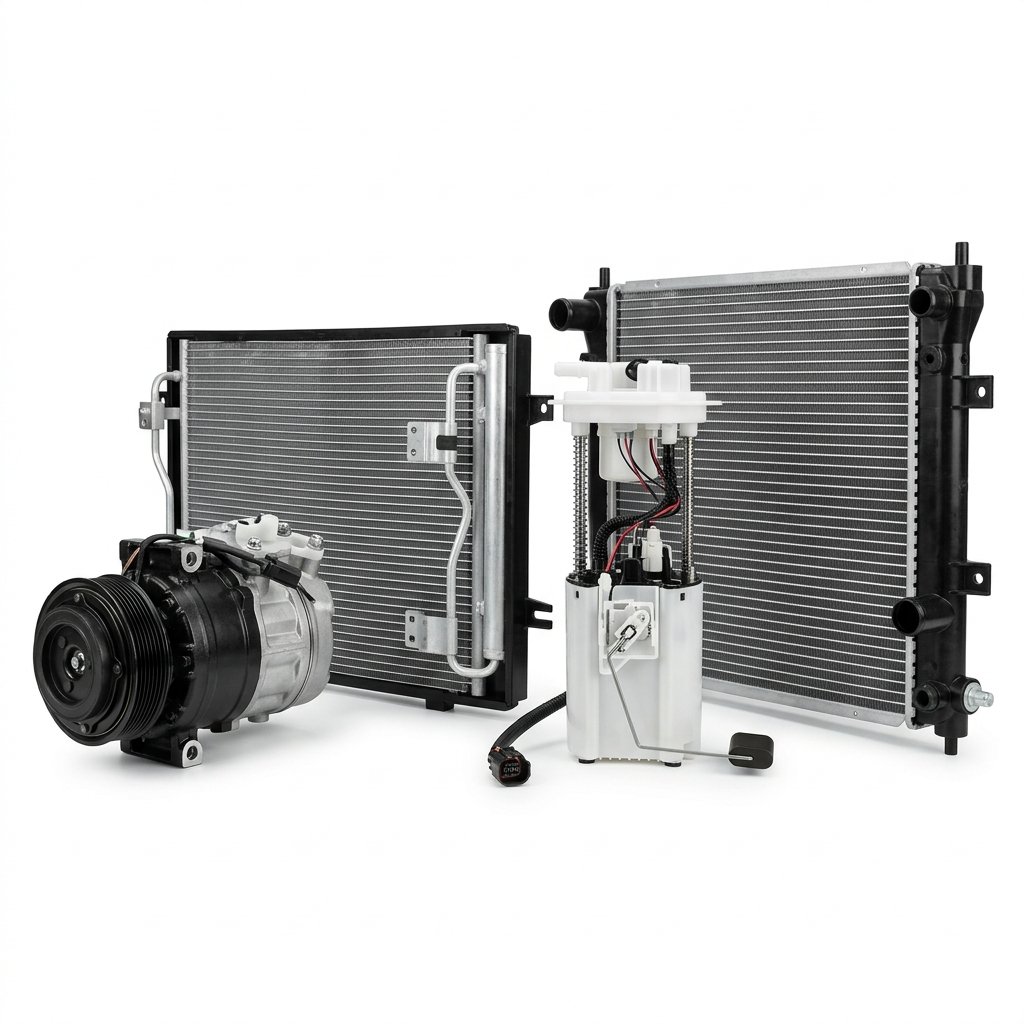
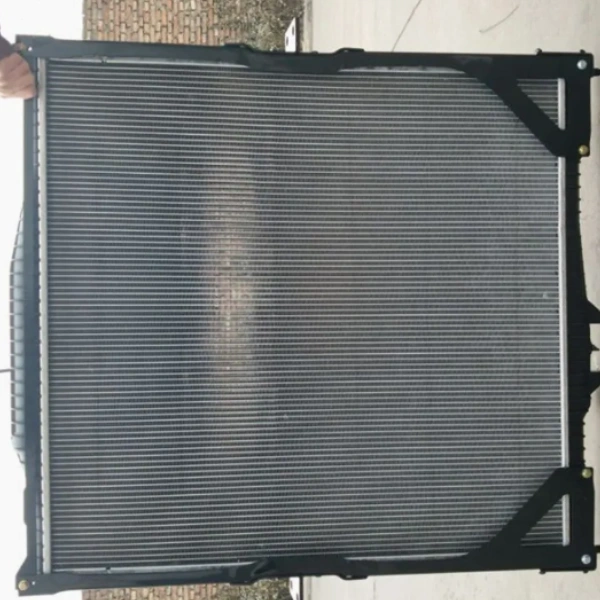
About the Volvo 50 Series Radiator
Direct fit Volvo V50 2004-2011 (8-year US production 5-door compact wagon). URL Note: ‘Volvo 50 Series’ refers to V50 wagon – 50 indicates wagon size tier in Volvo modern naming hierarchy (between 40 series S40 sedan/V40 wagon – Batch 60 vaz542, and 60 series S60/V60/XC60 mid-size). V prefix = Versatile/Wagon. V50 was compact wagon filling practical hatchback/wagon family market position in Volvo lineup.
V50 platform: Ford C1 / Volvo P1 / EUCD shared with S40 sedan 2004-2012 (Batch 60 vaz542), C30 hatchback 2007-2013 (Batch 60 vaz541), Ford Focus 2nd gen 2008-2011, Mazda3 1st gen 2004-2009. Ford-Volvo-Mazda alliance era from Ford Premier Auto Group 1999-2010 ownership of Volvo.
V50 body style: 5-door compact wagon with practical cargo area, longer roof line than S40 sedan, standard wagon profile (different from C30 coupe-like hatch). V50 was Volvo’s compact wagon offering in US market, sister to S40 sedan and (from 2007) C30 hatchback filling Volvo’s compact lineup.
V50 engines: (1) 2.4L naturally aspirated I5 (~168 HP – Volvo famous I5 engine family, DOHC 20-valve aluminum block, distinctive smooth I5 sound signature), (2) 2.5L Turbo I5 T5 (~227 HP – turbocharged performance variant with variable valve timing).
V50 transmissions: 6-speed manual M66 (Aisin sourced) or 5-speed Geartronic automatic (adaptive logic with manual mode). FWD standard, AWD optional for V50 T5 variants in some markets (V50 had more AWD availability than C30 which was FWD only US).
V50 trim levels: 2.4i (NA), T5 (turbo), R-Design (sport with Polestar-inspired styling). V50 was production successor to 1st generation V40 wagon (2000-2004 US production – see Batch 60 vaz542 40 series history for V40 detail). Modern V40 hatchback 2012-2019 was different vehicle (European-only).
Radiator definition: PRIMARY HEAT EXCHANGER in cooling system that removes heat from engine coolant via airflow across aluminum core, maintaining engine operating temperature (~195-220 degrees F for Volvo I5 engines). Function: (1) Hot coolant exits engine via upper (inlet) hose, (2) Flows into radiator top tank, (3) Distributes through many small aluminum tubes with fin construction, (4) Engine cooling fan and vehicle speed airflow pulls heat from coolant through fins, (5) Cooled coolant collects in bottom tank, (6) Returns to engine via lower (outlet) hose, (7) Cycle continues driven by water pump.
Construction: aluminum core (modern automotive – lightweight excellent heat transfer), plastic end tanks crimped to core with O-ring gasket sealing (cost effective but failure point), integrated transmission cooler for auto-equipped vehicles (separate tubes within radiator core for transmission fluid), mounting brackets to vehicle front support, inlet/outlet hose fittings, pressure cap or connection to expansion tank.
Pressure operation: cooling system operates under pressure ~15-20 PSI (raises coolant boiling point above normal 212 degrees F to ~250 degrees F for safe higher temperature operation, allows more efficient heat transfer). Pressure cap releases at set pressure preventing damage.
Common failure modes: (1) PLASTIC TANK CRACKING (MOST COMMON modern radiator failure – plastic embrittles with heat cycles over years, cracks form especially at stress points around hose fittings and crimp joints), (2) Aluminum core punctures (rocks, debris, corrosion from inside), (3) Plastic tank separation from core (crimp joint failure), (4) Mounting bracket breakage, (5) Internal corrosion/blockage (old coolant, dissimilar metal reactions reducing heat transfer), (6) TRANSMISSION COOLER CONTAMINATION (engine coolant mixing with transmission fluid – ‘strawberry milkshake’ condition catastrophic for both systems).
Symptoms: coolant leak visible under vehicle, coolant level dropping without external leak (internal failure), engine overheating (temperature gauge climbing), steam from front of vehicle, sweet coolant smell, white smoke from exhaust (severe internal leak), heater inoperative (air in system from low coolant). Replacement: moderate DIY 2-4 hours, requires coolant drain/refill, hose disconnection, mounting bracket removal, transmission cooler line disconnection if equipped, refill with proper Volvo coolant specification.
| Volvo V50 2004 (Launch Year) | Direct fit |
| Volvo V50 2005-2007 (Early Mid-Production) | Direct fit |
| Volvo V50 2008-2009 (Mid-Late) | Direct fit |
| Volvo V50 2010-2011 (Final Years) | Direct fit |
| Engine Specific: | |
| 2.4L I5 NA (2.4i trim) | Standard radiator |
| 2.5L Turbo I5 T5 (T5 trim) | Higher capacity radiator possibly |
| Transmission Specific: | |
| 6-Speed Manual M66 | No transmission cooler section |
| 5-Speed Geartronic Automatic | Includes integrated transmission cooler |
| Drivetrain: | |
| FWD Standard | Standard radiator |
| AWD T5 Variants | May have different mounting |
| Sister Vehicles (Platform Shared): | |
| Volvo S40 Sedan 2004-2012 (Batch 60 vaz542) | Same I5 – radiator may interchange |
| Volvo C30 Hatchback 2007-2013 (Batch 60 vaz541) | Same I5 – radiator may interchange |
| Ford Focus 2nd Gen | Different engine – different radiator |
| Mazda3 1st Gen | Different engine – different radiator |
| NOT Compatible: Pre-2004 V40 Wagon | Different P1 platform |
| NOT Compatible: Modern V40 Hatch 2012-2019 | European-only different platform |
Call (240) 301-0095. Critical questions: (1) Year (2004-2011). (2) Engine (2.4L NA vs 2.5L Turbo T5). (3) Manual or automatic (transmission cooler integration differs). (4) FWD or AWD (V50 T5 AWD some markets). (5) Trim (2.4i / T5 / R-Design). (6) Sister S40/C30 cross-reference if needed.
Aristotelis Konstantopoulos-Stamatides –
Replaced cracked radiator on my 2008 Volvo V50 T5 AWD (Volvo V50 5-door compact wagon within 8-year US production 2004-2011, 2.5L Turbo I5 T5 engine ~227 HP famous Volvo I5 engine family turbocharged variant with variable valve timing same engine as C30 T5 Batch 60 vaz541 and S40 T5 Batch 60 vaz542, 6-speed manual M66 transmission Aisin-sourced modern 6-speed for performance variants, AWD configuration V50 T5 AWD optional in some markets with active torque distribution front to rear axle – V50 had broader AWD availability than C30 which was FWD only US, 5-door wagon body with longer roof line than S40 sedan and practical cargo area, on Ford C1/Volvo P1/EUCD platform shared with sister vehicles S40 sedan Batch 60 vaz542 and C30 hatchback Batch 60 vaz541 plus Ford Focus 2nd Generation and Mazda3 1st Generation during Ford-Volvo-Mazda alliance era Ford Premier Automotive Group 1999-2010 Volvo ownership). Original radiator had cracked plastic upper tank near upper hose fitting – coolant leak became visible after months of small dripping plus coolant level dropping plus temperature gauge climbing toward red zone in stop-and-go traffic. Vaz educated me extensively on Volvo V50 heritage (8-year US production 2004-2011 5-door compact wagon, Ford C1/Volvo P1/EUCD platform), Volvo modern naming hierarchy context (number indicates vehicle size tier with 30=C30 compact hatch Batch 60 vaz541 reference, 40=S40 sedan/V40 wagon Batch 60 vaz542 reference, my 50=V50 wagon tier, 60=S60 sedan/V60 wagon/XC60 SUV mid-size, plus letter prefix S=Sedan V=Versatile/Wagon C=Compact XC=Cross Country/Crossover – my V50 is wagon variant in compact tier), sister vehicle context (Ford C1/Volvo P1/EUCD platform shared with my V50 plus Volvo S40 sedan 2004-2012 Batch 60 vaz542 plus Volvo C30 hatchback 2007-2013 Batch 60 vaz541 plus Ford Focus 2nd Generation 2008-2011 plus Mazda3 1st Generation 2004-2009 during Ford-Volvo-Mazda alliance era from Ford Premier Automotive Group 1999-2010 ownership of Volvo – Ford-Volvo-Mazda platform sharing extensive), Volvo I5 engine family heritage (my 2.5L Turbo T5 ~227 HP plus 2.4L NA ~168 HP – distinctive Volvo I5 sound signature with asymmetric firing intervals making distinctive warble or thrum, inline 5-cylinder rare outside Volvo and few Audi applications), 6-speed manual M66 Aisin-sourced context, V50 T5 AWD configuration context (active torque distribution, V50 had more AWD availability than C30 FWD only), V50 predecessor context (1st generation V40 wagon 2000-2004 US production on different P1 platform with Mitsubishi Carisma sister vehicle at NedCar Plant Netherlands joint venture – see Batch 60 vaz542 40 Series history), modern V40 hatchback 2012-2019 European-only different vehicle context, radiator function (primary heat exchanger removing heat from engine coolant via airflow across aluminum core), construction (aluminum core tube and fin with plastic end tanks crimped to core with O-ring sealing plus integrated transmission cooler for auto-equipped vehicles – mine was manual no cooler section plus mounting brackets plus inlet/outlet hose fittings plus pressure cap or expansion tank connection), operating pressure context (~15-20 PSI raising coolant boiling point above 212 degrees to ~250 degrees for higher temperature safe operation), operating temperature 195-220 degrees F for Volvo I5 thermostat range, common failure modes (my plastic tank cracking MOST COMMON modern radiator failure – plastic embrittles with heat cycles over years cracks form especially at stress points around hose fittings, aluminum core punctures, plastic tank separation from core crimp joint failure, mounting bracket breakage, internal corrosion/blockage, transmission cooler contamination strawberry milkshake catastrophic for both systems), symptoms (my coolant leak visible underneath plus coolant level dropping plus my engine overheating plus steam plus sweet coolant smell), and Strawberry Milkshake transmission cooler contamination catastrophic context for understanding. Sourced from 2009 V50 T5 AWD donor matching configuration. Pressure-tested at ~15 PSI for 30 minutes before shipping – held pressure no leaks. The Volvo V50 T5 AWD heritage and Ford C1/EUCD platform context was excellent.
Brunhilde Hartmann-Schweighofer –
Bought radiator for my 2006 Volvo V50 2.4i (Volvo V50 5-door compact wagon within 8-year US production 2004-2011, 2.4L naturally aspirated I5 engine ~168 HP famous Volvo I5 engine family NA variant DOHC 20-valve aluminum block distinctive smooth I5 sound signature, 5-speed Geartronic automatic transmission adaptive logic with manual shift mode, FWD only drivetrain for 2.4i variants, 5-door wagon body with practical cargo area, on Ford C1/Volvo P1/EUCD platform). Original radiator had cracked plastic tank at the transmission cooler line fitting on lower tank – coolant slowly mixing with transmission fluid was discovered during routine maintenance when transmission fluid showed early ‘strawberry milkshake’ coloration. Vaz patiently explained Volvo V50 heritage (8-year US production 2004-2011 compact wagon, sister to S40 sedan Batch 60 vaz542 and C30 hatchback Batch 60 vaz541 on shared Ford C1/Volvo P1/EUCD platform during Ford-Volvo-Mazda alliance era), Volvo modern naming hierarchy (my V50 is wagon variant in 50 series tier between 40 series S40/V40 and 60 series S60/V60/XC60), Volvo I5 engine family (my 2.4L NA 168 HP plus 2.5L Turbo T5 variant), Geartronic 5-speed automatic context (adaptive logic with manual shift mode), V50 predecessor 1st generation V40 wagon context, V50 successor V60 (2011+ different P3 platform) context, radiator function (primary heat exchanger cooling system), construction (aluminum core plus plastic tanks PLUS integrated transmission cooler section for auto-equipped vehicles – my V50 2.4i automatic had transmission cooler section in lower tank where my crack occurred), my plastic tank cracking failure most common modern radiator failure especially at hose/line fittings as stress points, my TRANSMISSION COOLER CONTAMINATION ‘STRAWBERRY MILKSHAKE’ context (engine coolant mixing with transmission fluid through internal radiator failure – catastrophic for both systems requiring complete cooling system flush plus transmission rebuild or replacement, my situation requires immediate radiator replacement plus transmission fluid replacement plus possible transmission damage assessment), symptoms warning (my transmission fluid showing ‘strawberry milkshake’ coloration is classic indicator requiring immediate radiator replacement before transmission damage from coolant in transmission causes clutch and seal damage), prevention context (regular cooling system flush every 5 years 60K miles plus regular transmission service plus replace radiator at first symptoms before catastrophic failure), and pressure operation 15-20 PSI raising boiling point above 212 to 250 degrees context. Sourced from 2007 V50 2.4i automatic donor matching configuration with intact transmission cooler section. After installation flushed cooling system completely plus replaced transmission fluid – early intervention saved transmission rebuild cost. One star off because the milkshake contamination was scary and required full system service beyond just radiator replacement. But the Volvo V50 2.4i heritage and integrated transmission cooler contamination context was excellent.