
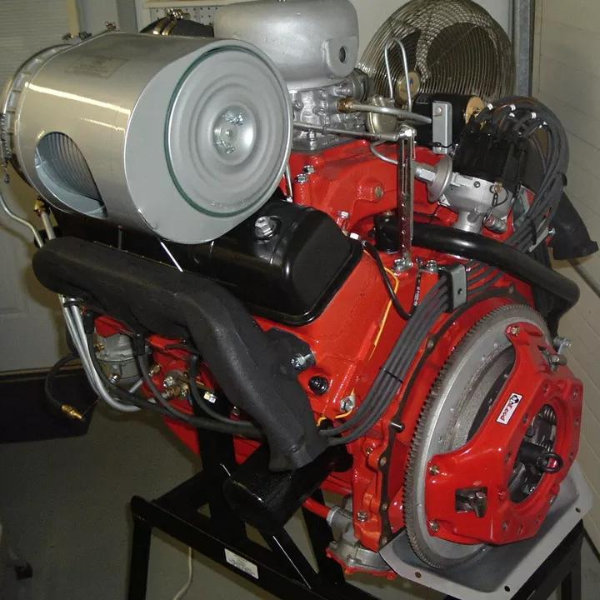


The Ford 312 Y-Block is the largest displacement member of the Ford Y-Block V8 family, produced from 1956 through 1960. The Y-Block name comes from the engine's distinctive deep-skirted block casting that extends well below the crankshaft centerline, forming a Y cross-section. This design makes the bottom end exceptionally rigid and strong but also creates the Y-Block's most well-known service characteristic: the oil pan cannot be removed in most applications without pulling the engine.
The 312 used a unique top-oiling valvetrain system where engine oil is fed through hollow pushrods to the rocker arms, then flows down the valve stems to lubricate the guides. This system requires specific attention to oil viscosity and valve stem-to-guide clearances- issues that are frequently neglected on aged Y-Block engines. A properly maintained 312 is a strong, smooth engine. One that has been run with incorrect oil or worn valve guides will show its age quickly.
In 1957, Ford offered the 312 in the Thunderbird with a factory-installed McCulloch centrifugal supercharger, making it one of the first factory-supercharged American production V8s. The supercharged 312 produced approximately 300 hp and made the 1957 T-Bird one of the fastest American production cars of its era. Standard naturally aspirated 312 versions were used across the Thunderbird, Fairlane, Crown Victoria, F-100 truck, and Edsel lineups.
The 312 was produced in several configurations across its 1956 to 1960 production run:
| Variant | Years | HP | Compression | Notes |
|---|---|---|---|---|
| 312 2V Standard | 1956 to 1960 | 210 to 215 hp | 8.4:1 | Base 312 with 2-barrel carb. Most common variant. Truck and full-size applications. |
| 312 4V Performance | 1956 to 1960 | 225 to 245 hp | 9.7:1 | 4-barrel carb, higher compression. Thunderbird and Fairlane performance option. |
| 312 Dual 4V | 1957 | 270 to 285 hp | 9.7:1 | Dual Holley 4-barrel setup. Very rare. Thunderbird performance package. |
| 312 Supercharged (McCulloch) | 1957 only | 300 hp | 8.5:1 | Factory McCulloch centrifugal supercharger. 1957 Thunderbird only. One of first factory-supercharged US V8s. |
| INCLUDED- Long Block | Block, crankshaft, pistons, connecting rods, camshaft, cylinder heads, hollow-pushrod valve train, oil pan, front timing cover, and water pump where present. |
|---|---|
| NOT INCLUDED | Intake manifold, carburetor, exhaust manifolds, distributor, ignition system, alternator, starter, flywheel or flexplate, accessory brackets. Supercharger unit not included on supercharged variants. |
| Core Note | No core charge. You are not required to return your old engine. |
The Ford 312 Y-Block was factory installed in the following vehicles:
| Ford Thunderbird | 1956 to 1957 (standard and supercharged variants) |
|---|---|
| Ford Fairlane and Mainline | 1956 to 1959 |
| Ford Crown Victoria | 1956 to 1959 |
| Ford F-100 and F-250 Truck | 1956 to 1960 |
| Edsel (all models) | 1958 to 1960 |
| Mercury Montclair and Monterey | 1956 to 1957 (some applications) |
The 312 Y-Block uses a different bellhousing bolt pattern from later Ford Windsor and FE engines. It is not directly swap-compatible with 289, 302, or 351W engines without adapter plates. For a like-for-like restoration replacement, match the original 312 application exactly. Call (240) 301-0095 with your specific vehicle details before ordering.
Transmission compatibility: Ford-O-Matic 2-speed automatic- most common period pairing | Ford 3-speed manual- base applications. The Y-Block bellhousing pattern is unique to the Y-Block family.
Not sure if this fits? Call (240) 301-0095 with your year, make, model, and current drivetrain. We verify fitment before every order ships.
Used OEM vs Rebuilt vs Aftermarket- Which Is Right for You?
Used OEM is the right choice for a Thunderbird, Crown Victoria, or F-100 restoration where a tested compression-confirmed 312 is the foundation. Clean Y-Block units are genuinely scarce- a tested unit is a significant find.
A specialist rebuild makes sense for a show-quality Thunderbird or if the unit you receive needs internal work. Y-Block rebuild specialists are a small but dedicated community. Call us and we can advise on the current unit's condition and whether a rebuild is warranted.
Mileage varies by unit. Where available from the donor vehicle we provide it. Where mileage cannot be confirmed, we disclose this before your order is placed.
| Displacement | 312 cu in (5.1L) |
|---|---|
| Engine Family | Ford Y-Block |
| Configuration | V8 | OHV | 16 valves |
| Bore X Stroke | 3.800 in x 3.440 in |
| Aspiration | Naturally Aspirated (standard) | Supercharged 1957 Thunderbird only |
| Valve Train | OHV | top-oiling through hollow pushrods |
| Block Material | Cast iron (deep-skirted Y cross-section) |
| Head Material | Cast iron |
| Production Years | 1956 to 1960 |
| Manufacturer | Ford Motor Company |
| Horsepower | confirmed at order | 210 to 300 hp- variant dependent |
| Torque | Approximately 317 to 332 lb-ft naturally aspirated |
| Compression Ratio | 8.4:1 to 9.7:1 depending on variant |
| Special Note | Oil pan removal requires engine removal in most applications- unique Y-Block service characteristic |
| Condition | Used OEM | compression tested and inspected |
Every used Ford 312 Y-Block Engine For Sale sold by Vaz Auto Solutions is covered by a 15 day replacement warranty from the date of delivery.
To make a claim, contact us within 15 days of delivery at (240) 301-0095 or info@vazautosolutions.com.


