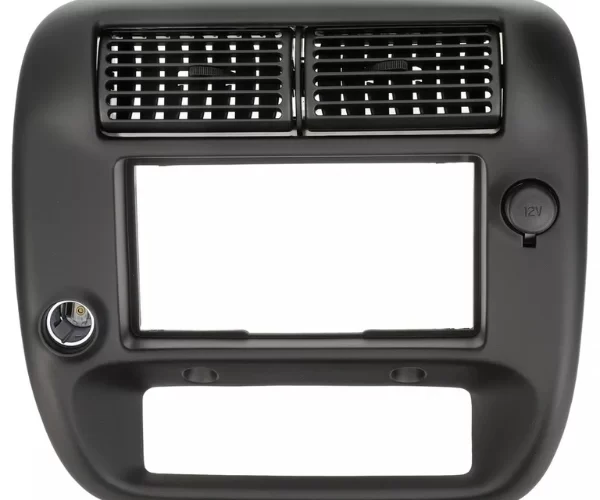
About the Ford Explorer Radio Bezel Trim
Direct fit Ford Explorer mid-size SUV 1991-current (33+ years across 6 generations). ONE OF MOST SUCCESSFUL SUVs in US automotive history with 8 million+ US units sold. Explorer was largely responsible for the SUV boom of 1990s-2000s. Replaced compact Ford Bronco II in 1991. Includes unique Sport Trac variant 2001-2010 with crew cab pickup bed.
Six generations: 1st gen 1991-1994 (replaced Bronco II, Ranger-based body-on-frame), 2nd gen 1995-2001 (most popular era, famous Firestone tire recall controversy 2000-2001), 3rd gen 2002-2005 (introduced IRS independent rear suspension - first mainstream SUV with IRS), 4th gen 2006-2010 (Limited premium era with 4.6L Modular V8), 5th gen 2011-2019 (MAJOR PARADIGM SHIFT to unibody crossover construction based on Ford Taurus platform), 6th gen 2020-current (return to RWD-based CD6 platform shared with Lincoln Aviator, Explorer ST ~400 HP).
Engines: 4.0L Cologne V6 (older), 4.0L SOHC V6, 5.0L V8 (2nd gen optional), 4.6L Modular V8 (3rd-4th gen), 3.5L Duratec V6 (5th gen), 3.5L EcoBoost Twin-Turbo V6 (Sport/Police ~365 HP, same engine family as Taurus SHO), 2.3L/2.0L EcoBoost I4, 3.0L EcoBoost V6 (6th gen including ST ~400 HP), hybrid powertrains (6th gen). Transmissions: 4/5-speed auto older, 6F50 6-speed auto (5th gen), 10R60 10-speed auto (6th gen). 2WD/4WD/AWD across generations.
Police Interceptor Utility (PIU) - 5th and 6th gen Explorer is most common US police vehicle replacing Crown Victoria. Explorer ST 6th gen ~400 HP is first ST Explorer in Ford Performance brand era. Radio bezel trim: interior dash trim panel around radio/infotainment head unit, includes HVAC vents, hazard switches, function buttons. Plastic with various finishes - black plastic standard, wood-grain (Eddie Bauer/Limited), chrome accents, silver/aluminum-look, modern brushed metal or piano black.
Explorer Six Generations
- 1st Gen 1991-1994: Replaced Bronco II, Ranger-based
- 2nd Gen 1995-2001: Most popular, Firestone controversy
- 3rd Gen 2002-2005: IRS introduction
- 4th Gen 2006-2010: Limited premium era
- 5th Gen 2011-2019: Unibody crossover (Taurus platform)
- 6th Gen 2020-Current: RWD CD6 platform, Explorer ST
Explorer Heritage
- Production: 1991-current (33+ years)
- Sales: 8 million+ US units
- Sport Trac: 2001-2010 unique crew cab pickup bed
- Police PIU: Most common US police vehicle
- Explorer ST: 6th gen 3.0L EcoBoost ~400 HP first ST
Vehicle Compatibility
Explorer Multi-Generation Coverage:
| Trim | Description |
|---|
| Ford Explorer 1991-1994 (1st Gen) | Replaced Bronco II era |
| Ford Explorer 1995-2001 (2nd Gen) | Most popular era |
| Ford Explorer 2002-2005 (3rd Gen) | IRS era |
| Ford Explorer 2006-2010 (4th Gen) | Limited premium era |
| Ford Explorer 2011-2019 (5th Gen) | Unibody crossover Taurus-based |
| Ford Explorer 2020-Current (6th Gen) | RWD CD6 platform Aviator-shared |
| Ford Explorer Sport Trac 2001-2010 | Crew cab pickup bed variant |
| Eddie Bauer Trim Variants | Wood-grain trim distinct |
| Limited Trim Variants | Premium appointments distinct |
| Sport Trim Variants | Sporty styling distinct |
| Platinum Trim Variants (Recent) | Most luxurious modern trim |
| ST Trim Variants (6th Gen) | Performance trim with distinct interior |
| Police Interceptor Utility 2011+ | Different dash layout for police equipment |
| NOT Compatible: Ford Bronco II (1984-1990) | Different vehicle (predecessor) |
| NOT Compatible: Ford Bronco (1966-1996, 2021+) | Different vehicle |
| NOT Compatible: Ford Expedition | Different vehicle (full-size SUV) |
| NOT Compatible: Cross-Generation Without Verification | 6 generations differ significantly |
Fitment Assistance
Call (240) 301-0095. Critical questions: (1) GENERATION (CRITICAL - 6 different generations). (2) Specific year. (3) Trim level (base XL/XLT vs Eddie Bauer/Limited/Platinum/ST - different finishes). (4) Standard Explorer or Sport Trac (different dash). (5) Radio/infotainment type (cassette/CD/SYNC/SYNC 3 require different cutouts). (6) Police Interceptor Utility (PIU)? (Different dash layout). (7) Interior color of trim acceptable.
Condition and Inspection
- No cracks in plastic
- Mounting tabs present Hold bezel to dash
- Switches functional Hazard, defrost, locks
- HVAC vents intact if equipped
- Wood-grain/finish in good condition Trim levels
- Trim level verified Eddie Bauer/Limited/etc.
- Year/generation verified
- Radio cutout matches expected radio type
- Sport Trac vs standard Explorer noted
- No major fading
- Donor vehicle disclosed
- Cleaned of dust and debris
Why Buy from Us
- For Ford Explorer radio bezel trim
- All 6 generations coverage 1991-current
- 33+ years multi-generation expertise
- One of best-selling US SUVs context (8M+ units)
- Bronco II to Explorer transition heritage
- Firestone controversy historical context
- IRS introduction 3rd gen knowledge
- 5th gen unibody crossover paradigm shift
- 6th gen RWD CD6 platform return
- Lincoln Aviator platform-sharing context
- Sport Trac unique variant heritage
- Police Interceptor Utility expertise
- Explorer ST 6th gen heritage
- Cologne V6 to EcoBoost engine evolution
- Modular V8 4.6L knowledge
- EcoBoost twin-turbo V6 knowledge
- Trim level differentiation
- Eddie Bauer / Limited / Platinum / ST trims
- Wood-grain vs modern finishes
- Radio head unit cutout knowledge
- Switch functionality verified
- Donor vehicle disclosed
- Excellent salvage donor pool
- Free shipping all 50 states
- 15 day warranty
- No core charge
What makes the Ford Explorer historically significant?
The Ford EXPLORER is one of MOST HISTORICALLY SIGNIFICANT VEHICLES in modern US automotive history: (1) SUV BOOM CATALYST - Explorer was largely responsible for SUV BOOM of 1990s-2000s that fundamentally transformed US automotive market: (a) Before Explorer: SUVs were niche (Suburban, Bronco, etc.), most families bought sedans and station wagons. (b) After Explorer: SUVs became mainstream family vehicles. (c) Every manufacturer followed Ford with mid-size SUV offerings. (d) Eventually wagons largely disappeared, sedans declined dramatically. (2) MARKET TRANSFORMATION: SUV market share US (1990): ~5% of new vehicle sales. SUV market share US (2020): ~50%+ of new vehicle sales. Explorer led this transformation. (3) SALES VOLUME - 8 million+ US units sold across 33+ years. Among best-selling SUVs in US history. (4) SIX GENERATIONS continuous production demonstrates enduring market relevance. (5) INNOVATIONS: (a) 3rd gen 2002 introduced IRS to mainstream mid-size SUV. (b) 5th gen 2011 introduced unibody crossover construction. (c) Police Interceptor Utility replaced Crown Vic as most common US police vehicle. (d) 6th gen Explorer ST 400 HP - performance SUV. (6) FIRESTONE CONTROVERSY 2000-2001 - linked tire failures and rollover incidents brought massive litigation and recall. Resulted in: federal NHTSA investigations, Firestone-Ford partnership dissolution, vehicle safety improvements industry-wide, congressional hearings, consumer awareness of SUV rollover risks. (7) SPORT TRAC INNOVATION 2001-2010 - unique crew cab pickup bed variant predicted future vehicles like Honda Ridgeline and Hyundai Santa Cruz. (8) POLICE INTERCEPTOR UTILITY 2011+ - Explorer-based police vehicle replaced Crown Victoria as most common US police vehicle. Most US police departments now use Explorer-based PIU. (9) CULTURAL IMPACT - Explorer is iconic American family SUV, recognizable across generations. Featured prominently in American suburban culture, family travel, soccer mom imagery.
What's the difference between Explorer generations?
Ford Explorer has SIX GENERATIONS across 33+ years with significant evolution: (1) 1ST GEN 1991-1994 (4 years) - Replaced compact Bronco II, body-on-frame construction based on Ranger pickup platform. 4.0L Cologne V6 OHV main engine. 2-door and 4-door body styles. Body-on-frame ruggedness. Established modern American SUV format. (2) 2ND GEN 1995-2001 (7 years, MOST POPULAR ERA) - Significantly updated styling and interior, more refined family SUV. Engines: 4.0L OHV V6, 4.0L SOHC V6, 5.0L V8 optional. 2-door 'Explorer Sport' variant. Famous Firestone tire recall controversy 2000-2001 affected reputation. (3) 3RD GEN 2002-2005 (4 years, MAJOR REDESIGN) - Independent Rear Suspension (IRS) introduction - first mainstream mid-size SUV with IRS, more carlike ride/handling. 4.0L V6 and 4.6L Modular V8. Sport Trac variant introduced 2001 (with pickup bed). (4) 4TH GEN 2006-2010 (5 years) - Continued body-on-frame with IRS, updated styling. 4.0L V6 and 4.6L Modular V8. Limited premium trim era with wood-grain interior. Eddie Bauer continued. (5) 5TH GEN 2011-2019 (9 years, MAJOR PARADIGM SHIFT) - UNIBODY CROSSOVER construction based on Ford Taurus platform (FWD-based with AWD). NO MORE body-on-frame. More carlike driving. 3rd row standard. 3.5L Duratec V6, 3.5L EcoBoost Twin-Turbo V6 (Sport/Police), 2.3L/2.0L EcoBoost I4. Famous Police Interceptor Utility variant. (6) 6TH GEN 2020-CURRENT - Returned to REAR-WHEEL-DRIVE-BASED architecture from CD6 platform shared with Lincoln Aviator. RWD standard, AWD optional. 2.3L EcoBoost I4, 3.0L EcoBoost V6, hybrid powertrains. Famous Explorer ST performance variant 2020+ with 3.0L EcoBoost ~400 HP - first ST Explorer. Different radio bezel trims between generations - always specify when ordering.
What was the Firestone tire controversy?
The FIRESTONE-FORD CONTROVERSY 2000-2001 was MAJOR auto industry crisis affecting Ford Explorer: (1) BACKGROUND - 2nd gen Ford Explorer 1995-2001 came with Firestone Wilderness AT and ATX tires as factory equipment. (2) TIRE FAILURES - reports emerged of: tire tread separation failures, tire blowouts, especially in hot weather/highway driving. Hundreds of cases reported. (3) ROLLOVERS - tire failures often led to Explorer ROLLOVERS due to: SUV higher center of gravity, vehicle dynamics under sudden tire failure, potentially design considerations. Some fatal accidents. (4) NHTSA INVESTIGATION - National Highway Traffic Safety Administration investigated. Determined: many tire failures, some Explorer rollover predisposition combined with tire issues, complex causation. (5) RECALL - Firestone recalled approximately 6.5 MILLION tires (August 2000). Ford's 13 MILLION more tires later (May 2001). Massive recall - one of largest in US history. (6) FORD-FIRESTONE BREAKDOWN - Long-standing Ford-Firestone relationship (Firestone family had supplied Ford tires since Henry Ford era) ended over controversy. Companies blamed each other publicly. (7) CONGRESSIONAL HEARINGS - Congressional investigations 2000-2001. CEOs testified. Tread Act legislation passed 2000. (8) LITIGATION - massive class-action and individual lawsuits. Billions in settlements. (9) VEHICLE IMPROVEMENTS - subsequent Explorer generations addressed: Electronic Stability Control (ESC) standard, tire pressure monitoring TPMS, improved suspension geometry, lower center of gravity in 5th gen unibody, better tire specifications. (10) INDUSTRY IMPACT - led to mandatory TPMS on all vehicles 2007+, NHTSA rollover ratings, stricter tire testing standards. (11) REPUTATION - affected Explorer reputation significantly through 2000s. Sales declined. Recovered eventually. (12) HISTORICAL SIGNIFICANCE - the Firestone controversy is cited in product liability law, automotive engineering, and corporate communication courses as case study in: corporate responsibility, supply chain management, crisis communication, regulatory response.
What's the Police Interceptor Utility?
The POLICE INTERCEPTOR UTILITY (PIU) is Ford EXPLORER-BASED POLICE VEHICLE: (1) HISTORY: Ford launched PIU 2011 as 5th gen Explorer-based police vehicle. Continues 6th gen 2020+. (2) PURPOSE - replaced Ford CROWN VICTORIA POLICE INTERCEPTOR (1998-2011, dedicated police sedan based on Crown Vic platform documented in earlier batches) as Ford's police vehicle offering. (3) WHY REPLACED CROWN VIC: Crown Vic discontinued 2011 due to declining sedan platform investment. PIU offered: (a) AWD capability (Crown Vic was RWD only). (b) More interior space for police equipment. (c) Better ground clearance. (d) Same passenger capacity. (e) Hybrid options later. (4) PIU FEATURES vs civilian Explorer: (a) Heavy-duty cooling system. (b) Heavy-duty alternator for police equipment. (c) Engine idle hours certified. (d) Police-specific suspension tuning. (e) Vinyl seats (cleaning). (f) Heavy-duty wiring for equipment. (g) Smaller front bucket seats (police belt accommodation). (h) Specific police LED lighting provisions. (i) Modified dashboard (radar, computer mounts). (j) Steel wheels (cost savings). (5) ENGINES: 3.5L Duratec V6, 3.5L EcoBoost Twin-Turbo V6 (popular police engine), 3.0L EcoBoost V6 (6th gen), hybrid options. (6) MARKET DOMINANCE - PIU is MOST COMMON US POLICE VEHICLE: Replaced Crown Victoria across most US police departments, large city and small town police use Explorers heavily, federal agencies use PIU extensively, state highway patrol some adoption. (7) ALTERNATIVES - Chevy Tahoe (other popular police SUV), Dodge Charger Pursuit (police sedan still produced), Chevy Silverado (police pickup), Ford F-150 (police pickup). (8) AS USED VEHICLE - former police PIUs sold to civilians or fleet customers, often have HIGH MILES but maintained well, can be good value. (9) FOR PARTS - police PIU shares most parts with civilian Explorer. Radio bezel may differ due to: police-specific dash layout, mounting holes for police equipment, removed civilian features. Specify if vehicle is PIU when ordering.
What was the Ford Explorer Sport Trac?
The Ford EXPLORER SPORT TRAC was UNIQUE VEHICLE 2001-2010 (10 years): (1) CONCEPT - 4-DOOR CREW CAB body PLUS PICKUP TRUCK BED, combining SUV interior with pickup utility. (2) WHY IT EXISTED: Ford identified customers wanting both: comfortable family SUV interior, pickup bed cargo utility, single vehicle for both family and work. (3) DESIGN: 4-door crew cab (full passenger seating), pickup bed behind cab (4.5-foot bed approximately), unibody/body-on-frame construction matching Explorer of era. (4) BASED ON EXPLORER PLATFORM but with pickup bed instead of SUV cargo area. (5) ENGINES: 4.0L V6 (1st gen Sport Trac), 4.0L SOHC V6 and 4.6L Modular V8 (2nd gen). (6) PRODUCTION: 1st gen Sport Trac 2001-2005 (based on 3rd gen Explorer), 2nd gen Sport Trac 2007-2010 (based on 4th gen Explorer). (7) SALES PERFORMANCE - moderate success, never dominant. Customer base was niche. Customers wanting full SUV interior compromise with smaller bed than full pickup, customers wanting pickup utility found dedicated pickup trucks better. (8) DISCONTINUED 2010 - customer preference shifted to either full SUV (Explorer) or full pickup truck (F-150). Sport Trac neither dominated market. (9) MODERN SUCCESSORS - the Sport Trac concept revived years later: (a) HONDA RIDGELINE 2005-current (4-door crew cab pickup with utility). (b) HYUNDAI SANTA CRUZ 2022+ (crew cab pickup with crossover styling). (c) FORD MAVERICK 2022+ (compact crew cab pickup, more pickup-focused than Sport Trac). (10) AS COLLECTOR VEHICLE - Sport Trac becoming interesting collector vehicle as: unique format from major manufacturer, limited production years, distinctive styling, useful concept. (11) FOR PARTS - Sport Trac shares many components with Explorer of same year but has DIFFERENT: bed sheet metal (not SUV cargo area), some interior layout differences, specific Sport Trac trim. Radio bezel may interchange with Explorer of same year - verify configuration.
What is the Explorer ST?
The Ford EXPLORER ST is PERFORMANCE VARIANT of 6th gen Explorer (2020+): (1) ST DESIGNATION - 'Sport Tuned' or 'Sport Technology' designation used by Ford for performance variants. ST heritage includes Focus ST and Edge ST. (2) ENGINE - 3.0L EcoBoost V6 producing ~400 HP and 415 lb-ft torque. Twin-turbocharged. Same engine family as Lincoln Aviator (sister vehicle on CD6 platform). (3) DRIVETRAIN - AWD STANDARD with Sport Mode and adjustable drive modes. (4) TRANSMISSION - 10R60 10-SPEED AUTOMATIC (Ford-GM joint development). (5) PERFORMANCE: 0-60 mph in ~5.5 seconds, top speed governed ~143 mph. Competitive with: Jeep Grand Cherokee SRT/Trackhawk, Dodge Durango SRT, BMW X3 M, Mercedes-AMG GLE 43. (6) STYLING: aggressive front fascia, ST-specific wheels (20-21 inch), dual exhaust with prominent tips, sport-tuned suspension, more aggressive rear styling, ST badging. (7) INTERIOR: ST-specific sport seats, leather/Alcantara combinations, performance gauges, ST badging, premium audio system. (8) MSRP $50,000-55,000+ (significantly more than base Explorer ~$35,000). (9) FIRST EXPLORER ST - Ford's FIRST performance Explorer in Ford Performance brand era. Prior premium Explorer was Sport variant (5th gen 2013-2019) with EcoBoost V6 but not officially 'ST'. (10) PRODUCTION VOLUME - approximately 10-20% of Explorer production is ST trim (significant volume for performance variant). (11) MARKET POSITION - performance family SUV combining: 3-row seating, family practicality, sports-car-like performance, premium appointments. Tries to replace customer need for separate sports car. (12) FOR RADIO BEZEL specifically - Explorer ST has SPECIFIC interior trim including: ST-badged accents, possibly different finishes (carbon fiber-look, alcantara accents), modern infotainment screen surround. Specify ST when ordering for 6th gen 2020+ vehicles.
How do I install a radio bezel trim?
Ford Explorer radio bezel trim installation: (1) Disconnect battery for safety (prevents accidental airbag/electrical events). (2) Park on level surface. (3) IDENTIFY MOUNTING POINTS - radio bezel typically secured by: hidden mounting clips (snap-fit), Phillips or Torx screws (sometimes hidden behind covers), tabs into dash structure. (4) REMOVE OLD BEZEL: (a) Locate any visible screws (often near top/bottom of bezel). (b) Carefully pry edges with plastic trim removal tool (not screwdriver - damages plastic). (c) Start at one edge and work around perimeter releasing clips. (d) Pull bezel out carefully. (e) Disconnect any wiring (HVAC controls, hazard switch, defrost, lock switches). (5) Compare new bezel to old for: same configuration, same color/finish, same cutouts for radio type, same switch positions. (6) PREPARE NEW BEZEL: (a) Transfer any switches/controls from old bezel if not included. (b) Clean any contamination. (c) Verify mounting clips intact. (7) INSTALL NEW BEZEL: (a) Connect wiring for switches/controls. (b) Position bezel carefully on dash. (c) Engage mounting clips around perimeter. (d) Install any screws (don't overtighten plastic). (e) Press firmly to seat all clips. (8) RECONNECT BATTERY. (9) TEST FUNCTIONALITY: (a) Radio/infotainment operation. (b) HVAC controls. (c) Hazard light switch. (d) Defrost switches. (e) Any other switches. (10) Verify alignment - even gaps with surrounding dash trim, no twisting. 30-60 minutes typical. TIPS: gentle pressure on plastic prevents cracking, use plastic trim tools not metal screwdrivers, label connectors if multiple to ease reconnection, take photo of original installation for reference.
How does shipping work?
Free shipping to all 50 US states. Ford Explorer radio bezel trim is small/lightweight (1-3 lbs) shipped in padded box. UPS or FedEx Ground typical (3-7 days transit). Excellent salvage donor pool from 33+ years of Explorer production and 8 million+ US units - any generation likely available. Sport Trac variants may take slightly longer due to lower production volumes. Premium trim variants (Eddie Bauer wood-grain, Limited, Platinum, ST) may take longer for specific finishes/colors. Aftermarket Explorer interior trim widely available if used OE not available.