
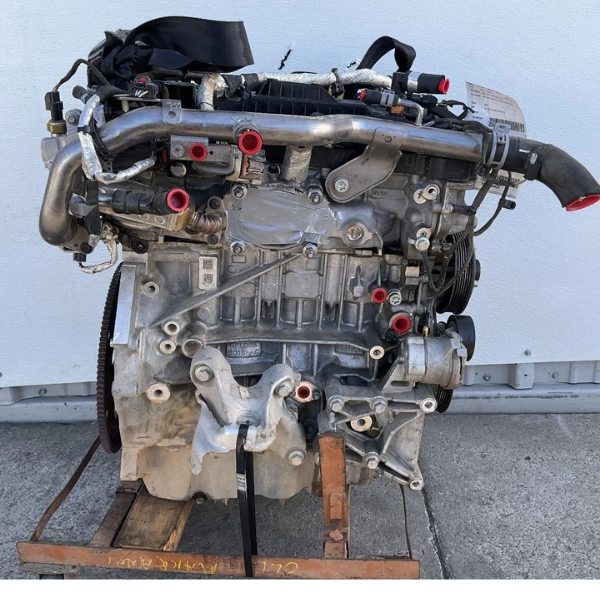



The Ford Ranger 2.3 Lima OHC engine is one of the most long-lived four-cylinder engines in American truck history. Introduced in the Ranger for 1983, it traces its roots directly to the German-designed 2.0-liter EAO engine that powered European Ford Cortinas and US-market Mercury Capris in the early 1970s. Ford expanded it to 2.3 liters for the 1974 Pinto and carried the architecture into the compact truck lineup, where it remained the standard four-cylinder in the Ranger until 1997- a 14-year run in the Ranger alone.
The Lima 2.3 went through three significant evolution phases in the Ranger. The early carbureted versions from 1983 to 1988 used a flat-tappet camshaft, a two-piece rope rear main seal (pre-1986), and a Duraspark distributor. The 1988 model year introduced a hydraulic roller camshaft- a significant improvement in durability and reduced oil consumption- along with smaller-diameter crankshaft main journals. The 1989 model year introduced the most distinctive version: a distributorless ignition system with dual spark plugs (two plugs per cylinder, eight total), multi-point EFI, and a revised cylinder head. This DIS version produced 105 hp vs the early carbureted unit's 82 hp.
The Lima 2.3 also powered the Bronco II, the Fox Body Mustang (both the turbocharged SVO version and the naturally aspirated base), and various Ford Mustang applications from 1979 through 1993. The Ranger application is specifically the naturally aspirated version- the turbocharged variants found in Mustang SVO and Thunderbird Turbo Coupe were never installed in the Ranger.
Three distinct generations define the Ranger 2.3 Lima across its production life:
| Generation | Years | HP | Ignition | Key Changes |
|---|---|---|---|---|
| Early Carb / Duraspark | 1983 to 1985 | 82 hp | Distributor | 2-barrel carb. Flat-tappet cam. Two-piece rope rear main seal. 9.0:1 compression. |
| Mid Carb / Updated | 1986 to 1988 | 88 hp | Distributor | One-piece lip rear main seal (1986). Roller cam (1988). Reduced main journal diameter (1988). 9.0:1 compression. |
| Late EFI / DIS | 1989 to 1997 | 105 hp | Dual-plug DIS | 2 spark plugs per cylinder (8 total). Multi-point EFI. Better head design. 9.2 to 9.4:1 compression. Most capable naturally aspirated Lima. |
| INCLUDED- Long Block | Block, crankshaft, pistons, connecting rods, SOHC camshaft, cylinder head, valve train, oil pan, front timing cover. Timing belt and tensioner NOT included- always replace at installation. |
|---|---|
| NOT INCLUDED | Timing belt and tensioner (replace at installation- MANDATORY), intake manifold, carburetor or EFI system, distributor (pre-DIS) or DIS module and coil pack (DIS), alternator, power steering pump, starter, flywheel, accessory brackets. |
| TIMING BELT WARNING | The Ford Lima 2.3 uses a rubber timing belt on an interference engine. ALWAYS replace the timing belt, tensioner, and idler at installation regardless of apparent condition. A broken belt destroys the head. |
| Core Note | No core charge. You are not required to return your old engine. |
The Ford Lima 2.3 OHC was factory installed in the following vehicles:
| Ford Ranger (2WD and 4WD) | 1983 to 1997- base 4-cylinder engine across all Ranger generations |
|---|---|
| Ford Bronco II | 1984 to 1990- naturally aspirated Lima 2.3 |
| Ford Mustang (Fox Body) | 1979 to 1993- naturally aspirated base 2.3 (not the turbocharged SVO version) |
| Ford Pinto and Mercury Bobcat | 1974 to 1980- original Lima 2.3 application |
| Ford Fairmont and Mercury Zephyr | 1978 to 1983 |
The Lima 2.3 uses the same external motor mount provisions across the Ranger and Bronco II applications, making it a direct replacement within those platforms. For a DIS-to-DIS or carb-to-carb swap, no fuel system conversion is needed. For a DIS engine going into a pre-DIS application, the complete fuel and ignition system from the DIS donor vehicle must accompany the engine. Call (240) 301-0095 with your year and current engine variant and we will advise on compatibility.
Transmission compatibility: Ford 5-speed manual (Mitsubishi-sourced, early Ranger) | Ford 4-speed manual (some early applications) | Ford A4LD 4-speed automatic | Ford C3 3-speed automatic (some early applications). Confirm your transmission before ordering.
Not sure if this fits? Call (240) 301-0095. We verify fitment before every order ships.
Used OEM vs Rebuilt- Which Is Right for You?
Used OEM is the right choice for a Ranger, Bronco II, or Fox Mustang replacement- particularly where a compression-tested documented engine with confirmed ignition system variant is needed. Our units are documented with ignition type, cam type, and seal generation confirmed before shipping.
A rebuilt Lima 2.3 makes sense if you want fresh tolerances and a new timing belt assembly throughout. Ford Lima specialists are relatively few but active in the Ranger and Fox Mustang communities. Call us and we can discuss what current unit condition warrants.
Mileage varies by unit. Where available from the donor vehicle we provide it. Where mileage cannot be confirmed, we disclose this before your order is placed.
| Displacement | 2 | 301 cc (2.3L / 140.5 cu in) |
|---|---|
| Engine Family | Ford Lima OHC (EAO / Pinto engine) |
| Configuration | Inline-4 | 8 valves | SOHC |
| Bore X Stroke | 96.0 mm x 79.5 mm |
| Aspiration | Naturally Aspirated |
| Timing System | Rubber timing belt- interference engine- MUST replace at installation |
| Cam Type | Flat-tappet (1983 to 1987) | Hydraulic roller (1988 onward) |
| Ignition | Distributor (1983 to 1988) | Dual-plug DIS- 8 spark plugs total (1989 onward) |
| Fuel System | 2-barrel carb (1983 to 1988) | Multi-point EFI (1989 to 1997) |
| Rear Main Seal | Two-piece rope (1983 to 1985) | One-piece lip (1986 onward) |
| Block Material | Cast Iron |
| Head Material | Cast iron |
| Production Years Ranger | 1983 to 1997 (Lima OHC) |
| Manufacturer | Ford Motor Company (Lima | Ohio plant) |
| Horsepower | 82 to 105 hp- year and variant dependent |
| Compatible Transmissions | Ford 5-speed manual | A4LD 4-speed auto | C3 3-speed auto |
| Condition | Used OEM | compression tested and inspected |
Every used Ford Ranger 2.3 Engine For Sale sold by Vaz Auto Solutions is covered by a 15 day replacement warranty from the date of delivery.
To make a claim, contact us within 15 days of delivery at (240) 301-0095 or info@vazautosolutions.com.


