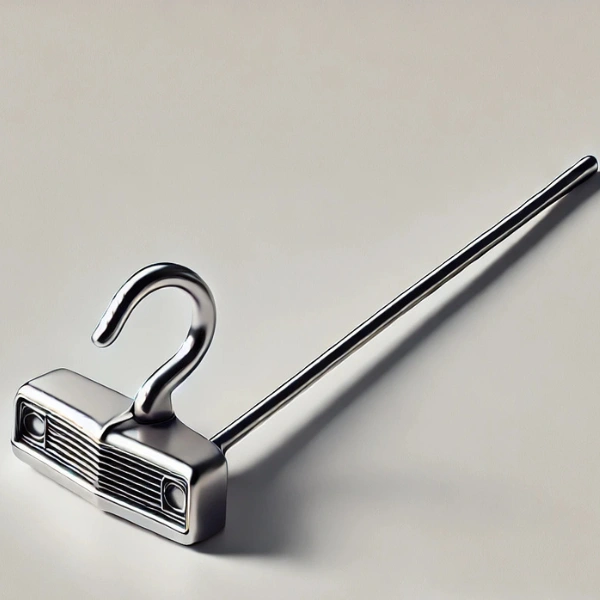
About the Chrysler Cordoba Hood Prop
Direct fit Chrysler Cordoba personal luxury coupe 1975-1983 (9 years US production, single generation with multiple sub-eras). One of most memorable American personal luxury coupes of 1970s era, Chrysler's entry competing with Ford Thunderbird, Pontiac Grand Prix, Buick Riviera, Oldsmobile Toronado, Mercury Cougar, Chevrolet Monte Carlo, Lincoln Mark Series.
Famous for the ICONIC RICARDO MONTALBAN 'fine Corinthian leather' television advertising campaign (1975-1980) that made Cordoba a cultural touchstone of 1970s American automotive marketing. 'Corinthian leather' was actually marketing invention - no such leather type exists - but the smooth sophisticated delivery by Mr. Montalban (later famous as Mr. Roarke on Fantasy Island and Khan in Star Trek II) created peak aspirational car advertising.
Two production eras: 1st gen B-Body 1975-1979 (peak personal luxury brougham styling with optional hidden headlights, vinyl roof, opera windows, stand-up hood ornament, engines 318/360 LA V8 plus 400 B-Block V8 plus 440 RB-Block V8). 2nd gen J-Body 1980-1983 (downsized smaller Cordoba sharing platform with Dodge Mirada and Chrysler Imperial, 318 LA V8 main, 225 Slant-6 base late production, no big-block V8 after downsizing). Sister vehicles: Dodge Charger SE/Magnum (1975-1979), Dodge Mirada (1980-1983).
TorqueFlite 727 3-speed automatic transmission (famous Chrysler workhorse, bulletproof reliability), RWD only, 2-door coupe only. Discontinued 1983 due to personal luxury coupe market decline and Chrysler focus shift to K-Car platform under Lee Iacocca recovery strategy after near-bankruptcy 1979-1980. Hood prop: simple steel rod stored in inner fender clip, hooks into hole in hood underside to hold hood open ~45 degrees for engine bay access. Pre-hydraulic-strut era component.
Cordoba Sub-Generations
- 1st Gen B-Body 1975-1979: Peak personal luxury brougham era
- 2nd Gen J-Body 1980-1983: Downsized due to CAFE standards
- Same nameplate, different platforms
- Hood prop may differ between eras
Cordoba Heritage
- Production: 1975-1983 (9 years)
- Famous Ads: Ricardo Montalban 'Corinthian leather'
- Sister: Dodge Charger Magnum/Mirada
- Engines: 318/360 LA V8 main, 400/440 V8 1st gen big-block
- Transmission: TorqueFlite 727 famous Chrysler auto
- Discontinued: 1983 (K-Car era focus, market decline)
Vehicle Compatibility
Cordoba Coverage:
| Detail | Description |
|---|
| Chrysler Cordoba 1975 (1st Year) | B-Body original Cordoba |
| Chrysler Cordoba 1976-1979 (1st Gen) | B-Body peak personal luxury era |
| Chrysler Cordoba 1980 (Transition) | J-Body downsized first year |
| Chrysler Cordoba 1981-1983 (2nd Gen) | J-Body downsized era |
| Cordoba Crown (1975-1979 trim) | Higher trim level 1st gen |
| Cordoba LS (some years) | Luxury trim variants |
| Sister Vehicles (Parts May Interchange): | |
| Dodge Charger SE 1975-1978 | B-Body direct sister |
| Dodge Charger Magnum 1978-1979 | B-Body Magnum era |
| Dodge Mirada 1980-1983 | J-Body direct sister |
| Plymouth Fury Coupe | B-Body Plymouth coupe |
| Chrysler Imperial 1981-1983 | J-Body Imperial variant |
| NOT Compatible: Chrysler Cordoba 1984+ | Cordoba discontinued 1983 |
| NOT Compatible: 4-Door Versions | Cordoba was 2-door coupe only |
| NOT Compatible: Chrysler New Yorker | Different vehicle (sedan) |
Fitment Assistance
Call (240) 301-0095. Critical questions: (1) Year (1975-1983, sub-generation critical). (2) 1st gen B-Body (1975-1979) or 2nd gen J-Body (1980-1983)? (3) Engine configuration (hood may differ for big-block vs small-block). (4) Mounting side (left or right fender storage). (5) Restoration project (NOS preferred) or driver vehicle (used acceptable). (6) Original or reproduction acceptable.
Condition and Inspection
- Rod straight (no bends)
- Proper length verified
- Hook ends functional both
- Surface rust cleaned
- 90-degree fender clip end intact
- Hood underside hook intact
- No structural damage
- Year/sub-generation verified
- Plating condition documented
- Donor vehicle disclosed
- Cleaned and protected
Why Buy from Us
- For Chrysler Cordoba hood prop
- Vintage personal luxury coupe heritage expertise
- 1975-1983 multi-generation knowledge
- 1st gen B-Body 1975-1979 era expertise
- 2nd gen J-Body 1980-1983 downsized era
- Ricardo Montalban 'Corinthian leather' advertising context
- Personal luxury coupe market era heritage
- Sister vehicle cross-reference (Charger/Mirada)
- Chrysler 1970s engine knowledge
- 318/360 LA V8 heritage
- 400 B-Block and 440 RB-Block V8 1st gen
- Slant-6 base engine 2nd gen knowledge
- TorqueFlite 727 famous Chrysler auto
- K-Car era Chrysler context
- Lee Iacocca recovery context
- Vintage hood prop pre-hydraulic-strut knowledge
- Straight rod verified
- Functional hooks both ends
- Donor vehicle disclosed
- Free shipping all 50 states
- 15 day warranty
- No core charge
What is the Chrysler Cordoba?
The Chrysler Cordoba is CLASSIC AMERICAN PERSONAL LUXURY COUPE produced 1975-1983 (9 years US production). Chrysler's entry in 1970s 'PERSONAL LUXURY CAR' segment competing with: Ford Thunderbird, Pontiac Grand Prix, Buick Riviera, Oldsmobile Toronado, Mercury Cougar, Chevrolet Monte Carlo, Lincoln Mark Series. Personal luxury coupes featured: long hood/short deck proportions, formal greenhouse, two-door coupe styling, plush velour or leather interior, opulent features (power windows/locks/seats, A/C, premium stereo), aspirational status symbol image. Iconic for: (a) RICARDO MONTALBAN 'CORINTHIAN LEATHER' television advertising campaign 1975-1980 - the Mexican actor's smooth sophisticated delivery made Cordoba cultural touchstone of 1970s American automotive marketing. 'Corinthian leather' was actually marketing invention (no such leather type exists in industry), but the phrase became famous. Mr. Montalban later became Mr. Roarke on Fantasy Island TV (1977-1984) and Khan Noonien Singh in Star Trek II The Wrath of Khan (1982). (b) Two production eras: 1st gen B-Body 1975-1979 (peak personal luxury brougham styling, big-block V8 options 400/440), 2nd gen J-Body 1980-1983 (downsized smaller Cordoba, no more big-block V8). (c) Sister vehicles: Dodge Charger SE/Magnum (1975-1979), Dodge Mirada (1980-1983). (d) Discontinued 1983 due to personal luxury coupe market decline and Chrysler focus shift to K-Car platform under Lee Iacocca recovery.
What was the 'Corinthian leather' advertising?
The CHRYSLER CORDOBA 'CORINTHIAN LEATHER' advertising campaign (1975-1980) is one of MOST FAMOUS automobile TV commercials in American history: (1) RICARDO MONTALBAN - Mexican actor (born 1920, died 2009) served as Cordoba spokesperson, his sophisticated continental accent and elegant delivery created memorable advertising character. (2) FAMOUS QUOTES from commercials: 'The Chrysler Cordoba, with fine Corinthian leather', 'A small car... with fine Corinthian leather'. The 'Corinthian leather' phrase delivered with deliberate slow elegance became cultural touchstone. (3) MARKETING INVENTION - 'Corinthian leather' is NOT real type of leather. There is no leather industry classification called 'Corinthian' - the term was CREATED BY CHRYSLER MARKETING to sound exotic, sophisticated, premium. The actual leather supplier was based in Newark, New Jersey, not Corinth, Greece or any Corinthian region. (4) POP CULTURE IMPACT: phrase became widely referenced/parodied, cited in countless cultural references, often joked about as example of marketing invention, jingle music memorable to generation of viewers. (5) RICARDO MONTALBAN LATER CAREER: (a) Mr. Roarke on Fantasy Island TV series 1977-1984 (overlapping with Cordoba ads, famous 'The plane! The plane!' Tattoo's catchphrase to Mr. Roarke's island arrivals). (b) Khan Noonien Singh in Star Trek II: The Wrath of Khan (1982, one of most beloved Star Trek films, his 'KHAAANN!' confrontation with Captain Kirk iconic). (c) Continued acting through career, voice work in animated films. (6) ADVERTISING LEGACY - the Cordoba ads represent PEAK 1970s ASPIRATIONAL AUTOMOBILE MARKETING, often cited in advertising textbooks as example of: (a) Personality-driven brand ambassador strategy. (b) Successful use of foreign accent for premium positioning. (c) Cultural memorability through repetition and distinctive delivery. (d) Marketing language invention to differentiate product. (7) The ads HELPED Cordoba achieve significant sales success in first years of production despite being mid-range Chrysler product.
What's the difference between 1st gen and 2nd gen Cordoba?
The Chrysler Cordoba had TWO DISTINCT PRODUCTION ERAS reflecting industry-wide downsizing: (1) 1ST GEN B-BODY 1975-1979 (5 YEARS): (a) B-Body Chrysler mid-size platform shared with Dodge Charger SE/Magnum and Plymouth Fury coupe. (b) Long hood/short deck proportions classic personal luxury. (c) Length ~215+ inches, wheelbase 115 inches. (d) Body-on-frame construction. (e) Engines: 318 LA V8 5.2L (workhorse), 360 LA V8 5.9L (optional), 400 B-Block V8 6.6L, 440 RB-Block V8 7.2L (limited 1975-1978). (f) Optional features: hidden headlights, vinyl roof, opera windows, stand-up hood ornament with ribbon, wire wheel covers, two-tone paint. (g) Peak personal luxury brougham era styling. (h) Heavier vehicle (~4,200 lbs typical). (i) This is the 'classic' Cordoba most people remember. (2) 2ND GEN J-BODY 1980-1983 (4 YEARS): (a) J-Body platform shared with DODGE MIRADA (direct sister) and CHRYSLER IMPERIAL 1981-1983. (b) DOWNSIZED smaller vehicle reflecting Federal CAFE Fuel Economy Standards forcing Detroit to reduce vehicle size. (c) Length ~210 inches, wheelbase ~112 inches. (d) Unibody construction (different from 1st gen body-on-frame). (e) Engines simplified: 318 LA V8 5.2L (main), 360 LA V8 5.9L (optional), 225 SLANT-6 INLINE-6 (base late production - famous Chrysler engine documented Batch 53). (f) NO MORE BIG-BLOCK V8s (400 and 440 discontinued for emissions/fuel economy). (g) Reduced luxury appointments, more 'value-oriented' personal luxury. (h) Lighter vehicle (~3,400 lbs typical, 800 lbs lighter than 1st gen). (i) Less distinctive styling vs 1st gen. (3) PARTS INTERCHANGE - mostly NOT interchangeable between generations due to: different platforms (B-Body vs J-Body), different chassis dimensions, different engine bay layouts, different body structure (body-on-frame vs unibody). HOOD PROP may also differ between generations (different hood dimensions/mounting). Always specify generation when ordering.
What was the personal luxury coupe era?
The PERSONAL LUXURY COUPE was DOMINANT American auto industry segment 1970s-mid 1980s: (1) DEFINITION - 2-door coupes positioned between mainstream cars and luxury cars, offering: aspirational styling, premium features (power everything, A/C, premium stereo, plush interior), long hood/short deck proportions, brougham styling cues (vinyl roof, opera windows, stand-up hood ornament, formal greenhouse), comfortable highway cruising, status symbol image. (2) ORIGIN - Ford Thunderbird 1955 (originally 2-seat sports car, evolved into 4-passenger personal luxury 1958+) established segment. Other manufacturers followed with: Buick Riviera 1963, Pontiac Grand Prix 1969, Oldsmobile Toronado 1966, Lincoln Continental Mark Series. (3) PEAK 1970s - Cordoba era - SEGMENT DOMINATED American auto market: nearly every manufacturer had personal luxury coupe, sales were strong, styling was distinctive. (4) COMPETITORS: Ford Thunderbird, Pontiac Grand Prix, Buick Riviera, Oldsmobile Toronado, Mercury Cougar (Thunderbird-based), Chevrolet Monte Carlo, AMC Matador (limited), Cadillac Eldorado (premium personal luxury), Lincoln Continental Mark Series (premium). (5) WHY DECLINE: (a) 1979 ENERGY CRISIS reduced customer interest in large coupes. (b) DOWNSIZING under CAFE Fuel Economy Standards made personal luxury coupes smaller and less distinctive. (c) IMPORT COMPETITION - BMW/Mercedes/Audi sport sedans appealed to younger luxury buyers. (d) FAMILY VEHICLE PREFERENCE shifted to minivans (1984+) then SUVs. (e) AGING BUYER BASE - personal luxury coupe buyers aged out, younger buyers didn't continue segment. (6) DEMISE BY 1990s - most personal luxury coupes discontinued by mid-1990s as 2-door cars in general declined in US market. (7) LEGACY - the personal luxury coupe era 1970s-1980s represents PEAK American automotive optimism, distinctive styling, customer interest in style over practicality. Now collector vehicles for 1970s/1980s era enthusiasts.
How is the Cordoba related to the Dodge Magnum/Mirada?
The Chrysler Cordoba had Dodge SISTER VEHICLES across both production eras: (1) DODGE CHARGER SE 1975-1978 (1st Gen Era): (a) Direct personal luxury equivalent in Dodge division. (b) Same B-Body platform as Cordoba. (c) Same body structure, engines, transmissions. (d) Different front fascia, badging, interior trim. (e) Dodge-branded marketing approach. (2) DODGE CHARGER MAGNUM 1978-1979 (Late 1st Gen): (a) Replacement for Charger SE in Dodge personal luxury lineup. (b) Distinct styling vs Charger SE. (c) Slightly more aggressive image than Cordoba (Dodge brand positioning). (d) Same mechanical underpinnings. (3) DODGE MIRADA 1980-1983 (2nd Gen J-Body Era): (a) Direct personal luxury equivalent for 2nd gen J-Body Cordoba. (b) Same J-Body platform. (c) Same downsized dimensions. (d) Same engines (318/360 LA V8). (e) Different styling - Mirada had more aggressive Dodge-brand styling vs Cordoba's traditional formal Chrysler-brand approach. (4) PLYMOUTH FURY COUPE - some years mid-1970s Plymouth shared B-Body coupe platform but positioned as mainstream not personal luxury. (5) CHRYSLER IMPERIAL 1981-1983 (Late J-Body) - sharing J-Body platform but positioned as PREMIUM IMPERIAL above Cordoba, with full luxury features, distinct styling. (6) PARTS INTERCHANGE - Cordoba/Magnum/Mirada parts often interchange directly due to shared platforms (especially mechanical components, suspension, drivetrain). Body parts may differ due to brand-specific front fascia/trim/badging. (7) PRODUCTION VOLUMES: Cordoba was higher volume than Dodge equivalents in most years (Chrysler positioning more mainstream than Dodge personal luxury). (8) MODERN PARTS SOURCING - cross-references to sister vehicles expands sourcing options significantly for Cordoba restoration projects.
What is a hood prop and how is it used?
A HOOD PROP is SIMPLE MANUAL DEVICE that holds vehicle hood open for engine bay access: (1) DESIGN - typically: STEEL ROD approximately 3 feet long, 1/2-inch diameter steel wire rod, bent at both ends. ONE END has 90-degree bend fitting into INNER FENDER CLIP (storage position). OTHER END has HOOK SHAPE fitting into HOOD UNDERSIDE HOLE (use position). (2) STORAGE LOCATION - rod stored CLIPPED to INNER FENDER (typically driver side or passenger side depending on manufacturer). Out of way during normal hood-closed operation. (3) USE PROCEDURE: (a) Pull hood release inside vehicle to release latch. (b) Reach under hood and lift safety catch. (c) Open hood fully. (d) Unclip hood prop from inner fender storage clip. (e) Lift hook end of rod up to hood underside. (f) Insert hook end into hole in hood underside (specific hole engineered for prop). (g) Position rod to hold hood open at approximately 45-degree angle. (h) Engine bay accessible for oil check, coolant check, service work. (4) CLOSING HOOD: (a) Lift hood slightly to relieve pressure on prop. (b) Remove hook end from hood hole. (c) Replace rod in inner fender storage clip. (d) Lower hood slowly and let it close last few inches by gravity (or push closed). (5) ERA - hood props were COMMON on ALL PRE-1990s VEHICLES before HYDRAULIC GAS STRUTS became standard automotive equipment (~1990s+). Modern vehicles typically use two hydraulic gas struts that automatically hold hood open without manual rod (more convenient but more expensive and eventually fail requiring replacement). (6) WHY CORDOBA USES HOOD PROP: 1975-1983 production was pre-hydraulic-strut era. Manual hood props were universal. (7) WHEN REPLACEMENT NEEDED: (a) Lost rod (very common with vintage vehicles). (b) Bent rod (improper use). (c) Rust corrosion (40+ year-old steel). (d) Broken hook ends. (8) ALTERNATIVES if original prop unavailable: aftermarket reproduction props, universal hood props (may not be exact fit), retrofitting with hydraulic gas struts (custom installation).
What's the history of the Chrysler K-Car?
The CHRYSLER K-CAR PLATFORM was REVOLUTIONARY for Chrysler 1981+: (1) BACKGROUND - Chrysler Corporation almost WENT BANKRUPT 1979-1980 due to: (a) 1979 ENERGY CRISIS dramatically reduced sales of Chrysler's larger cars (like Cordoba). (b) Falling market share to Japanese imports. (c) Outdated product lineup. (d) Limited new product investment. (2) FEDERAL LOAN GUARANTEES - Chrysler obtained $1.5 billion FEDERAL LOAN GUARANTEES (1980 Chrysler Corporation Loan Guarantee Act), allowing company to continue operating during crisis. (3) LEE IACOCCA RECOVERY - Lee Iacocca (formerly of Ford, hired by Chrysler 1978) led recovery strategy focusing on: NEW PRODUCT LINEUP centered on K-Car platform, COST REDUCTION, REORGANIZATION. (4) K-CAR LAUNCH 1981 - Dodge Aries and Plymouth Reliant were original K-Cars: (a) FRONT-WHEEL-DRIVE compact sedans/coupes/wagons. (b) Modern design vs aging RWD Chrysler lineup. (c) Excellent fuel economy. (d) Affordable pricing. (e) Practical family transportation. (5) K-CAR PROLIFERATION - the basic K-Car platform expanded into: Chrysler LeBaron (1982+), Dodge 600 (1983+), Plymouth Caravelle, Chrysler New Yorker (1983+ K-Body New Yorker), Chrysler E-Class, Dodge Daytona, Chrysler Laser, Chrysler Town & Country (wagon), and eventually DODGE CARAVAN/PLYMOUTH VOYAGER MINIVANS 1984 (game-changing minivans built on K-derived chassis). (6) PERSONAL LUXURY ABANDONMENT - K-Car focus meant Chrysler stopped investing in personal luxury coupes like Cordoba. Cordoba discontinued 1983 as part of K-Car-era simplification. (7) MINIVAN REVOLUTION - 1984 Dodge Caravan/Plymouth Voyager (K-derived) REVOLUTIONIZED family transportation, captured station wagon/SUV market space for decades. (8) RECOVERY SUCCESS - Chrysler paid back federal loans early (1983), returned to profitability, Iacocca celebrated as turnaround executive. (9) FOR CORDOBA OWNERS - the K-Car era represented end of Chrysler personal luxury coupe heritage. Cordoba and similar models discontinued. Mid-1980s Chrysler lineup was dominated by K-Car derivatives and minivans rather than personal luxury coupes.
How does shipping work?
Free shipping to all 50 US states. Chrysler Cordoba hood prop is small/lightweight (0.5-1 lbs) shipped in long padded tube/box to prevent bending during transit. UPS or FedEx Ground typical (3-7 days transit). Sourcing variable for vintage 40+ year-old vehicle - donor pool decreasing. Available alternatives: NOS (New Old Stock) from vintage Mopar dealers $35-80, aftermarket reproductions from Year One/Mopar restoration specialists $25-60, universal hood props $10-25 (may not be exact fit).