
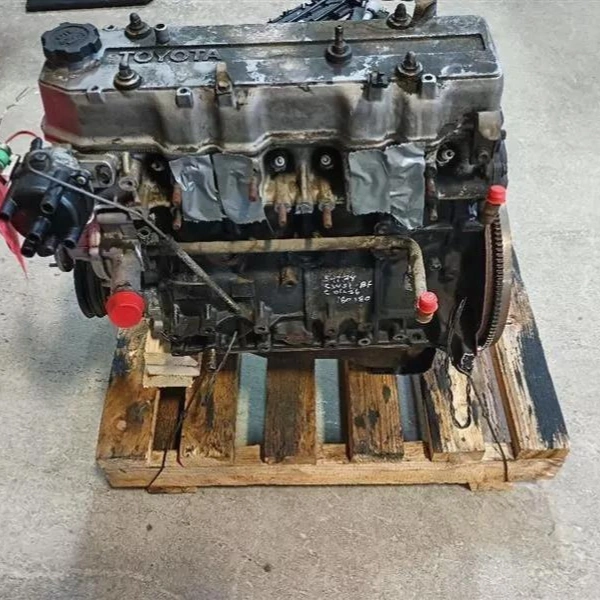



The Toyota 22RE is one of the most reliable inline-four engines ever built for a production vehicle. With its 2.4-liter displacement, SOHC design, and Toyota EFI system, the 22RE powered the Toyota Pickup (known internationally as the Hilux) and the Toyota 4Runner from 1983 through 1995. Many examples exceed 300,000 miles with regular maintenance, some documented examples have approached 500,000 miles. This is not marketing language: it is why the Toyota Pickup and early 4Runner became the reference vehicle for reliability in cultures from rural America to the Australian outback to conflict zones worldwide.
The 22RE distinguishes itself from the carbureted 22R by its Toyota EFI system, an L-type airflow meter-based injection setup that provides consistently accurate fuel delivery across temperature extremes, altitude changes, and load variations. For off-road use in particular, the EFI's consistent operation regardless of vehicle angle gives the 22RE a significant advantage over the 22R's carburetor, which can flood or starve on steep grades.
The critical piece of information every 22RE buyer needs to know: Toyota significantly redesigned the 22RE in 1985. The post-1985 block has a different deck height. The cylinder head, pistons, timing components, water pump, and oil pump all changed. Pre-1985 and post-1985 parts are largely not interchangeable. Installing a pre-1985 head on a post-1985 block, or vice versa, will cause severe compression problems and potential engine damage. We confirm block generation before every order ships.
The 22RE sits within a broader Toyota 22R family. Understanding the differences helps buyers choose correctly:
| Engine | Years | HP | Fuel System | Notes |
|---|---|---|---|---|
| 22R | 1981 to 1995 | 96 to 108 hp | Carburetor | The carbureted version. Simpler but less consistent than 22RE at altitude and in off-camber situations. |
| 22RE | 1983 to 1995 | 105 to 116 hp | EFI (electronic) | Fuel-injected. Better cold-start, better off-road consistency, slightly more power. This is the unit sold on this page. |
| 22R-TE | 1986 to 1988 only | 135 hp | EFI + Turbo | Factory turbocharged version. Very rare. Lower compression (7.5:1). Compatible only with 22R-TE-specific components. |
| Item | Details |
|---|---|
| INCLUDED, Long Block | Block, crankshaft, pistons, connecting rods, SOHC camshaft, aluminum cylinder head, valve train, timing chain assembly, oil pan, front timing cover. |
| NOT INCLUDED | Intake manifold and EFI fuel rail and injectors, throttle body, airflow meter (MAF/AFM), coolant temperature sensor, exhaust manifold, distributor and ignition system, alternator, power steering pump, starter, flywheel, accessory drive components. |
| EFI Note | The 22RE EFI system components (airflow meter, fuel rail, injectors) are specific to the 22RE and should be reused from your original engine if in good condition, or sourced separately. These are not included with the long block. |
| Core Note | No core charge. You are not required to return your old engine. |
The Toyota 22RE was factory installed in the following vehicles:
| Vehicle | Compatibility |
|---|---|
| Toyota Pickup (Hilux), RWD and 4WD | 1983 to 1995, 2WD and 4WD configurations |
| Toyota 4Runner, all generations | 1984 to 1995, 2WD and 4WD |
| Toyota HiAce Van (select markets) | 1984 to 1989 |
| Toyota Cressida (select international markets) | Limited applications |
The 22RE is a direct replacement in any Toyota Pickup or 4Runner that originally used the 22RE or carbureted 22R. The EFI 22RE can also be installed in a 22R carbureted application with the addition of the complete 22RE EFI system including the ECU, wiring harness, airflow meter, fuel rail, and injectors. This is a common and well-documented conversion in the Toyota truck community. Call (240) 301-0095 with your vehicle year and current engine.
Transmission compatibility: Toyota 5-speed W-series manual (most common), W56 and W58 variants, Toyota 4-speed L-series manual (earlier applications), A-series 4-speed automatic. 2WD and 4WD versions require different transmission and transfer case configurations.
Every used Toyota 22RE we ship goes through this process:
Mileage varies by unit. Where available from the donor vehicle we provide it. Where mileage cannot be confirmed, we disclose this before your order is placed.
| Displacement | 2,366 cc (2.4L / 144.4 cu in) |
|---|---|
| Engine Code | 22R-E |
| Configuration | 8 valves, Inline-4, SOHC |
| Bore X Stroke | 92 mm x 89 mm |
| Compression Ratio | 9.3:1 |
| Horsepower | 105 hp (1983 to 1988), 112 hp (1989 to 1995) |
| Torque | 137 lb-ft (1983 to 1988), 142 lb-ft (1989 to 1995) |
| Firing Order | 1, 3, 4, 2 |
| Aspiration | Naturally Aspirated |
| Fuel System | Electronic Fuel Injection (L-type airflow meter) |
| Timing System | Timing chain, not a belt |
| Block Material | Cast Iron |
| Head Material | Aluminum alloy (crossflow) |
| Critical Note | Pre-1985 and post-1985 blocks, parts NOT interchangeable between generations |
| Production Years | 1983 to 1995 |
| Manufacturer | Toyota Motor Corporation |
| Applications | Toyota Pickup (Hilux), Toyota 4Runner, select international applications |
| Price | $1,600.00 |
The Toyota 22R-E Engine I bought from Vaz Auto Solutions exceeded my expectations. Excellent service and fast delivery. Very satisfied!
The Toyota 22R-E Engine from Vaz Auto Solutions is exactly what I needed. Smooth transaction and quick shipping. Definitely recommend this company!
Every used Toyota 22RE engine sold by Vaz Auto Solutions is covered by a 15 day replacement warranty from the date of delivery.
To file a claim, contact us within 15 days of delivery at (240) 301-0095 or support@vazautosolutions.com.


