
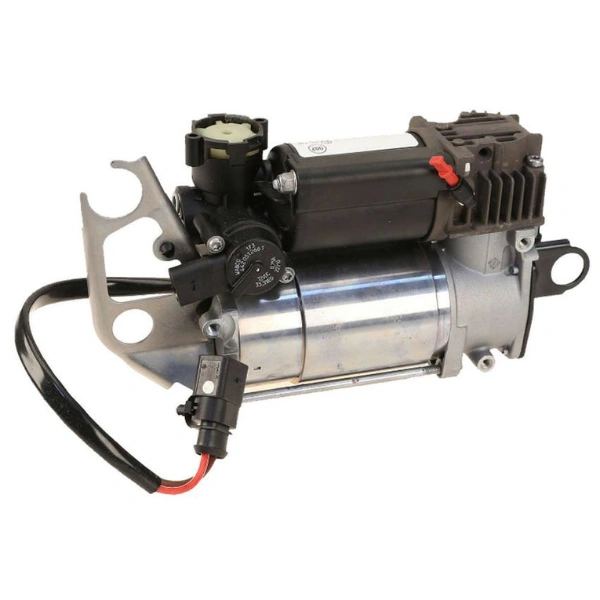

The air ride compressor is the heart of any air suspension system. It builds and maintains the pressure that holds the air bags inflated, manages the moisture content of the system air, and cycles automatically to keep ride height stable as load and temperature change. When a compressor wears out, the symptoms are immediate: the vehicle sags overnight, the compressor runs longer and longer cycles trying to maintain pressure, an error light shows on the dash, and eventually the compressor fails entirely.
A verified used Audi Q3 air ride compressor restores OEM pressure performance at a fraction of new dealer pricing. We bench-test every compressor for a full cycle from cut-in to cut-out, measure pressure output at the discharge port, and assess the dryer and isolation mounts before shipping.
Get your Audi Q3 air suspension system back to reliable operation with a tested compressor today.
The Audi Q3 air ride compressor is a self-contained 12V DC piston-style pump with integrated air dryer and pressure switch. The piston is driven by an electric motor through an offset connecting rod. As the piston cycles, intake air is drawn through the dryer (a chamber filled with desiccant material that absorbs moisture), compressed to working pressure, and pushed out the discharge port to the air ride reservoir. The pressure switch monitors discharge pressure and cycles the motor on and off automatically.
The whole assembly is housed in a reinforced plastic shell with rubber isolation mounts on three or four mounting points. The isolation mounts reduce vibration transmission to the chassis so the compressor runs quietly even during long cycles. A pressure relief valve provides a fail-safe in case the pressure switch ever fails to cut out, releasing excess pressure before it can damage downstream components.
The Audi Q3 is Audi's compact luxury crossover SUV. The first-generation Q3 launched globally in 2011 on the 8U chassis. Audi held off introducing the Q3 to the US market until 2015 model year, three years after the global launch, in response to growing US demand for premium compact SUVs.
The second-generation Q3 (F3 chassis) launched globally in 2018 and arrived in the US for 2019 model year. The F3 is built on the MQB platform shared with the VW Tiguan and Atlas Cross Sport. It uses a different air suspension package where fitted, and the air ride compressor for the F3 is not interchangeable with the 8U compressor in this listing.
We want to be transparent about Audi Q3 air suspension applications because the topic is often misunderstood:
| Vehicle | Compatibility |
|---|---|
| Audi Q3 (8U chassis) | 2015 to 2018 US market with rear axle self-leveling option, or aftermarket air ride conversion |
| Audi Q3 (8U chassis, European market) | 2011 to 2018 European market with towing package self-leveling rear axle |
| Aftermarket Air Ride Setups | Q3 platform with aftermarket full air ride conversion (Air Lift, Accuair, RideTech, Universal Air etc) |
| Cross-Reference Potential | Some VW Tiguan (5N chassis, 2008 to 2017) and Audi A3 (8P chassis) air suspension applications may use a similar compressor, verify with original Audi or VW part number |
| NOT Compatible | Audi Q3 F3 chassis (US 2019 onward, second generation), Audi Q5, Audi Q7 (which uses a different higher-pressure compressor), and any non-Q3 Audi without verifying part number cross-reference |
| Part Type | Air ride compressor assembly with integrated dryer and pressure switch |
|---|---|
| Vehicle Application | Audi Q3 8U chassis (US 2015 to 2018) OEM self-leveling and aftermarket air ride conversions |
| Compressor Type | 12V DC piston, positive displacement |
| Peak Pressure | Approximately 150 to 200 PSI |
| Air Dryer | Integrated desiccant |
| Pressure Switch | Integrated, automatic cycle control |
| Pressure Relief Valve | Built-in fail-safe |
| Housing Material | Reinforced plastic for underbody environment |
| Isolation Mounts | Rubber, 3 or 4 point depending on configuration |
| Air Line Fittings | Quick-connect, 1/4 inch or 6mm compatibility |
| Voltage | 12V DC |
| Current Draw | Approximately 12 to 20A under load |
| Approximate Weight | 6 to 9 lbs assembled |
| Service Life | Typically 80,000 to 150,000 miles |
| Installation Difficulty | Moderate DIY, requires raising vehicle |
| Coding Required | No for direct OEM replacement, configuration may be needed for aftermarket controllers |
| Price | $279.00 |
Running an Air Lift V2 setup on my 2016 Q3. Original compressor was struggling to keep up after a few years of show car duty. Vaz had this Audi-style unit in stock, pressure tested to spec, dryer was clean. Wired it through my existing relay and it cycles faster than the original. Bench test paperwork was a nice touch. Solid value for a quality compressor.
Bought this for an aftermarket air ride install on my Q3. Vaz helped me verify the wiring connector matched my Accuair setup over the phone before I ordered. Compressor builds pressure smoothly and runs quietly with the rubber mounts intact. One star off only because the air line fittings needed a bit of thread tape that I had not expected, but no leaks once installed.
Contact (240) 301-0095 within 15 days of delivery.


